

Theory:
The nervous system in different organisms:
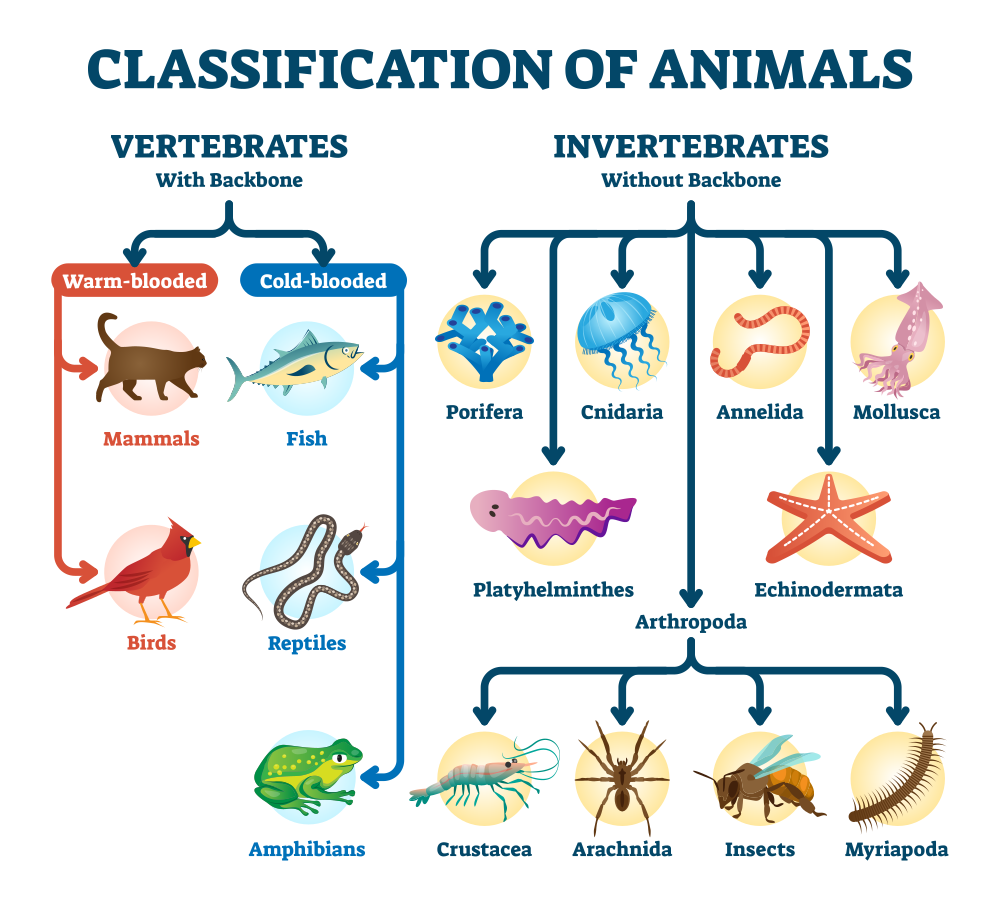
Classification of animals based on vertebrae
Animals exhibit progressively more complex nervous systems, from absent or diffuse nerve nets in Porifera, Cnidaria, and Ctenophora to centralised ganglia in flatworms and annelids, advanced systems in arthropods and molluscs, and highly developed dorsal nerve cords in chordates.
The Brain-to-body ratio of humans and animals:
Although brain size rises with body size, the brain-to-body ratio better reflects intelligence. Humans have the highest ratio approximately (1:40) among mammals and dolphins, monitor lizards, and parrots/crows leading in their respective groups.
Human nervous system:
The human nervous system consists of two major divisions:
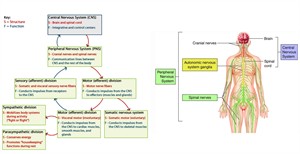
Classification of the nervous system and the picture showing the divisions of the nervous system
1. Central nervous system:
- The CNS consists of the brain and spinal cord and acts as the body’s control and coordination centre, processing sensory information and regulating thoughts, movements, emotions, and vital functions.
- In vertebrates, it includes a brain and dorsal spinal cord, while in invertebrates, it mainly forms a ventral nerve cord with ganglia. Nuclei are clusters of neurons within the CNS, whereas ganglia are neuron clusters outside it.
2. Peripheral nervous system:
- The PNS includes all nerves connecting the body to the CNS and consists of \(12\ \)cranial nerves and\(\ 31\) pairs of spinal nerves. Afferent (sensory) fibres carry impulses to the CNS, while efferent (motor) fibres transmit responses from the CNS to organs and muscles.
- Spinal nerves include \(8\ \)cervical, \(12\ \)thoracic, \(5\) lumbar, \(5\) sacral, and \(1\ \)coccygeal pair.
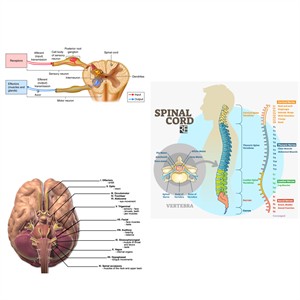
Afferent and Efferent types of neurons, spinal and cranial nerves (clockwise)
- The PNS includes the somatic nervous system (SNS), which controls voluntary skeletal muscle actions, and the autonomic nervous system (ANS), which regulates involuntary functions like heartbeat, breathing, and digestion.
- The ANS has three divisions: the sympathetic (fight-or-flight response), the parasympathetic (rest-and-digest response), and the enteric (independent control of gastrointestinal function). Sympathetic and parasympathetic systems work oppositely to maintain body balance, while the enteric system acts as a semi-independent “second brain” for digestion.
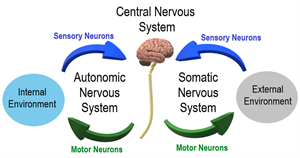
Autonomic nervous system and Somatic nervous system
Human brain structure and function:
The human brain, weighing about \(1.5\ kg\ \)and containing nearly \(100\ billion\) neurons, has specialised regions that control sensation, movement, thinking, memory, and emotions.
The brain is the control and coordinating centre of the body. It controls the entire processing of information and serves as the central information-processing organ of our body.
Also, it controls and regulates,
- Voluntary movements of the body
- Balance of the body
- Function of involuntary organs, such as the lungs, heart, and the kidneys.
- Temperature of the body
- Endocrine glands
Meninges of the brain:
The brain processes vision, hearing, speech, memory, intelligence, emotions, and thoughts, and the skull and three-layered cranial meninges protect it.
- Dura mater - outer layer
- Arachnoid mater - middle layer
- Pia mater - inner layer
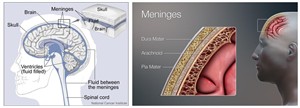
The location of cranial meninges and cerebrospinal fluid
Also, there is a clear fluid called cerebrospinal fluid (CSF) present in the ventricles of the brain, the subarachnoid space of the brain and the spinal cord. It acts as a shock-absorbing medium.
The brain has three main parts: the brain stem, the cerebral cortex, and the cerebellum, which work together to control vital functions and coordinated behaviours.
The brain has three main parts: the brain stem, the cerebral cortex, and the cerebellum, which work together to control vital functions and coordinated behaviours.
Parts of the brain:
There are three major parts or regions of the brain,
- Forebrain
- Midbrain
- Hindbrain
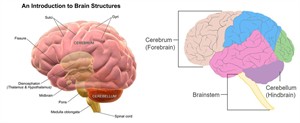
Pictures showing the regions of the brain
I. Forebrain:
- The forebrain controls thinking and contains sensory regions for vision, hearing, smell, and hunger.
- It integrates sensory inputs with stored memories in association areas to analyse situations.
- It makes decisions and sends signals to the motor area to control voluntary muscle movements.
The forebrain consists of,
- Olfactory lobes
- Cerebrum
- Diencephalon
1. Olfactory Lobes: Detect and process the sense of smell.
2. Cerebrum: The largest brain part, with a cerebral cortex divided into two hemispheres connected by the corpus callosum, controls sensory perception, memory, thinking, decision-making, and voluntary actions.
Lobes: Frontal-reasoning and movement; Parietal-touch and spatial awareness; Occipital-vision; Temporal-language, memory, and emotion; Limbic system emotion, motivation, and sexual behaviour.
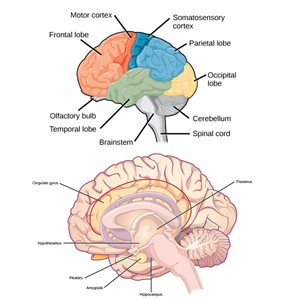
The lobes of the brain and the regions of the thalamus and hypothalamus
3. Diencephalon:
It is consists of,
- The epithalamus secretes the hormone melatonin.
- The thalamus lies superior to the midbrain. It is mainly composed of grey matter. Except smell, each sense channel and its sensory nerves pass through the thalamus.
- The hypothalamus lies above the pituitary gland and is attached to it by a stalk called the infundibulum. This region maintains homeostasis and controls the urge to eat and drink. Neurosecretory cells in this region secrete a hormone called a hypothalamic hormone.
II. Midbrain:
The midbrain lies between the forebrain and hindbrain and helps with vision, hearing, and the transmission of signals between different parts of the brain.
III. Hindbrain:
Controls many involuntary actions and includes the pons, cerebellum, and medulla.
-
Pons: Relays messages between brain regions and helps regulate breathing.
-
Cerebellum: Maintains balance, posture, and precision of voluntary movements.
-
Medulla (medulla oblongata): Controls breathing, heartbeat, blood pressure, salivation, and vomiting, and connects the brain to the spinal cord.
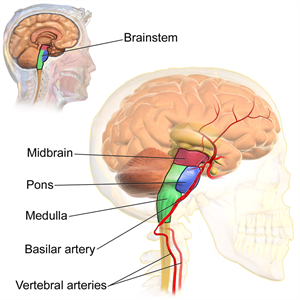
Parts of the brain stem
Brain stem and spinal cord:
-
Brainstem: Composed of the midbrain, pons, medulla oblongata, and diencephalon, it connects the brain to the spinal cord and controls vital autonomic functions like breathing and heart rate.
-
Grey and White Matter: Grey matter (neuron cell bodies) processes information, while white matter (myelinated axons) transmits signals between brain regions and the body.
-
Spinal Cord: Extends from the medulla, relays impulses between the brain and spinal nerves, and controls most reflex actions.
Did you find an error?