

Control and Coordination in Plants:
Plants grow and respond to stimuli but lack a nervous system, so coordination is controlled by hormones, and their movements occur as responses to environmental stimuli.
Plant Movements:
Some plants show movement in response to stimuli. For example, Mimosa pudica folds its leaves when touched (no growth involved), while seedling growth (like sunflower) shows directional movement with growth.
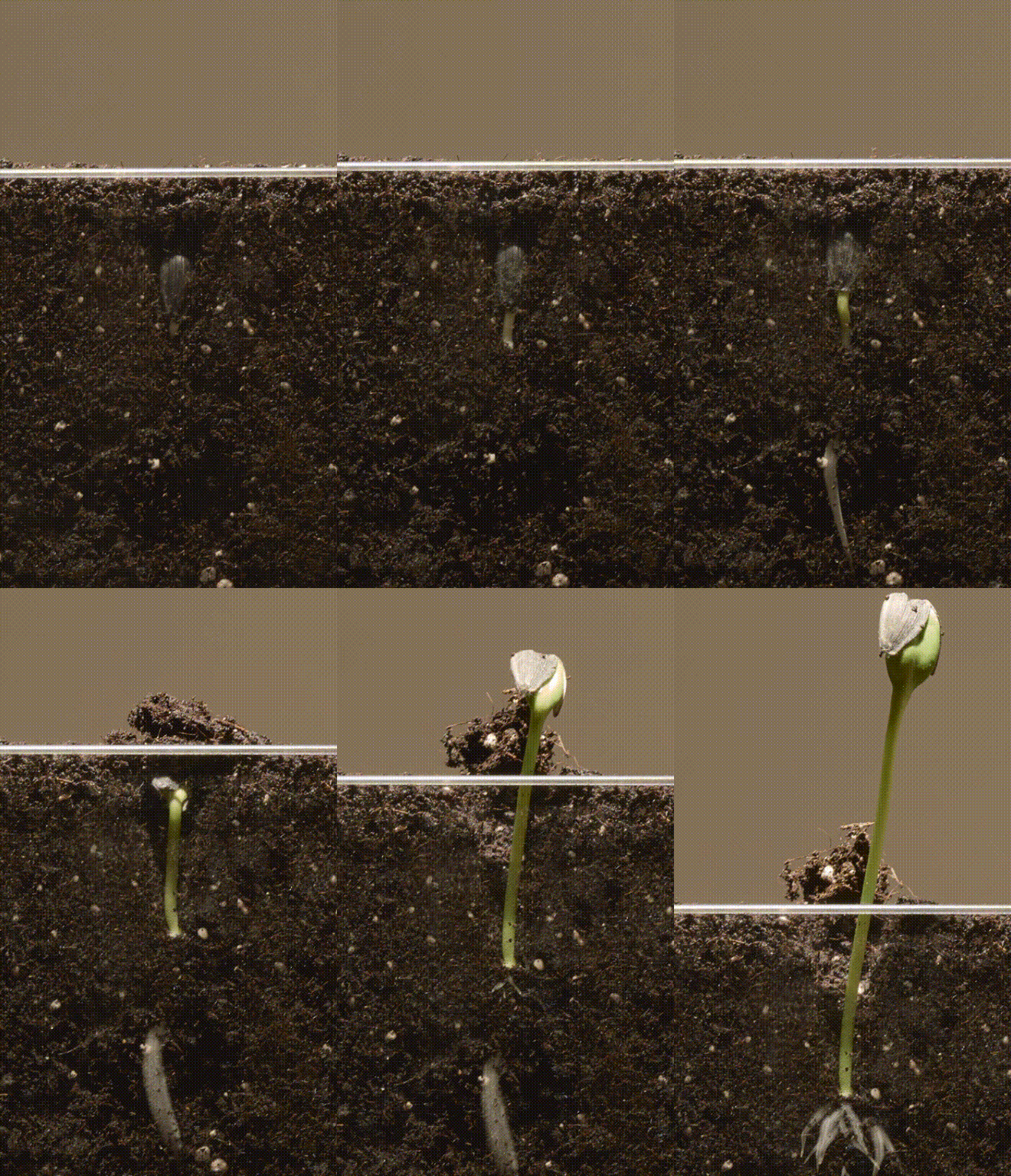
Germination of a seed
In plants, movement usually indicates growth and occurs only in response to external stimuli like light, gravity, and temperature, helping them obtain sunlight, water, and nutrients.
Based on this plants show two different types of movements:
1. Tropic movement
2. Nastic movement
2. Nastic movement
Tropism in plants:
Tropism is the directional growth of a plant (or its part) towards a stimulus, helping it adapt to the environment. Common stimuli include light, gravity, water, and touch.
Types of tropism:
- Phototropism: Growth of plant parts in response to light; shoots grow towards light while roots grow away.
- Geotropism: Growth in response to gravity; roots grow downward and shoots grow upward.
- Hydrotropism: Growth in response to water; roots grow towards moisture in the soil.
- Thigmotropism: Growth in response to touch; tendrils coil around support for climbing.
- Chemotropism: Growth in response to chemicals; pollen tube grows towards the ovule during fertilization.
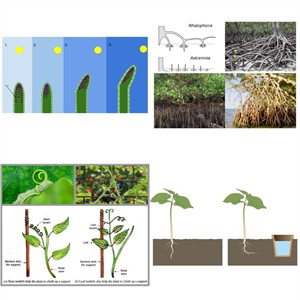
Phototropism, Negatively geotropic roots of Rhizophora & Avicenna - Mangrove forest, hydrotropism and Thigmotropism (clockwise).
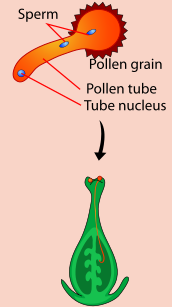
Pollen tube formation in the stigma
Activity: Phototropism
Seeds placed in a flask setup with light from one side show shoots bending towards light and roots away, due to unequal auxin distribution causing faster growth on the shaded side.
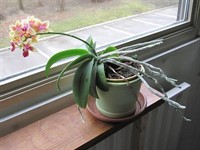
Positive and negative phototropism
Nastic movements:
Nastic movements are non-directional responses of plants to stimuli, meaning they do not depend on the direction of the stimulus, unlike tropism.
Types of Nastic Movements:
- Photonasty: Non-directional movement of plant parts in response to light (e.g., flowers opening and closing).
- Thigmonasty/Seismonasty: Non-directional response to touch (e.g., Mimosa pudica folding leaves, Venus flytrap closing traps).
- Thermonasty: Non-directional movement in response to temperature changes (e.g., tulip blooming).
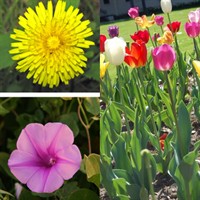
Taraxacum officinale (Top), Ipomoea alba (Bottom) and Tulip flowers showing thermonasty
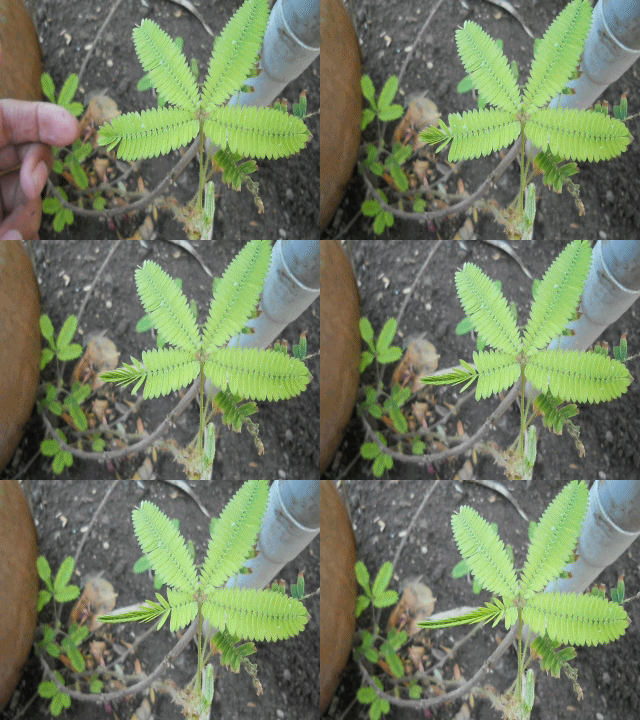
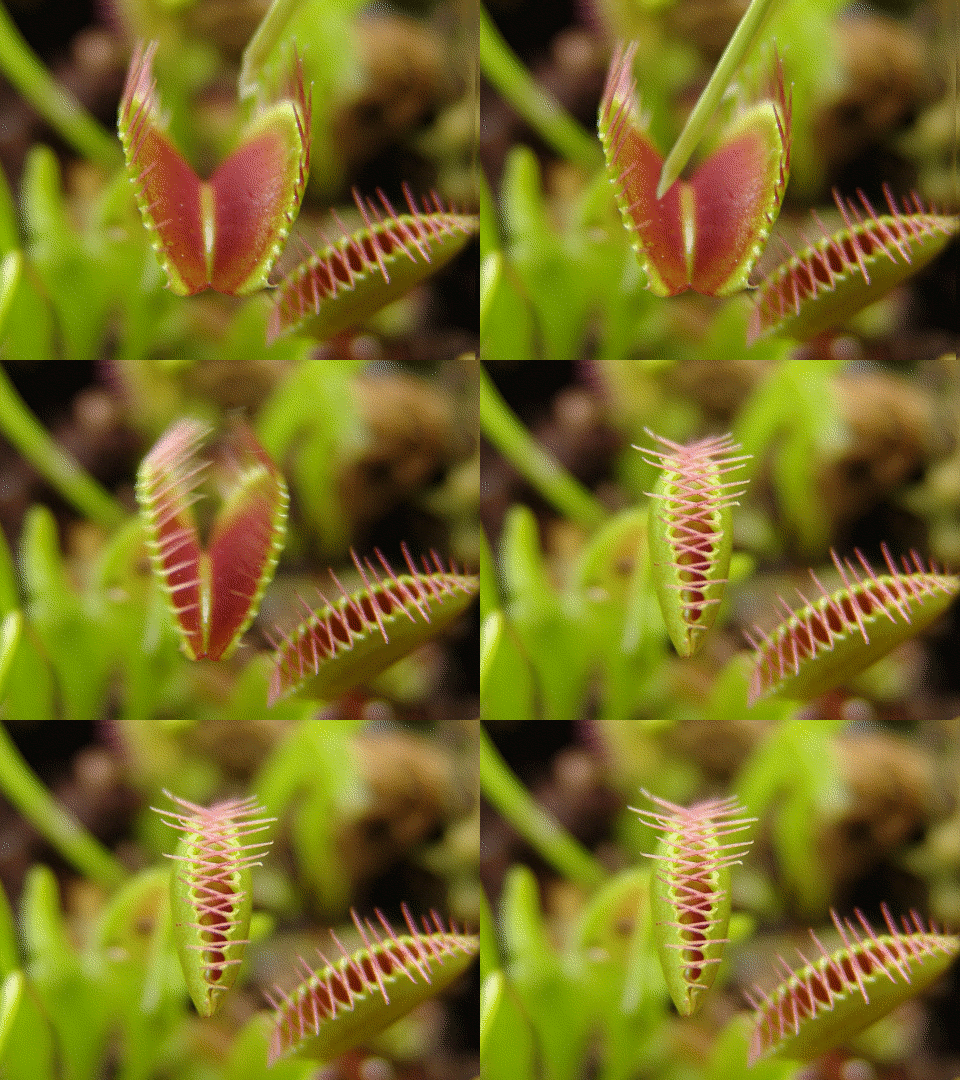
Thigmonasty by Mimosa pudica and Venus flytrap (Dionaea muscipula)
Chemical Communication and Hormones:
Quick responses need fast communication; animals use electrical impulses and chemical messengers, but plants lack nerves and rely only on chemical communication.
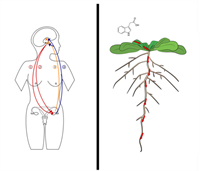
Transportation of hormones in plants and animals
Hormones: Chemicals released by plant cells that diffuse through the plant and control growth and responses.
Plant Hormones (Phytohormones): Organic substances produced in small amounts that regulate various physiological and growth processes in plants.
Hormones: Chemicals released by plant cells that diffuse through the plant and control growth and responses.
Plant Hormones (Phytohormones): Organic substances produced in small amounts that regulate various physiological and growth processes in plants.
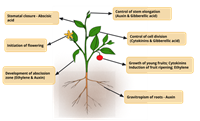
Hormonal interaction in plant growth and development
Types of plant hormones:
Plant hormones can be classified as five major classes. They are as follows:
- Auxins: Growth hormones produced at shoot and root tips that promote stem elongation, apical dominance, and phototropic bending.
- Cytokinins: Hormones that promote cell division, delay ageing, and stimulate lateral bud growth.
- Gibberellins: Hormones that promote stem elongation, seed germination, flowering (bolting), and fruit development.
- Abscisic Acid (ABA): Growth-inhibiting hormone that induces dormancy, stomatal closure, and stress responses.
- Ethylene: Gaseous hormone that promotes fruit ripening, senescence, and leaf/fruit shedding.
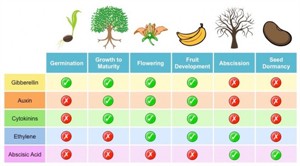
Functions of plant hormones