Neuron
 
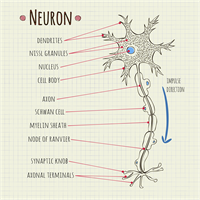
A neuron is a tiny structure found in the brainspinal cord, and nerves. A single neuron can be up to a metre long and is made up of three parts: 
 
Neuronw800.png
Neuron
 
1. Cell body (soma): The main part of the neuron containing the nucleus and organelles that control cell activities. It maintains the structure of the neuron and provides energy for its functions.
2. Axon: A
long cylindrical fibre that carries nerve impulses away from the cell body to other neurons, muscles, or glands. It ends in synaptic terminals that release neurotransmitters.
3. Dendrites:
Short, branched extensions of a neuron that receive signals from other neurons. They transmit these impulses toward the cell body. 
 
 
Types of neurons:
 
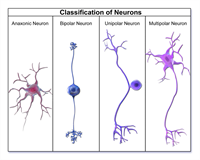
Neurons are classified as apolar, unipolar, bipolar, and multipolar based on their structure and number of processes. Axons form nerve fibres of two types myelinated fibres with a myelin sheath and nodes of Ranvier, and non-myelinated fibres without a myelin sheath.
 
1125pxNeuronClassification1w952.png
Classification of neurons
 
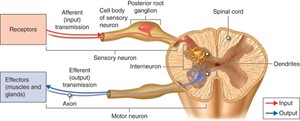
Based on function, neurons are of three types: sensory (afferent) neurons that carry impulses to the CNS, motor (efferent) neurons that transmit impulses to muscles and glands, and relay (interneurons) that connect sensory and motor neurons within the brain and spinal cord.
 
Nerv5w769.jpg
The action of sensory and motor neuron
 
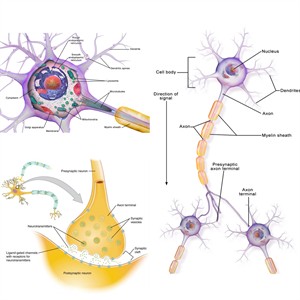
A synapse is the junction where a nerve impulse passes from one neuron to another as an electrochemical signal through the synaptic cleft, from the presynaptic neuron (sender) to the postsynaptic neuron (receiver).
 
Transmission of an impulse:
 
Information received at the dendrite generates an electrical impulse that travels through the cell body and axon, triggering chemical release at the synapse, which then starts a similar impulse in the next neuron or effector cell. There are two types of synapses they are electrical synapse, where impulses pass directly between neurons through gap junctions, and chemical synapse, where neurotransmitters cross the synaptic cleft to transmit the nerve impulse.
 
MixCollage-13-Mar-2026-02-38-PM-5618.jpg
Transmission of nerve impulse 
 
Neuromuscular junction
 
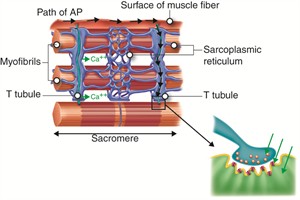
The brain controls voluntary and involuntary actions by processing information and sending signals to muscles. A nerve impulse from the motor neuron reaches the neuromuscular junction, releasing chemicals that trigger muscle contraction. When the signal stops, muscle fibres return to their original length, causing muscle relaxation.
 
Muscle11.jpg
Neuromuscular Junction - Overall Mechanism
 
Reflex Action and Reflex Arc:

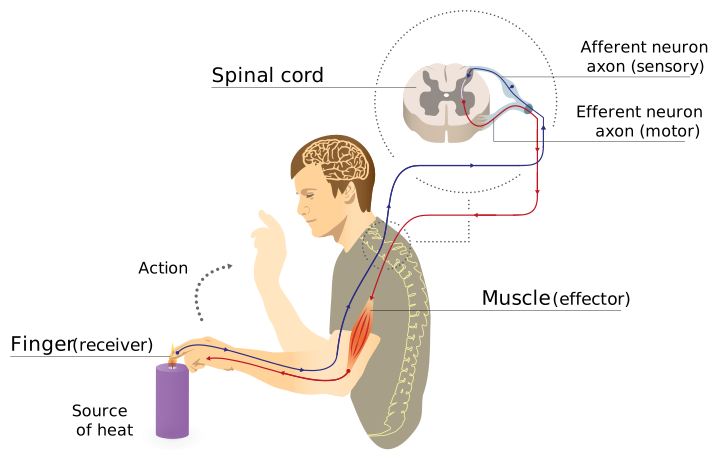
Reflex action is a quick, automatic, and involuntary response to a stimulus without conscious thinking, such as withdrawing the hand from a hot object. It occurs instantly to protect the body from harm and is controlled through a simple neural pathway.
 
A reflex arc is the neural pathway that allows sensory nerves to directly connect with motor nerves, usually in the spinal cord, enabling rapid responses. It evolved to provide fast protection in dangerous situations, even before the brain processes the signal.
 
ImgnotraC3A7atarcreflexeng.svg
Process of reflex action