

Life processes help an organism survive, and control and coordination help it function properly. But to ensure the continuity of life, organisms must produce new individuals.
What is reproduction?
Reproduction is the biological process through which organisms produce offspring that are genetically identical to themselves.
Importance of reproduction:
- Reproduction is essential for the maintenance and continuity of species.
- It is a process that maintains the population of young, adult and aged persons.
- The process of reproduction introduces variations in the organisms. These variations are essential for adaptations and evolution.
- The existence of life on earth is due to the process of reproduction. The inability of a species of an organism to reproduce results in species extinction.
Do organisms make their exact copies?
DNA controls all body functions by directing protein formation. During cell division, DNA copies are made and passed to daughter cells, sometimes with small variations that can lead to evolution.
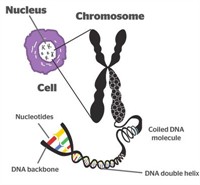
Nucleus from DNA
Mitosis produces identical body cells, while meiosis forms reproductive cells with half the chromosomes. These variations help organisms adapt and survive, ensuring continuity of life.
Importance of variation:
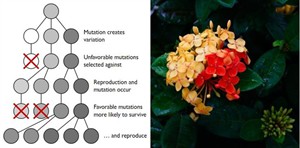
Mutation leads to variation
- Variations may or may not be successful, or in other words, it is based on the amount of mutation in the particular cell, chromosome or gene.
-
Variations do not help all individuals survive, but some develop advantages that make them the fittest in their niche (their role in the environment).
-
As environmental or sudden changes alter niches, the best-adapted individuals survive, while others die out or become extinct.
Types of reproduction:
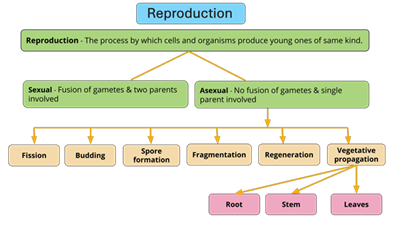
Types of reproduction
Based on the structural complexity, physiology and habitat of the organisms, reproduction is divided into two types:
1. Asexual reproduction
2. Sexual reproduction
1. Asexual reproduction
2. Sexual reproduction
Asexual reproduction:
In asexual reproduction, a single parent produces offspring without gamete fusion, resulting in identical copies. It involves only somatic cells and occurs mainly in unicellular and lower organisms, not in higher animals.
Characteristics of Asexual reproduction:
- A single parent is involved in the process of reproduction (uniparental).
- Gametes are not produced.
- There is no fertilisation process, and thus called agamogenesis or agamogeny.
- In asexual reproduction, only mitotic cell divisions are involved.
- Asexual reproduction is quick and is a rapid mode of multiplication.
The process of asexual reproduction occurs through:
a. Binary fission
b. Fragmentation
c. Budding
d. Spore formation
a. Binary fission
b. Fragmentation
c. Budding
d. Spore formation
e. Regeneration
f. Vegetative propagation
a. Fission:
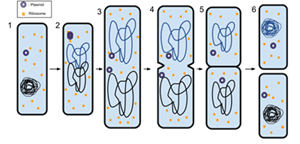
Binary fission
In fission, a unicellular parent divides to form new individuals, binary fission produces two identical cells in different planes, while multiple fission forms many daughter cells at once. Examples include Amoeba, Euglena, Paramecium (binary) and Plasmodium (multiple fission under favourable conditions).
b. Fragmentation:
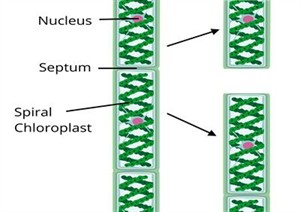
Fragmentation in Spirogyra
The parent body breaks into two or more pieces called fragments, which develops into an individual. The process takes place in flatworms, sponges, spirogyra, sea anemones (coelenterates) and is also observed in echinoderms.
c. Budding:
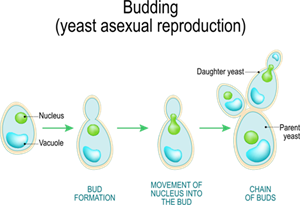
Budding in Yeast
In this process, a daughter individual is formed from a small bulb-like projection on the parent body called a bud. The bud detaches from the parent body and forms a new daughter cell. It is seen in organisms such as Yeast and Hydra.
d. Spore formation;
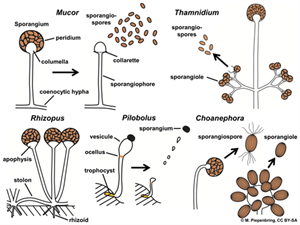
Spore formation in Rhizopus
In spore formation, fungi like Rhizopus produce spores that spread through air and grow into new individuals under favourable conditions. These spores form inside a sporangium, develop from hyphae, and germinate into new fungal growth when they land on a suitable surface.
e. Regeneration:
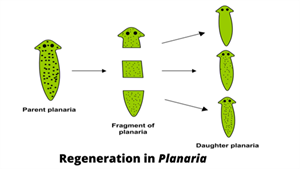
Regeneration in Planaria
The ability of an individual organism's lost bodily components to regenerate into a whole new organism is known as regeneration.
A specialised mass of cells carries it out. It is observed in organisms such as Hydra and Planaria.
A specialised mass of cells carries it out. It is observed in organisms such as Hydra and Planaria.
f. Vegtative propagation:
It is a type of reproduction in which new plantlets are formed from the plants somatic or vegetative cells, buds, and organs. In this type, the vegetative parts such as roots, stems and leaves develop into new plants under appropriate conditions. Meiotic divisions are absent, and only mitotic divisions are present because it does not include the fusion of gametes.
Types of vegetative propagation
1. Natural Vegetative Propagation:
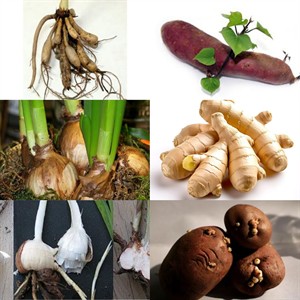
Root tubers in hem and sweet potato, Rhizome-ginger, Stem tuber of potato, Corm of Crocus and Bulb of onion (clockwise).
New plants develop from roots, stems, or leaves of the parent (e.g., Bryophyllum, Potato) through structures like rhizomes, tubers, bulbs, stolons, and offsets. These parts contain adventitious buds that grow into new plants under favourable conditions without seeds.
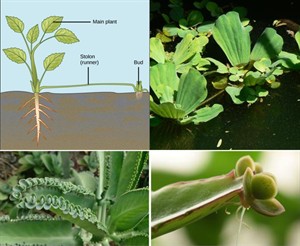
Stolon and runner, Pistia offsets, and Leaf propagation in Bryophyllum
It occurs naturally for food storage, perennation (survival in unfavourable conditions), and propagation, producing identical offspring. Different stem modifications like underground, aerial, and sub-aerial stems help in spreading and forming new plants in various environments.
2. Artificial Vegetative Propagation:
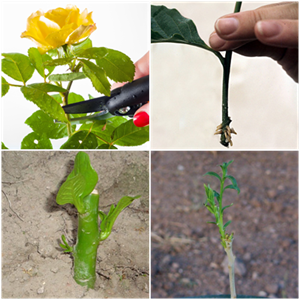
Method of stem cutting
Humans use methods like cutting, layering, grafting, and tissue culture to grow new plants. It helps in producing plants with desired traits, faster growth, and disease-free varieties (e.g., Mango, Rose). Techniques like tissue culture (micropropagation) use totipotent cells to produce many identical plants rapidly in laboratories.
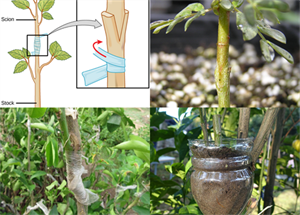
The process of grafting
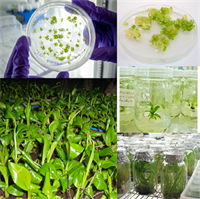
Cell culture, callus formation, plantlets develop from callus, small plantlets form, plantlets are transferred to nursery (clockwise).