

Transportation in organisms:
Transportation is through body fluids which can be either intracellular or extracellular. Extracellular fluid includes blood, lymph, cerebrospinal fluid (CSF) etc.
Blood:
Blood is a connective tissue with a slightly alkaline pH of \(7.4\), found in most multicellular organisms. Its components include plasma which transports nutrients, gases, and wastes, along with blood cells RBCs (oxygen transport), WBCs (defense), and platelets (clotting).
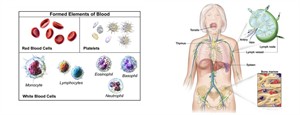
The components of blood and Lymphatic organs
Lymph:
Lymph is a colourless connective tissue (tissue fluid) formed when plasma, proteins, and lymphocytes leak from capillaries into tissue spaces. Its components include lymph plasma and lymphocytes, which help in defence, transport of nutrients and hormones, and absorption of fats while returning excess fluid to the blood.
Circulatory system:
The circulatory system transports oxygen, nutrients, hormones, and wastes using the heart, blood, and blood vessels. It includes an open system (blood flows into body cavities, seen in arthropods and molluscs) and a closed system (blood flows in vessels, seen in annelids and vertebrates).
Human circulatory system:
The human circulatory system is a closed type consisting of the blood vascular and lymphatic systems. The blood vascular system includes the heart, blood, and vessels, while the lymphatic system includes lymph, vessels, capillaries, nodes, and ducts.
Heart:
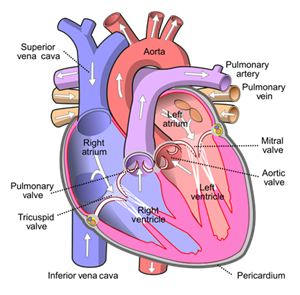
Human heart
- The heart is a fist-sized muscular organ in the thoracic cavity with three layers pericardium, myocardium, and endothelium and four chambers separated by septa to prevent mixing of oxygenated and deoxygenated blood.
- It has four valves (tricuspid, mitral, pulmonary, and aortic) that ensure unidirectional flow of blood during systole (contraction) and diastole (relaxation).
- The heart maintains two types of circulation, namely pulmonary circulation between the heart and lungs, and systemic circulation between the heart and the rest of the body.
- In circulation, deoxygenated blood enters the right atrium, moves to the right ventricle and is sent to the lungs, while oxygenated blood returns to the left atrium, passes to the left ventricle, and is pumped to the entire body.
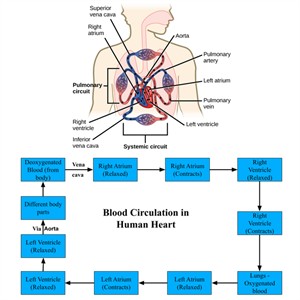
Transport and exchange of \(O_2\) and \(CO_2\) and Circulation of blood in the heart
Circulation of blood in different organisms:
The heart is divided into chambers to prevent mixing of oxygenated and deoxygenated blood and to ensure efficient oxygen supply, especially in animals with high energy needs like birds and mammals.
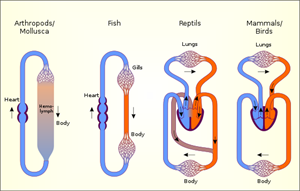
Circulation in different organisms
In different organisms, fishes have a two-chambered heart with single circulation, amphibians and most reptiles have a three-chambered heart with some mixing, while birds, mammals, and crocodiles have a four-chambered heart with complete separation and double circulation.
In different organisms, fishes have a two-chambered heart with single circulation, amphibians and most reptiles have a three-chambered heart with some mixing, while birds, mammals, and crocodiles have a four-chambered heart with complete separation and double circulation.
Blood and its vessels:
Blood vessels transport blood throughout the body, with arteries carrying oxygenated blood from the heart and veins returning deoxygenated blood back to the heart.
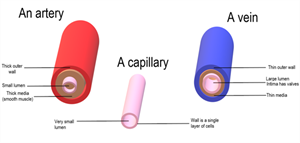
Arteries, veins, and capillaries
Arteries have thick, elastic walls for high-pressure flow, while veins are wider with valves to prevent backflow; capillaries are thin, one-cell thick vessels that enable exchange of substances between blood and tissues.
Blood pressure :
Blood pressure is the force exerted by blood on arterial walls during circulation and is essential for pumping oxygenated blood. It includes systolic (during heart contraction) and diastolic (during relaxation) pressure, normally \(120/80\ mmHg\), measured using a sphygmomanometer.
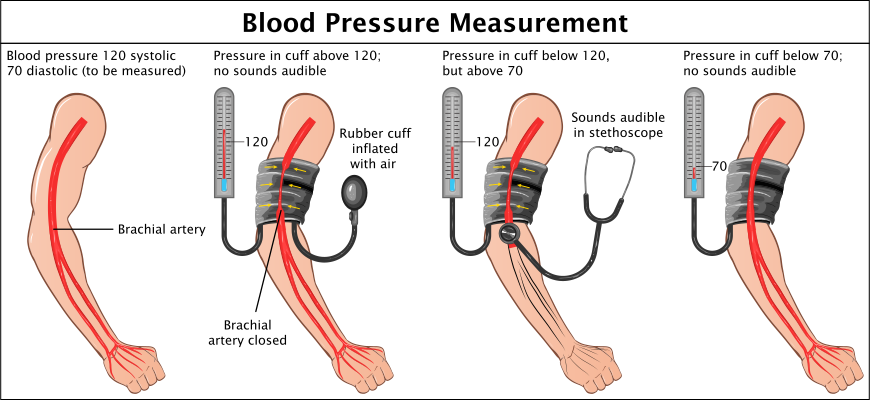
Measuring the blood pressure using Sphygmomanometer
High blood pressure (hypertension) occurs due to increased resistance in blood vessels and can lead to serious complications like artery damage and internal bleeding.
Blood clotting:
Blood clotting is the process that prevents excessive blood loss by forming a plug at the site of injury using platelets. Platelets trigger reactions that convert fibrinogen into fibrin, forming a mesh that traps blood cells and creates a clot.