

Nutrition:
The process through which living organisms obtain ATP necessary for growth, development and maintenance is called nutrition.
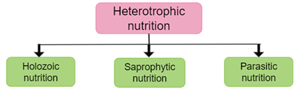
Types of heterotrophic nutrition and Holozoic nutrition
a. Holozoic: Organisms ingest, digest, and absorb complex food (e.g., Amoeba, animals, humans).
b. Saprophytic: Organisms obtain nutrients from dead and decaying matter by external digestion (e.g., fungi, bacteria).
c. Parasitic: Organisms derive food from a living host, harming it (e.g., mosquito, tapeworm).
b. Saprophytic: Organisms obtain nutrients from dead and decaying matter by external digestion (e.g., fungi, bacteria).
c. Parasitic: Organisms derive food from a living host, harming it (e.g., mosquito, tapeworm).
Nutrition in other organisms:
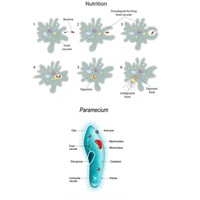
Nutrition in Amoeba and Paramecium
1. Amoeba: Amoeba engulfs food using pseudopodia by phagocytosis, forming a food vacuole where digestion occurs. The digested nutrients diffuse into the cytoplasm, and undigested food is expelled.
2. Paramecium: Paramecium uses cilia to sweep food into the oral groove, forming a food vacuole for intracellular digestion. The nutrients are absorbed into the cytoplasm, and waste is removed through the anal pore.
Nutrition in human beings
The alimentary canal is a long tube from mouth to anus, with specialized regions for digestion.
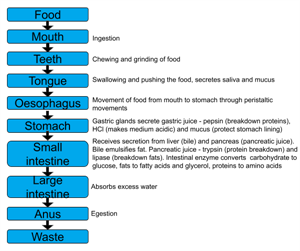
Process of digestion
Mouth:
-
Food is chewed by teeth and mixed with saliva, which contains salivary amylase to break starch into sugar.
-
The tongue helps mix and move food.
Oesophagus:
-
Food moves to the stomach through peristaltic movements.
Stomach:
-
Gastric glands secrete HCl, pepsin, and mucus.
-
HCl aids protein digestion; mucus protects the stomach lining.
-
Food exits gradually via a sphincter into the small intestine.
Small intestine:
-
Longest part of the canal thats is coiled to fit the abdomen.
-
Small intestine receives bile (from liver) and pancreatic juice (from pancreas).
-
Bile neutralizes acid and emulsifies fats (Emulsification)
-
Pancreatic enzymes are trypsin (proteins) and lipase (fats).
-
-
Villi absorb nutrients into blood vessels for energy, growth, and repair.
Large intestine and anus:
-
Absorbs water from waste; remaining material is expelled through the anus under control of the anal sphincter.
Nutrition in humans includes ingestion, digestion, absorption, assimilation, and egestion, providing energy and materials for life.
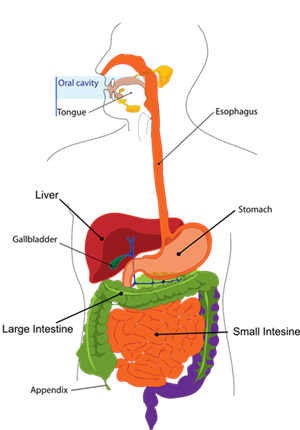
The parts of human digestive system
Activity to check the action of salivary amylase
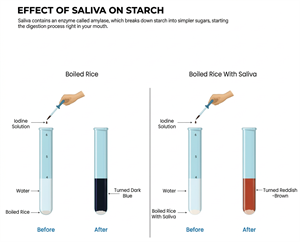
Activity of salivary amylase in digestion
Starch solution is mixed with saliva in one test tube and water in another, then tested with iodine after some time. The saliva-treated sample shows no blue-black color, proving that salivary amylase breaks starch into sugars.