

Autotrophic nutrition:
Autotrophic nutrition is the process by which organisms like green plants make their own food.
- Photoautotrophs are organisms that rely on sunlight to survive.
- Chemoautotrophs are organisms that rely on energy obtained from inorganic substances such as ammonia and nitrites.
Heterotrophic nutrition:
Heterotrophs include animals, fungi, and some plants such as insectivorous plants (Venus flytrap) and parasitic plants like Cuscuta.
Photosynthesis:
Photosynthesis is an anabolic process in which chlorophyll-containing cells use sunlight to convert carbon dioxide and water into organic compounds, transforming light energy into chemical energy for autotrophic nutrition.
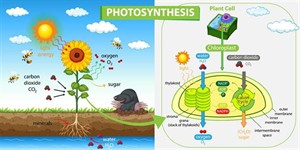
The overall photosynthesis process
Activities for photosynthesis:
1. A destarched leaf partly covered with black paper is exposed to sunlight, then tested with iodine after removing chlorophyll. The uncovered part turns blue-black, showing starch formation, proving that sunlight is necessary for photosynthesis.
2. Two destarched plants are kept under bell jars, with potassium hydroxide placed beside one plant to absorb carbon dioxide. After sunlight exposure and iodine testing, only the plant with carbon dioxide turns blue-black, showing that carbon dioxide is essential for photosynthesis.
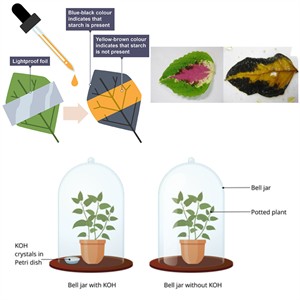
Experiment to show the presence of sunlight and CO₂ for photosynthesis
Chlorophyll:
Chlorophyll a is known as the universal photosynthetic pigment as it is found in all photosynthetic plants and some bacteria. Because it participates in the photosynthetic reaction, it is also known as a primary photosynthetic pigment.
Process of photosynthesis:
- Absorption of light energy by chlorophyll.
- Conversion of light energy to chemical energy and splitting water into hydrogen and oxygen.
- Reduction of carbon dioxide to carbohydrates.
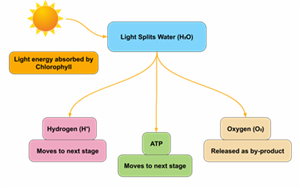
Mechanism of photosynthesis
The role of stomata
Gases are exchanged across the surface of stems, roots, and leaves as well. Large volumes of water can be lost through these stomata in addition to the gaseous exchange. As a result, when carbon dioxide isn't needed, the plant closes the stomatal pores.
The guard cells control the pores opening and closing. For example,
The guard cells control the pores opening and closing. For example,
- The guard cells enlarge when water rushes into them, causing the stomatal pore to open,
- In the same way, as the number of guard cells decreases, the pore closes.
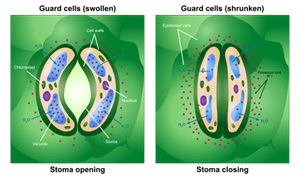
The opening and closing of stomata