Respiration:
 
Respiration is the oxidation process in cellular metabolism, which involves the degradation of food substances to generate energy.
 
Respiration involves two processes - breathing and cellular respiration. Breathing is the gaseous exchange where there is an intake of \(O_2\) from the atmosphere called inspiration and release of \(CO_2\) called expiration. Metabolism is the sum of all biochemical reactions in cells, including catabolism (breakdown releasing energy) and anabolism (building molecules using energy).
 
Types of cellular respiration:
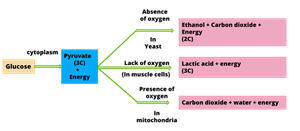
 
1. Aerobic respiration: Uses oxygen in mitochondria to completely oxidize food and produce more ATP.
2. Anaerobic respiration: Occurs without oxygen in the cytoplasm, producing less ATP (fermentation).
 
Cellular respiration is the breakdown of food substances to release energy.
 
Respiw715 (1).png
Breakdown of glucose through different processes
 
Respiratory system in humans:
 
Mammals have a well-developed respiratory system : nose, trachea, lungs, and a complete separation of nasal and oral passages.
 
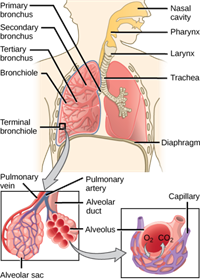
Pathway of air: Nostrils → Nasal cavity → Pharynx → Larynx → Trachea → Bronchi → Bronchioles → Alveoli → Capillaries.
 
Air enters through the nostrils, passes through the nasal cavity, pharynx, larynx, and trachea, then moves into bronchi, bronchioles, and finally reaches the alveoli, where gas exchange occurs.
 
430pxFigure390106.png
Human respiratory system
 
Nose, Larynx, Trachea, and Alveoli:
 
The nose filters, warms, and moistens the air, and the hair and mucus trap dust and microorganisms. 
The larynx, also called the voice box, contains the epiglottis to prevent food from entering the trachea.
The trachea and bronchi are reinforced with cartilage to prevent collapse, and cilia help remove dust and pathogens. The alveoli are tiny balloon-like sacs with thin walls and rich blood supply, providing a large surface area for efficient oxygen and carbon dioxide exchange.
 
Breathing:
 
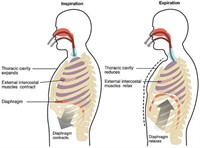
Breathing is controlled by the diaphragm and intercostal muscles. During inhalation, the diaphragm contracts and the ribs move outward, increasing lung volume and drawing in air. During exhalation, the diaphragm relaxes and the ribs return to their position, decreasing lung volume and expelling air. 
 
800px2316InspirationandExpirationw500.jpg
Inspiration and Expiration
 
Gas Exchange and Haemoglobin:
 
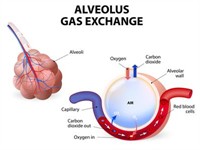
Oxygen from the alveoli diffuses into the blood, and carbon dioxide moves from the blood to the alveoli. Haemoglobin in red blood cells carries oxygen efficiently to tissues, while carbon dioxide is mostly transported in dissolved form.
 
shutterstock239128069w400.jpg
Exchange of gases in the alveolus and blood capillary
 
Smoking damages the cilia and alveoli, reducing gas exchange and increasing the risk of lung disease, heart problems, and cancer.
 
Activities for the process of respiration:
 
MixCollage-18-Mar-2026-04-51-PM-5268.jpg
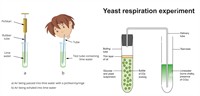
Activity to check the Respiration in human beings and Fermentation in yeast
 
1. Respiration in human beings: Exhaled air is passed through lime water and turns it milky faster than normal air, showing higher \(CO_2\) content. This proves that carbon dioxide is released during respiration.
 
2. Fermentation in yeast: Yeast added to sugar solution produces \(CO_2\)  during fermentation, which turns lime water milky. This proves that \(CO_2\)  is released during yeast respiration (fermentation).
 
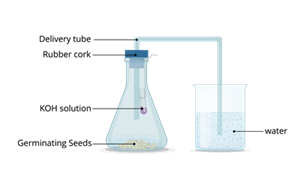
3. Respiration in plants: Germinating seeds are placed in an airtight flask with \(KOH\), which absorbs \(CO_2\) released during respiration, creating a vacuum that causes water level to rise in the connected tube. This demonstrates that \(CO_2\) is produced during respiration in plants.
 
2D0A0D0B5D181D183D180D1811w400.png
Experimental setup
 
Gas exchange in plants:
 
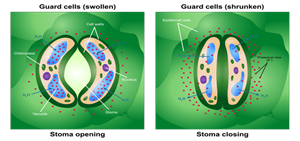
Plants exchange gases through stomata by diffusion, where guard cells use ATP to pump \(K^+\) ions, causing water influx and opening of the stomatal pore.
 
OpeningandClosingofStomasvgw628.png
The opening and closing of stomata.