

The chapter on "life processes" is assigned a weightage of \(9\) marks, highlighting its significance in the overall curriculum. Understanding this chapter will enhance how to classify organisms as living and what are the various life processes.
Also to prepare effectively for related exam questions. It is essential to grasp the various life processes of plants and animals, such as nutrition, respiration, circulation, and excretion.
In the below, we have provided the details of the question distribution among the different sections.
- Section A (\(1\) mark) - two question
- Section B (\(2\) mark) - two question
- Section C (\(3\) mark) - one question
Life processes in plants – Learning outcomes:
-
Identify the key characteristics and life processes of living organisms.
-
Describe how plants prepare food through photosynthesis and explain the roles of chlorophyll, water, and carbon dioxide.
-
Understand the growth and movmement based on stimulus in plants.
-
Compare different modes of nutrition in living organisms.
- Need for basic life-process like digestion,reproduction, metabolism, and excreation.
Living things show movement, growth, and molecular activity that keep them alive. They constantly repair and maintain their structures to stay organised.
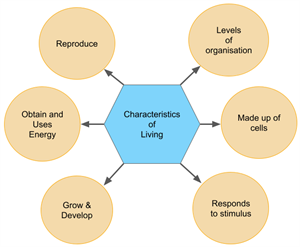
Characteristics of living organisms
All living organisms carry out certain maintenance functions even when they are resting or asleep. These actions are called life processes.
Growth and movement in plants
In the biological context, the terms growth and development are related to each other.
When the organism's body increases in size or mass with time, it is referred to as growth.
When the organism grows mentally, physically and physiologically, it is known as development.
Growth in plants:
Plant growth occurs in four types primary growth increases length through meristematic cell division, secondary growth increases thickness, vegetative growth forms roots, stems, and leaves, and reproductive growth leads to flower formation.
Growth in living organisms is controlled by internal factors like heredity, enzymes, and hormones, and external factors such as light, water, temperature, minerals, and nutrients.
Movement
The act of changing position by one or more parts of the body towards the stimulus is known as a movement.
Types of Movement in Living Organisms:
-
Continuous movement: Occurs inside cells to maintain vital activities, such as cytoplasmic or protoplasmic streaming.
-
Positional movement: Seen in specific organs of organisms, for example, peristalsis in the intestine.
-
Total movement (locomotion): Movement of the whole organism from one place to another for food, reproduction, or safety.
Movement in Plants:
-
Tropic movements: Directional growth responses towards a stimulus, such as phototropism (light), geotropism (gravity), hydrotropism (water), thigmotropism (touch), and chemotropism (chemicals).
-
Nastic movements: Non-directional movements of plant parts that occur independent of the direction of the stimulus.
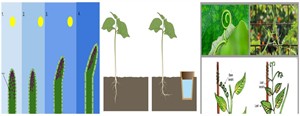
Phototropism, hydrotropism and thigmotropism seen in plants
Metabolism
The total amount of biochemical reactions involved in maintaining the living condition of the cells in an organism is known as metabolism.
Types of metabolism:
Metabolic process is of two types:
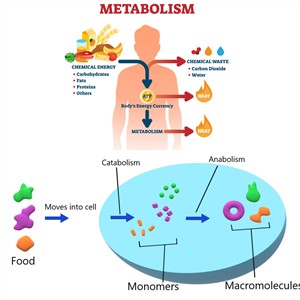
Metabolism and types
1. Catabolism: The process mainly involved in breaking down larger organic molecules (polymers) into smaller molecules (monomer) by releasing energy is known as catabolism. Eg., Respiration, excretion, digestion.
2. Anabolism: The process of building up complex molecules (polymers ) from simpler substances (monomers) by utilizing the stored energy is known as anabolism.
In cellular respiration, oxidation of organic compounds takes place in the cell cytoplasm to produce energy in the form of ATP. This energy helps the cell to perform all metabolic activities.
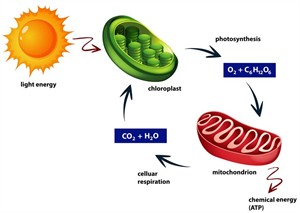
Cellular respiration
Exam tip:
- Growth vs Development:
- Types of Plant Growth
- Movement Classification and Plant Movements
- Metabolism
Nutrition
Different organisms obtain food in different ways. Some use simple inorganic substances like carbon dioxide and water; these are autotrophs, including green plants and some bacteria. Others rely on complex organic substances and need enzymes to break them down; these are heterotrophs, including animals and fungi. Heterotrophs depend directly or indirectly on autotrophs.
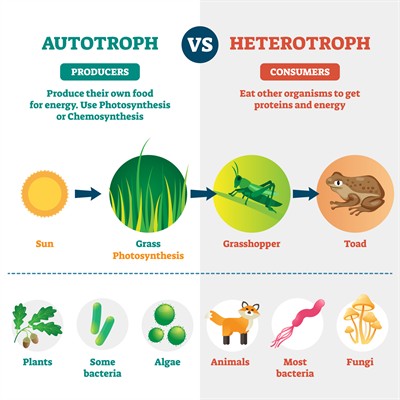
Types of nutrition
Autotrophic Nutrition
Autotrophs meet their carbon and energy needs through photosynthesis, converting carbon dioxide and water into carbohydrates using sunlight and chlorophyll. Carbohydrates provide energy, and excess is stored as starch for later use, similar to glycogen storage in humans.
Heterotrophic nutrition:
Organisms adapt their nutrition to their environment. Bio-catalysts (enzymes) drive these processes, showing that heterotrophs depend directly or indirectly on autotrophs for survival. Heterotrophs include animals, fungi, and some plants such as insectivorous plants (Venus flytrap) and parasitic plants like Cuscuta.
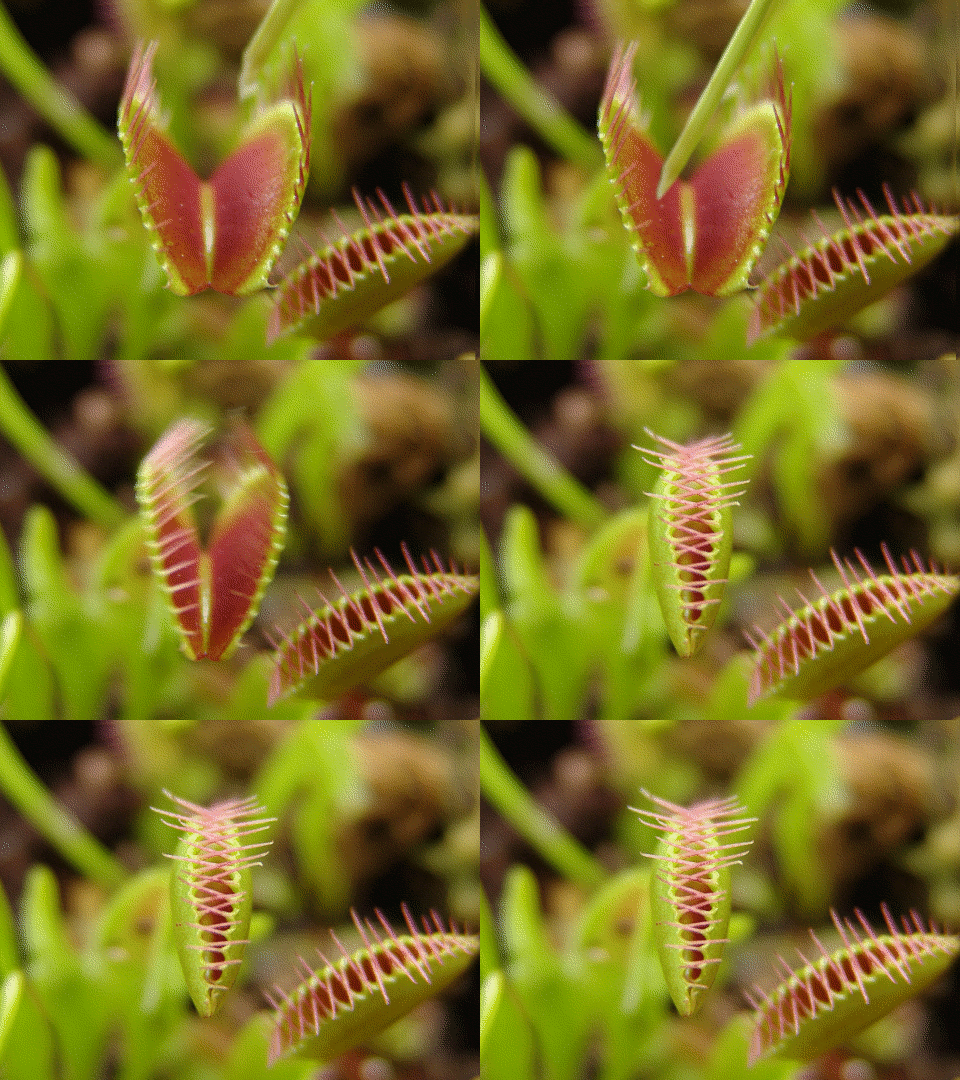
Venus fly trap
Steps of photosynthesis:
-
Absorption of light energy by chlorophyll.
-
Conversion of light energy to chemical energy and splitting water into hydrogen and oxygen.
-
Reduction of carbon dioxide to carbohydrates.
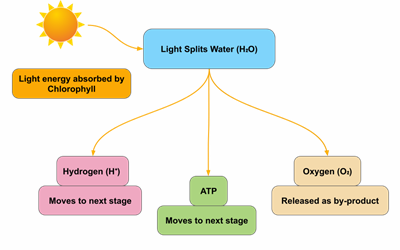
Mechanism of photosynthesis
Photosystems are functional units of photosynthesis present in the thylakoid membranes of chloroplasts. They are multiprotein pigment complexes containing chlorophyll that absorb and transfer light energy during the light reaction.
Types of photosystems:
-
Photosystem II (PS II): Located mainly in the grana; initiates the light reaction by absorbing light and splitting water.
-
Photosystem I (PS I): Located mainly on the outer thylakoid membrane; carries out the final stage of the light reaction to form energy-rich molecules.
Important!
Chlorophyll a is known as the universal photosynthetic pigment as it is found in all photosynthetic plants except bacteria. As it performs the reaction of photosynthesis it is also known as primary photosynthetic pigment.
Activity on sunlight needed for photosynthesis
A destarched potted plant is kept in sunlight with part of a leaf covered, then the leaf is boiled, decolourised with alcohol, and tested with iodine. The uncovered part of the leaf turns blue-black, showing the presence of starch, while the covered part does not.
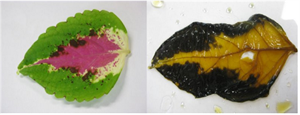
A picture indicating the starch test
Conclusion: This proves that sunlight is essential for photosynthesis and starch formation.
Activity on carbon dioxide needed for photosynthesis
Two similar destarched potted plants are kept under bell jars, with potassium hydroxide placed near one plant to absorb carbon dioxide. After exposure to sunlight, the leaf from the plant without potassium hydroxide turns blue-black with iodine, while the other remains brown.
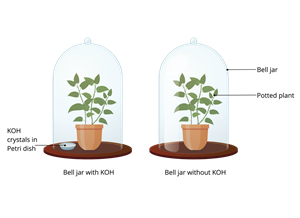
Experiment shows that \(CO_2\) is necessary for photosynthesis
Conclusion: This shows that carbon dioxide \(CO_2\) is essential for photosynthesis and starch formation.
Important PYQ's:
Exam tip:
- 3 steps of photosynthesis - Absorption, conversion and reduction
- Photolysis of water where splitting happens
- Equation of photosynthesis

Chloroplasts:
Some plants, like desert species, take in carbon dioxide at night and use energy absorbed during the day. Chlorophyll in chloroplasts is essential for photosynthesis. Carbon dioxide enters leaves through stomata, tiny pores regulated by guard cells that open and close depending on water availability.
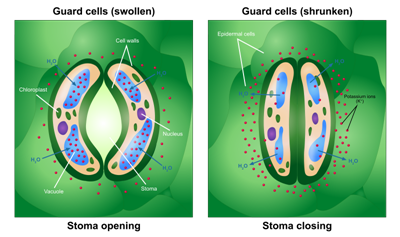
Stomatal opening and closure
Important PYQ's:
Exam tip:
-
Night \(CO_2\) intake
-
Stomatal control, chlorophyll