Transportation:
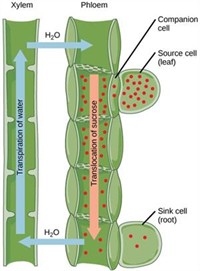
The process of movement of water and nutrients throughout the plant for its survival is known as transportation.
Transportation in plants by vascular tissues
Vascular tissue
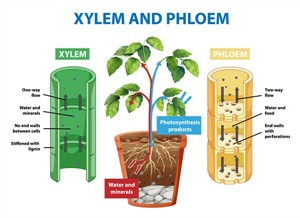
The tissues associated with the conduction of water, minerals and food materials in plants are called vascular tissue
Xylem:
Xylem is a dead, lignified tissue made of tracheids and vessels that conducts water and minerals unidirectionally from roots to the plant tips, providing mechanical support through passive transport.
Mechanism of water transportation
1. Cohesion and adhesion: Cohesion (attraction between water molecules) and adhesion (attraction between water and xylem walls) together help maintain a continuous water column and enable the upward movement of water in plants.
2. Transpirational pull: Transpirational pull is a suction force that drives the upward movement of water from roots to leaves through xylem (ascent of sap), where transpiration creates negative pressure in the leaves that pulls a continuous water column upward due to cohesion and adhesion, thereby supplying water for photosynthesis, replacing lost water through stomata, and acting as the main force for water transport during the day.
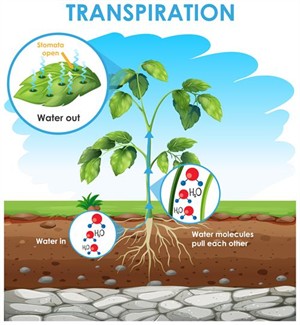
The illustration of Transpirational pull
Activity to demonstrate transpirational pull
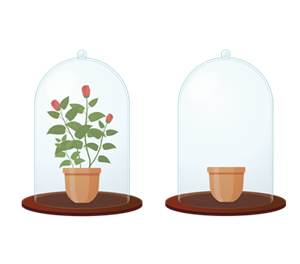
The experimental set up for transpirational pull
Two pots (one with a plant and one with a stick) are covered with plastic and kept in sunlight; only the plant setup shows water droplets due to transpiration. This demonstrates that transpiration creates transpirational pull, which helps in absorption and upward movement of water and minerals in plants.
Phloem:
Phloem is a living tissue made of sieve tubes and companion cells that transports food and organic solutes bidirectionally between leaves, storage organs, and growing parts through active transport.
Translocation:
Translocation is the movement of organic solutes through phloem, occurring downward (leaves to roots/storage) and upward (storage to growing parts).