

Life in Action – From Tissues to Survival
In the previous session, we explored how life begins at the cellular level and how cells organise into tissues and systems that perform essential life activities.
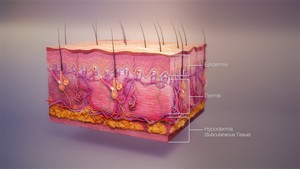
Epithelial cell to tissue to a sensory organ
Building on that foundation, this session takes us further from understanding structure to understanding function, continuity, and interaction with the environment.

Bricks form walls, which can form either interior walls or pavements, and then the building is constructed(clockwise)
Just as individual bricks join to form different walls or pavements, cells come together to form tissues, and these tissues further combine to build different organs with specific functions.
If Class 9 taught us how organisms are built, Class 10 helps us understand how they live, survive, and continue across generations.
What We Have Already Learnt
From Class 9 Biology – Tissues
In Class 9, we learnt that:
-
Cells with similar structure and function group together to form tissues.
-
Plant tissues like xylem and phloem help in transport.
-
Animal tissues, such as muscle, epithelial, nervous, and blood, perform specific functions.
-
Different organisms show different levels of organisation, from unicellular to multicellular forms.
From this, we understood an important idea:
Important!
Life processes do not occur randomly; they are carried out efficiently by specialised tissues.
1. Transport in Plants and Animals – Sustaining Life
In Class 9:
-
We learnt that xylem transports water and minerals from the roots to the leaves.
-
Blood acts as a fluid connective tissue.
In Class 10:
-
Transport is studied as a life process, essential for nutrition, respiration, and waste removal.
-
Xylem transport supports photosynthesis, which, in turn, supports all food chains
-
Blood circulation ensures that every cell receives oxygen and nutrients needed for survival.
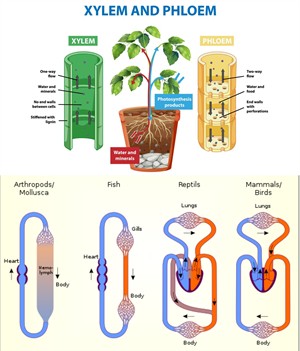
Transportation in xylem and phloem in plants to circulation in animals
Concept Interlinking:
Efficient transport at the tissue level sustains life processes and prepares the organism for growth and reproduction.
Efficient transport at the tissue level sustains life processes and prepares the organism for growth and reproduction.
2. Nutrition, Digestion, and Epithelial Tissue
In Class 9:
-
As we learnt, epithelial tissue has the properties of protective and absorptive.
-
It lines organs like the intestine.
In Class 10:
-
Digestion and absorption are explained as life processes.
-
Epithelial tissue absorbs digested food into the bloodstream.
-
These nutrients provide energy for growth, repair, and reproduction.
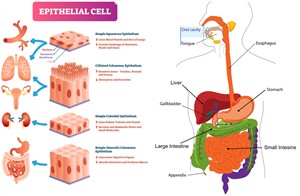
Epithelial tissue and its properties in organ systems
Concept Interlinking:
Without specialised epithelial tissues, nutrition cannot occur, and life processes would stop.
Without specialised epithelial tissues, nutrition cannot occur, and life processes would stop.
3. Movement, Muscle Tissue, and Survival
In Class 9:
-
Muscle tissue was studied as a contractile tissue that enables movement.
In Class 10:
-
Movement supports survival activities such as feeding, escaping predators, and reproducing.
-
Muscle movement also supports internal functions such as heartbeat and peristalsis.
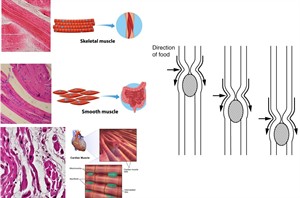
Types of muscle tissue and peristaltic movement
Concept Interlinking:
Movement driven by muscle tissue is essential for survival, interaction, and reproduction.
Movement driven by muscle tissue is essential for survival, interaction, and reproduction.
4. Circulation, Blood, and Internal Coordination
In Class 9, we learnt that blood is a specialised connective tissue that structurally links the body.
In Class 10:
-
Blood circulation supports respiration, nutrition, hormone transport, and waste removal.
-
It maintains internal balance (homeostasis).
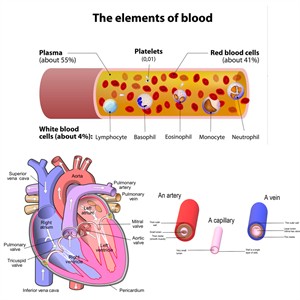
Blood components, blood vessels and heart (clockwise)
Concept Interlinking:
Circulatory tissues link all organs and life processes into one coordinated system.
Circulatory tissues link all organs and life processes into one coordinated system.
5. From Life Processes to Reproduction
We learnt that life processes help prepare the body for reproduction. It needs
-
Proper nutrition builds healthy reproductive tissues.
-
Efficient respiration supplies energy.
-
Transport systems deliver hormones and nutrients.
-
Muscle and epithelial tissues support reproductive organs.
In Class 10:
-
Reproduction in plants and animals ensures continuity of life.
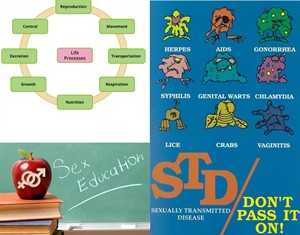
The Life Processes, Common sexually transmitted diseases and Sex education provided in schools (clockwise)
Concept Interlinking:
Thus, we understand that only organisms with well-functioning life processes can reproduce successfully.
Thus, we understand that only organisms with well-functioning life processes can reproduce successfully.
6. Tissues, Cell Division, and Heredity
In Class 9, we explored how cells replicate through mitosis and meiosis, and Tissues grow and repair through mitosis.
In Class 10:
-
Meiosis produces gametes carrying genetic information.
-
Heredity explains how traits are passed from parents to offspring.
-
Variations arise due to genetic recombination.
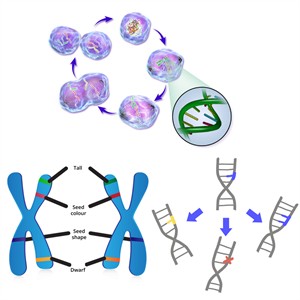
Cell division and DNA copies, mutations, and chromosome gene locations
Concept Interlinking:
Thus, we understand that healthy tissues and controlled cell division ensure the accurate transfer of hereditary information.
Thus, we understand that healthy tissues and controlled cell division ensure the accurate transfer of hereditary information.
7. Life Processes and Environmental Interactions
In Class 8:
- We studied diversity in organisms and their adaptations.
In Class 10:
-
Organisms interact with the environment through Natural resources, Food chains and Energy flow
- Plants form the base of ecosystems using xylem-supported photosynthesis.
-
Animals depend directly or indirectly on plants.
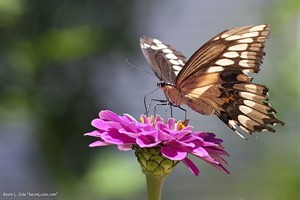
Mutualism of butterflies and flowers
Concept Interlinking:
Internal organisation supports survival, while interactions with the environment ensure balance in ecosystems.
Internal organisation supports survival, while interactions with the environment ensure balance in ecosystems.
8. Food Chains, Energy Flow, and Continuity of Life
We have learnt that
-
Energy flows from the sun \(\rightarrow\) plants \(\rightarrow\) animals.
-
Life processes allow organisms to capture, use, and transfer energy.
-
Reproduction ensures the continuation of species within ecosystems.
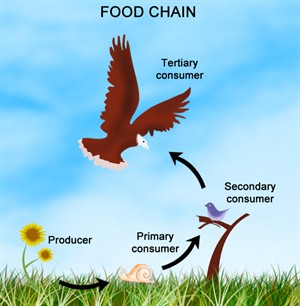
Food chain: Energy flow starts from the sun and plants
Concept Interlinking:
Life processes at the tissue level sustain energy flow and ecological balance.
Life processes at the tissue level sustain energy flow and ecological balance.
9. From Tissues to Ecosystems – The Bigger Picture
We have learnt what begins as:
-
Cells \(\rightarrow\) tissues \(\rightarrow\) organs \(\rightarrow\) organ systems
Extends to:
-
Organisms \(\rightarrow\) populations \(\rightarrow\) ecosystems
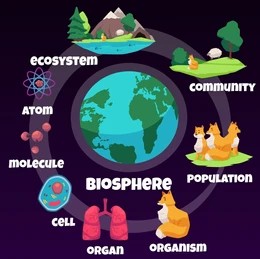
Cells to biosphere
Concept Interlinking:
Biological organisation connects the microscopic world of tissues to the macroscopic world of environments.
Summary – Why This Bridge Matters for Class 10
In this session, we understood that:
-
The functional units that carry out life processes are called tissues.
-
Life is sustained by circulation, respiration, transportation, and nutrition.
-
Reproduction and heredity are made possible by life processes.
-
For resources and energy, organisms rely on their surroundings.
-
Life is maintained by internal organisation and environmental balance.
This understanding will help students to:
- Understand the chapters in Class 10 as related concepts rather than discrete subjects.
- Provide confident answers to application and reasoning-based questions.
- Consider biology to be a living, logical science.
When tissues work together, life continues within the organism and across generations.
Important!
As we move forward from understanding structure to exploring life in action, we are fully prepared to begin Class 10 Biology. Welcome to the next grade of our learning journey.