

Importance
The chapter on "how do organisms reproduce" is assigned a weightage of 6 marks, highlighting its significance in the overall curriculum. Understanding this chapter will enhance the biological process by which organisms produce new individuals.
Also to prepare effectively for related exam questions. In the below, we have provided the details of the question distribution among the different sections.
- Section A (\(1\) mark) - One question
- Section D (\(5\) mark) - One question
Learning outcomes
Reproduction in Plants:
-
Understand why organisms reproduce and the role of DNA and variation.
-
Know types of asexual reproduction in plants.
-
Identify vegetative propagation through different plant parts.
-
Recall artificial propagation and tissue culture.
-
Know stages of sexual reproduction and flower parts.
-
Understand pollination, fertilisation, and double fertilisation.
-
Recall types and conditions of germination.
Reproduction in animals:
-
Know types of asexual reproduction in animals.
-
Understand basics of sexual reproduction and puberty.
-
Identify male and female reproductive systems.
-
Recall fertilisation and early embryonic stages.
-
Understand menstrual cycle and reproductive health.
-
Know contraception methods and need for family planning.
Why do organisms reproduce?
Reproduction helps organisms create new individuals of their own kind. It maintains the species and keeps their population stable in nature.
Exam Tip:
- Mention “continuity of species” in your definition.
DNA copying and variation
Cells make copies of DNA during reproduction. Small changes called variations naturally occur. These variations help species survive when the environment changes.
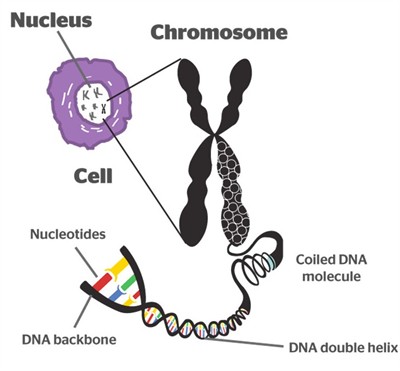
DNA is present in the nucleus and carries hereditary information
Exam Tip:
- Write: Variation helps species adapt to environmental changes.
Asexual reproduction
Asexual reproduction requires only one parent and does not involve gametes.
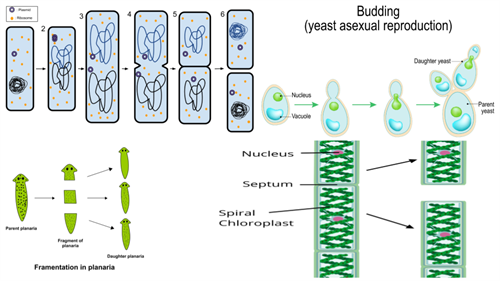
Types of asexual reproduction: Clockwise from top left: Binary fission, Budding, Regeneration, and Fragmentation
Exam Tip:
- Key idea: “Asexual reproduction → identical offspring.”
Fission:
Unicellular organisms divide to form new organisms. Amoeba divides into two (binary fission), while Plasmodium divides into many (multiple fission).
Exam Tip:
- Binary = two cells; Multiple = many cells.
Fragmentation:
Simple multicellular organisms like Spirogyra break into fragments. Each fragment grows into a new organism.
Exam Tip:
- Only organisms with simple body design show fragmentation.
Regeneration:
Organisms like Planaria and Hydra can regrow lost parts into whole organisms. Specialized cells help them regenerate.
Exam Tip:
- Regeneration is not a usual method in complex animals.
Budding:
In hydra and yeast, a small bud grows on the parent body and later separates to form a new organism.
Exam Tip:
- Hydra budding diagram is a common question.
Vegetative propagation
New plants grow from roots, stems, or leaves. Examples include potato, bryophyllum, and money plant. It is quick and produces identical plants.
Exam Tip:
- Useful for plants that do not produce seeds, like banana and jasmine.
Spore formation:
Rhizopus forms spores inside sporangia. These spores have thick walls and grow into new organisms when conditions are suitable.
Exam Tip:
- Spores survive harsh conditions due to thick walls.
PYQ's