

The chapter on "life processes" is assigned a weightage of \(9\) marks, highlighting its significance in the overall curriculum. Understanding this chapter will enhance how to classify organisms as living and what are the various life processes.
Also to prepare effectively for related exam questions. It is essential to grasp the various life processes of plants and animals, such as nutrition, respiration, circulation, and excretion.
In the below, we have provided the details of the question distribution among the different sections.
- Section A (\(1\) mark) - two question
- Section B (\(2\) mark) - two question
- Section C (\(3\) mark) - one question
Life processes in plants and animals – Learning outcomes:
-
Identify the key characteristics and life processes of living organisms.
-
Describe how plants prepare food through photosynthesis and explain the roles of chlorophyll, water, and carbon dioxide.
-
Understand the process of respiration and how it helps release energy in plants and animals.
-
Compare different modes of nutrition in living organisms.
-
Explain the structure and functions of the human digestive system and the role of each organ in digestion.
Living things show movement, growth, and molecular activity that keep them alive. They constantly repair and maintain their structures to stay organised.
All living organisms carry out certain maintenance functions even when they are resting or asleep. These actions are called life processes.
Food provides carbon-based molecules that are broken down through chemical reactions to release energy and this happens in mitochondria. Most organisms use oxygen to oxidize food, a process known as respiration.
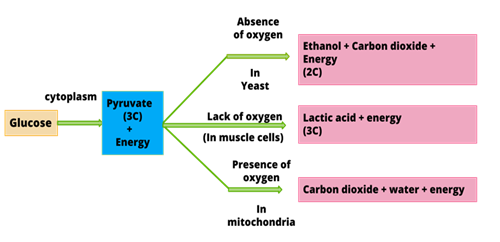
Cellular respiration
Important PYQ's:
4. ATP produced
Exam tip:
- Ethanol fermentation - commercial purposes
- Production of ATP and number of ATP produced
- Anaerobic respiration and its types
- Glysolysis in cytoplasm
Nutrition
Different organisms obtain food in different ways. Some use simple inorganic substances like carbon dioxide and water; these are autotrophs, including green plants and some bacteria. Others rely on complex organic substances and need enzymes to break them down; these are heterotrophs, including animals and fungi. Heterotrophs depend directly or indirectly on autotrophs.
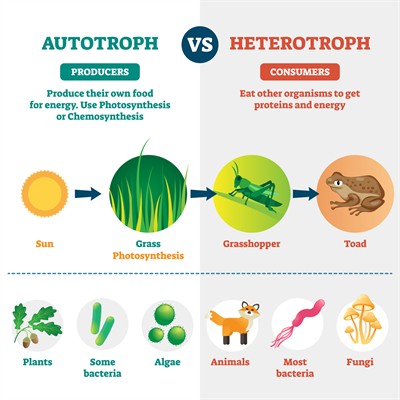
Types of nutrition
Autotrophic Nutrition
Autotrophs meet their carbon and energy needs through photosynthesis, converting carbon dioxide and water into carbohydrates using sunlight and chlorophyll. Carbohydrates provide energy, and excess is stored as starch for later use, similar to glycogen storage in humans.
Steps of photosynthesis:
-
Absorption of light energy by chlorophyll.
-
Conversion of light energy to chemical energy and splitting water into hydrogen and oxygen.
-
Reduction of carbon dioxide to carbohydrates.Mechanism of photosynthesis
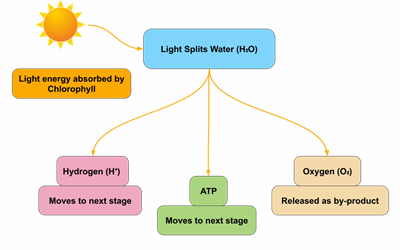
Important PYQ's:
Exam tip:
- 3 steps of photosynthesis - Absorption, conversion and reduction
- Photolysis of water where splitting happens
- Equation of photosynthesis

Chloroplasts:
Some plants, like desert species, take in carbon dioxide at night and use energy absorbed during the day. Chlorophyll in chloroplasts is essential for photosynthesis. Carbon dioxide enters leaves through stomata, tiny pores regulated by guard cells that open and close depending on water availability.
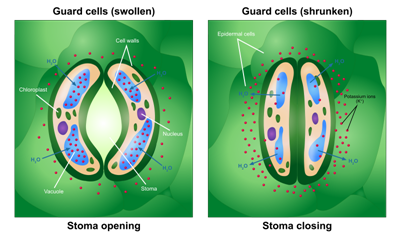
Stomatal opening and closure
Important PYQ's:
Heterotrophic nutrition:
Organisms adapt their nutrition to their environment. Some, like fungi (bread moulds, yeast, mushrooms), digest food externally and absorb it, while others ingest and digest food internally. Parasitic organisms such as cuscuta, ticks, lice, leeches, and tapeworms obtain nutrition from hosts without killing them.
How do organisms obtain their nutrition
Different organisms obtain and digest food differently, depending on their structure and complexity.
Nutrition in unicellular organisms
-
Amoeba: Uses finger-like pseudopodia to engulf food into a food vacuole, where enzymes break it down. Undigested material is expelled.
-
Paramecium: Food enters at a specific spot, moved there by cilia, and is digested similarly.
Important PYQ's:
Exam tip:
- Phagocytosis process in amoeba
- Food vacuole formation
Nutrition in human beings
The alimentary canal is a long tube from mouth to anus, with specialized regions for digestion.
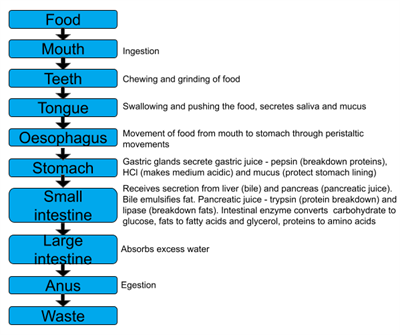
Process of digestion
Mouth:
-
Food is chewed by teeth and mixed with saliva, which contains salivary amylase to break starch into sugar.
-
The tongue helps mix and move food.
Oesophagus:
-
Food moves to the stomach through peristaltic movements.
Stomach:
-
Gastric glands secrete HCl, pepsin, and mucus.
-
HCl aids protein digestion; mucus protects the stomach lining.
-
Food exits gradually via a sphincter into the small intestine.
Small intestine:
-
Longest part of the canal thats is coiled to fit the abdomen.
-
Small intestine receives bile (from liver) and pancreatic juice (from pancreas).
-
Bile neutralizes acid and emulsifies fats (Emulsification)
-
Pancreatic enzymes are trypsin (proteins) and lipase (fats).
-
-
Villi absorb nutrients into blood vessels for energy, growth, and repair.
Large intestine and anus:
-
Absorbs water from waste; remaining material is expelled through the anus under control of the anal sphincter.
Nutrition in humans includes ingestion, digestion, absorption, assimilation, and egestion, providing energy and materials for life.
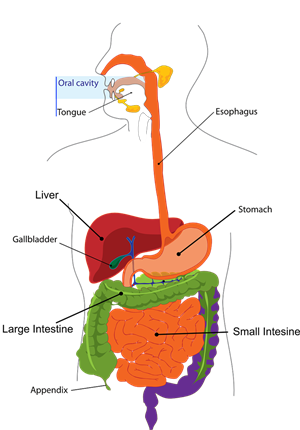
Human digestive system
Important PYQ's:
Exam tip:
-
Intestinal juice completes digestion:
-
Proteins → Amino acids
-
Carbohydrates → Glucose
-
Fats → Fatty acids and glycerol
-
- Salivary amylase function - Breaks starch into maltose in mouth
- Villi's importance - increases the surface area of absorption
- Action of enzymes in digestion