

Life processes in plants and animals
Learning outcomes:
-
Explain the structure and function of the human heart and the concept of double circulation.
-
Describe the roles of arteries, veins, capillaries, platelets, and lymph in transportation.
-
Understand how plants transport water, minerals, and food through xylem and phloem.
-
Explain the process of excretion in humans through nephrons and urine formation.
-
Describe how plants remove wastes through transpiration, diffusion, and storage.
Circulatory system in humans
The heart is a muscular, fist-sized organ with four chambers that prevent oxygenated and deoxygenated blood from mixing. The left side pumps oxygen-rich blood to the body, while the right side sends deoxygenated blood to the lungs.
Valves prevent backflow, and ventricles have thicker muscular walls than atria. Mammals and birds show double circulation (blood passes through heart twice per cycle) for efficient oxygen supply, while fish have single circulation and amphibians show partial mixing in three chambers.
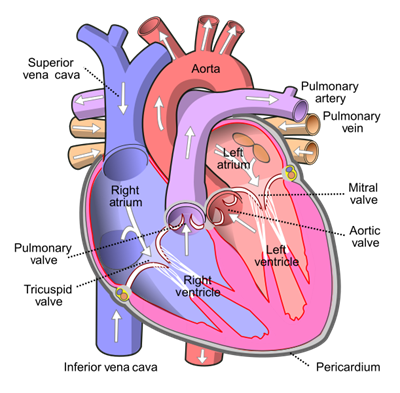
Human heart
Exam tip:
-
Double circulation → efficient oxygen supply, warm-blooded animals
-
Valves → prevent backflow (1 mark)
-
Left ventricle → thickest wall, pumps to whole body
-
Heart diagram + blood flow → 3-mark favorite
Blood vessels and lymph
Arteries carry blood away from the heart under high pressure and have thick elastic walls. Veins carry blood toward the heart with valves and thin walls. Capillaries are one-cell thick and allow exchange of materials. Platelets clot blood to prevent loss. Lymph is a colorless fluid that carries fats from the intestine and returns excess tissue fluid to the bloodstream.
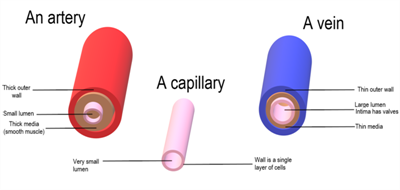
Blood vessels
Exam tip:
-
Arteries - thick, no valves
-
Veins - thin, valves present
-
Capillaries → one-cell thick, exchange site
-
Lymph → fat transport + fluid balance
-
Platelets → clotting, prevents blood loss
Transportation in plants
Plants transport water and minerals via xylem and food via phloem. Xylem movement is upward due to root pressure (night) and transpiration pull (day). Phloem carries food in both directions (up and down) through translocation, which uses ATP energy.
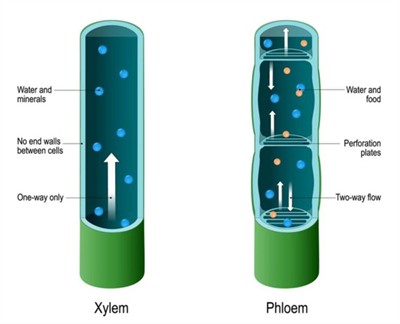
Vascular tissues - Xylem & Phloem
Exam tip:
- Remember: Transpiration pull is the main driving force for water movement. (\(2\)-mark reasoning question)
-
Transpiration is passive; Translocation is active (uses ATP)
-
Phloem → bidirectional; Xylem → unidirectional
-
Root pressure → Active at night
Excretion in humans
The excretory system includes kidneys, ureters, urinary bladder, and urethra. Kidneys filter nitrogenous wastes (urea, uric acid) through nephrons, each with a Bowman’s capsule for filtration and tubules for reabsorption of glucose, salts, and water. Urine is stored in the bladder and excreted through the urethra under nervous control.
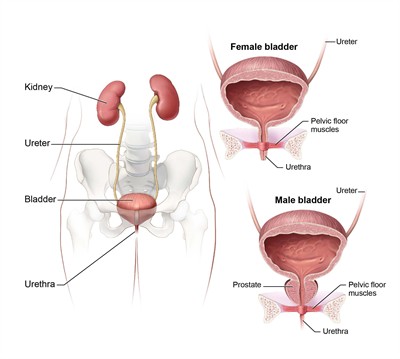
Human excretory system
Exam tip:
- Quick recall: Filtration → Reabsorption → Collection → Excretion.
- Nephron → structural and functional unit of kidney — must label Bowman’s capsule in diagrams.
- Main nitrogenous waste → Urea - easy 1-mark.
- Urinary bladder under nervous system control → \(1\)-mark tricky concept question.
Excretion in plants
Plants lack special excretory organs. They remove gases (O₂, CO₂), lose water by transpiration, and store wastes in vacuoles, leaves, gums, and resins. Some wastes are released into soil through roots.
Exam tip:
- Plant excretion = Storage + removal through fall or diffusion - \(1\) mark favorite!
- Shedding of leaves = Natural waste disposal system
- Resins and gums = Waste storage in old xylem (Important example-based question)