

Importance
The chapter on "our environment" is assigned \(5\)marks, highlighting its significance in the overall curriculum. Understanding this chapter will enhance understanding of the environment, including all living and non-living factors that interact in a particular area.
Both biotic and abiotic elements make up the environment, according to the "Our Environment" chapter. Both biotic and abiotic elements make up the ecosystem. It also includes the concept of an ecosystem, food chains, food webs, and waste management.
Also, to prepare effectively for related exam questions. Below, we have provided the details of the question distribution among the different sections.
- Section A or B ( \(1\) or \(2\) mark) - One question
- Section C or E ( \(3\) or \(4\) mark) - One question
Learning outcomes
- Environment and ecosystem: An introduction to the environment, ecosystems, and their components, including both biotic and abiotic factors.
- Ecosystem dynamics: A classification of ecosystems, exploring the food chain, trophic levels, food web, and the different types of ecological pyramids.
- Energy flow and impact: A discussion on how energy flows through ecosystems, the concept of biological magnification, and the impact of human activities on the environment.
- Ozone layer and depletion: An explanation of the causes, effects, and control measures related to the depletion of the ozone layer.
- Waste and its management: A theory covering the classification and sources of waste, its harmful effects, and the various techniques for waste management.
Ecosystem:
An ecosystem is a functional unit where living organisms interact with each other and with the physical environment. It includes both biotic and abiotic components working together as a system.
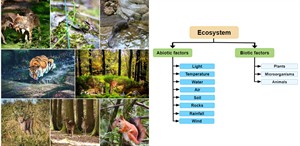
A forest ecosystem and components of ecosystem
Elements of an ecosystem:
- Producers, consumers, and decomposers are biotic components.
- Sunlight, water, air, soil, and minerals are examples of abiotic elements.
Producers:
Green plants and algae prepare food by photosynthesis using sunlight.
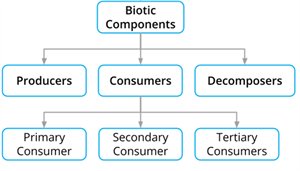
The types of organisms based on the nutrition
Consumers:
Organisms that depend on producers or other consumers for food.
-
Primary consumers - Herbivores
-
Secondary consumers - Carnivores
- Tertiary consumers - Top carnivores
Decomposers:
Microorganisms, such as bacteria and fungi, break down dead organisms into simpler substances, returning nutrients to the soil.
Important PYQ's:
Exam tip: Ecosystem = Biotic + Abiotic + Energy flow + Nutrient cycling
Food chain and food web:
A food chain shows the transfer of energy from producers to consumers in a linear sequence. Each step is called a trophic level.
Food webs are interconnected food chains that provide stability to the ecosystem by offering alternate pathways for energy flow.
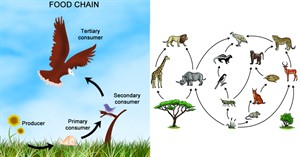
Food Chain and Food Web
Important PYQ's:
Exam tip: Each trophic level passes only \(10\)% of its energy to the next.
Trophic levels and energy flow:
Trophic levels represent the feeding positions of organisms in a food chain. Energy decreases at each successive level due to metabolic activities and heat loss. It explains why food chains are usually short and why organisms at higher trophic levels are fewer in number.
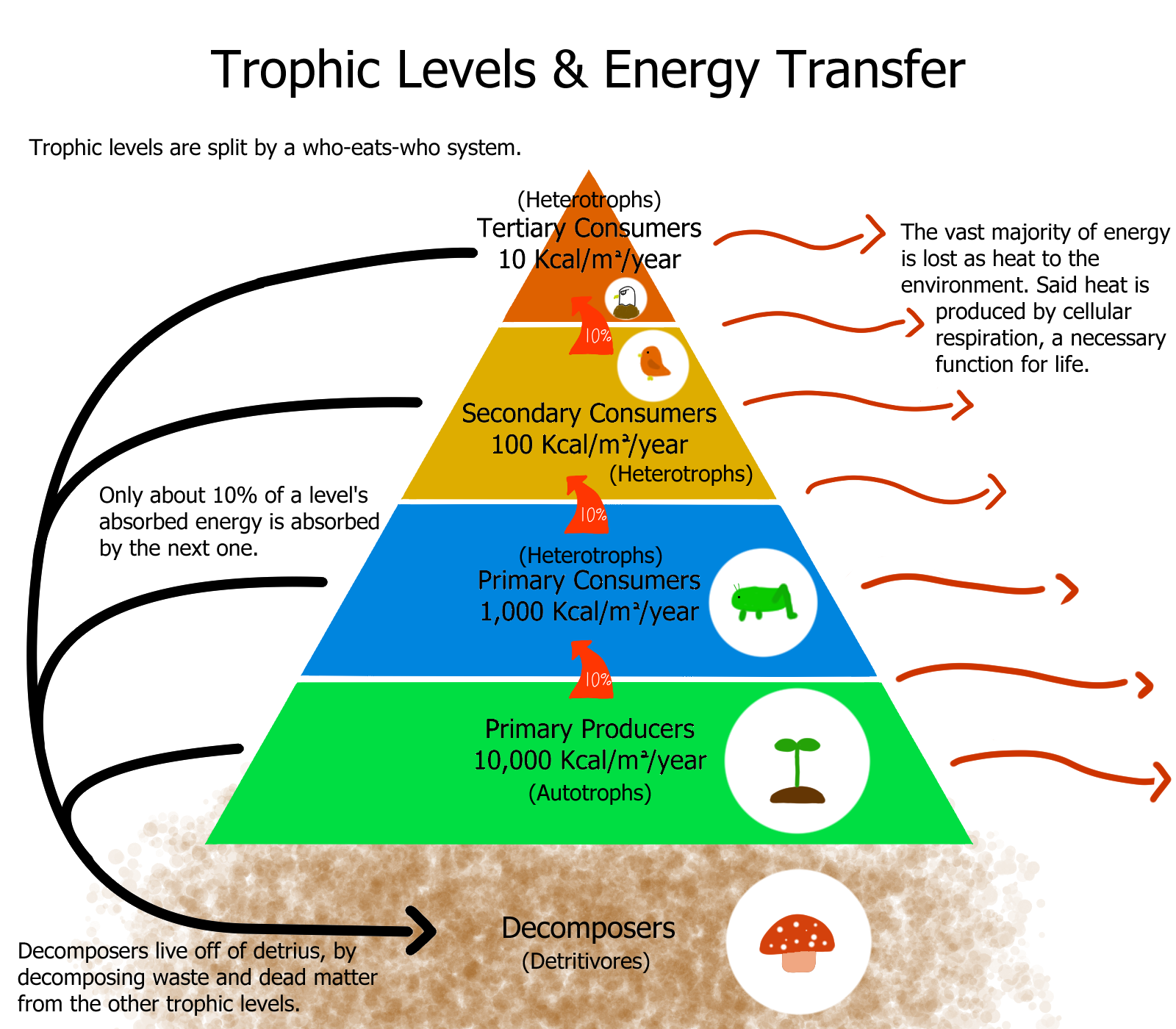
The tropic levels and their energy transfer
Types of ecological pyramids:
- Pyramid of energy
- Pyramid of biomass
- Pyramid of numbers
Important PYQ's:
Exam tip: The energy pyramid is always upright due to continuous energy loss.
Biogeochemical cycles:
Matter is recycled in nature through biogeochemical cycles, ensuring the continuous availability of essential elements like carbon, nitrogen, oxygen, and water.
Unlike energy, matter is conserved and reused within ecosystems.
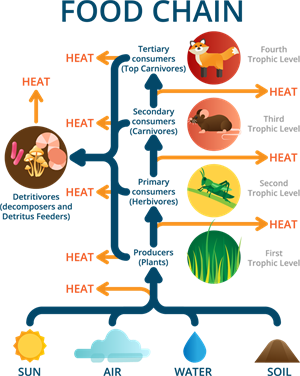
The transfer of energy
Important PYQ's: Role of decomposers
Exam tip:
Energy flows \(\rightarrow\) one direction
Matter cycles \(\rightarrow\) cyclic pathway
Matter cycles \(\rightarrow\) cyclic pathway
Ozone layer and its depletion:
The ozone layer in the stratosphere protects living organisms by absorbing harmful ultraviolet (UV) radiation from the Sun.
Human activities have led to ozone depletion due to the release of chlorofluorocarbons (CFCs), increasing the risk of skin cancer and ecological imbalance.
Human activities have led to ozone depletion due to the release of chlorofluorocarbons (CFCs), increasing the risk of skin cancer and ecological imbalance.
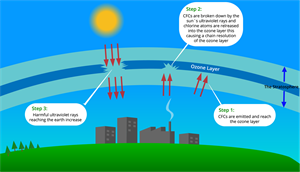
Destruction of the ozone layer
Effects of ozone depletion:
- Skin cancer
- Eye damage
- Reduced crop productivity
Important PYQ's:
Exam tip:
CFCs \(\rightarrow\) Ozone depletion \(\rightarrow\) Increased UV radiation
CFCs \(\rightarrow\) Ozone depletion \(\rightarrow\) Increased UV radiation
Waste management:
Improper waste disposal leads to environmental pollution. Waste management aims to reduce, reuse, and recycle materials to minimise environmental damage.
Nature decomposes biodegradable waste, whereas non-biodegradable waste persists in the environment for long periods.
Biomagnification is the progressive increase in the concentration of harmful, non-biodegradable substances in organisms at higher trophic levels of a food chain.
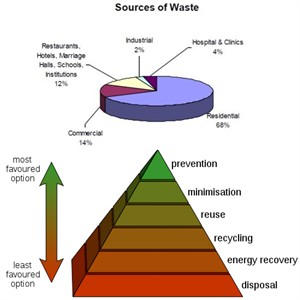
Sources of wastes and waste management
Methods of waste management:
- Recycling
- Composting
- Sanitary landfills
- Incineration
Important PYQ's:
Exam tip: Follow the 5R rule – Refuse, Reduce, Reuse, Repurpose, and Recycle.