

Energy flow in the ecosystem:
The sun is the ultimate source of energy for all ecosystems. Green plants (producers) capture about \(1%\) of the solar energy falling on their leaves and convert it into chemical energy through photosynthesis. This energy is stored in the form of carbohydrates, starch, and other organic compounds.
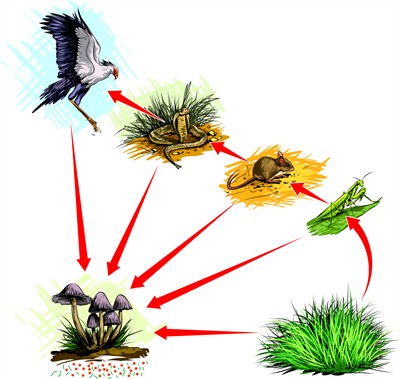
The energy flow
When herbivores (primary consumers) feed on plants, a large portion of energy is lost as heat. The remaining energy is utilized in life processes such as digestion, growth, and reproduction. When carnivores (secondary and tertiary consumers) consume herbivores, further energy loss takes place.
This stepwise transfer of energy from one trophic level to the next is governed by the \(10%\) law, which states that only about 10% of the energy is transferred to the next trophic level, while the rest is lost as heat. Due to this progressive loss, food chains rarely exceed three or four trophic levels.
Energy flow in an ecosystem is always unidirectional from the sun → producers → consumers → decomposers. Energy once used cannot return to the previous level or to the sun.
Food chain and food web:
A food chain is a linear sequence showing the flow of energy through successive organisms. In nature, organisms often feed on and are fed upon by multiple species, giving rise to a food web, which represents a network of interconnected food chains.
As we move up the trophic levels, the number of organisms decreases, with producers being the most abundant.
Ecological pyramids:
Ecological pyramids were proposed by Charles Elton in \(1927\) and are also called Eltonian pyramids. They are graphical representations showing the number, biomass, or energy at different trophic levels, with producers at the base and top carnivores at the tip.
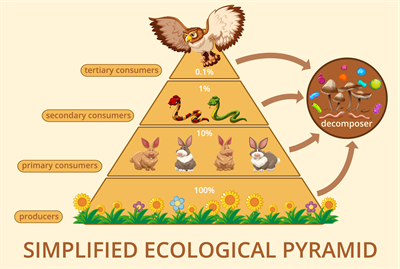
Ecological pyramids
The pyramid of numbers shows the number of organisms and may be upright, as in grasslands, or inverted, as in parasitic chains. The pyramid of biomass shows the total living matter; it is upright in terrestrial ecosystems but inverted in aquatic ecosystems.
The pyramid of energy shows the flow of energy and is always upright because only \(10%\) of energy is transferred to the next level. Ecological pyramids have limitations, as they do not represent food webs, species at multiple trophic levels, or decomposers.
Food web:
A food web is the network of interlinked food chains that shows feeding relationships among organisms in a community. It is more realistic than a food chain because organisms feed on more than one species at different trophic levels.
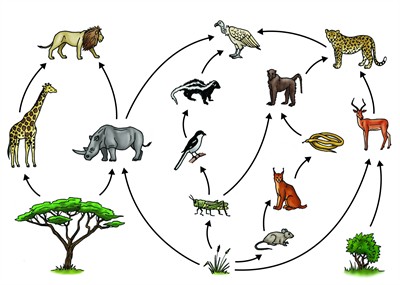
Terrestrial food web
Characteristics of a food web:
- It consists of many food chains interlinked at different trophic levels.
-
It is not straight or parallel but highly interconnected.
-
It provides alternate food options for consumers.
-
It helps maintain the stability of ecosystems by keeping populations balanced.
Effect of pesticides and fertilizers:
The use of chemical fertilizers and pesticides contaminates food chains. These chemicals enter the soil and water, are absorbed by plants, and pass on to herbivores and higher consumers.
Biological magnification:
Toxic chemicals such as DDT are non-biodegradable and accumulate in organisms at each trophic level. Their concentration increases progressively from producers to herbivores and then to carnivores.
The highest concentration is found in top consumers, including humans. This process is called biological magnification. It poses serious health risks, and washing food items does not remove these toxins. Excessive chemical use therefore disrupts ecosystems and causes environmental pollution.
How do human activities affect the environment?
Human activities such as the use of chemicals and CFCs damage the environment, especially the ozone layer in the stratosphere. The ozone layer protects life on Earth by absorbing harmful UV radiation.
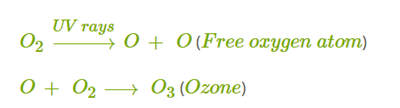
Ozone is formed when UV rays split oxygen molecules and free atoms combine to form O₃. Excessive use of chemicals causes ozone depletion, leading to harmful effects on humans and ecosystems. To prevent this, the Montreal Protocol (\(1987\)) was signed, and World Ozone Day is observed on \(September\ 16\).