

Ozone layer depletion
Causes:
Ozone layer depletion occurs mainly due to chlorofluorocarbons (CFCs), which release chlorine atoms that break down ozone molecules into oxygen. Other chemicals like HCFCs, carbon tetrachloride, methyl chloroform, volatile organic compounds (VOCs), and nitrogen monoxide also contribute to ozone depletion. These substances are commonly found in aerosols, refrigerants, vehicle exhaust, and industrial smoke.
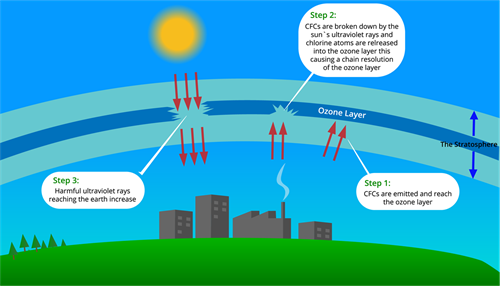
Destruction of the ozone layer
Effects:
-
Increased UV radiation reaching Earth.
-
Health issues: Skin cancer, sunburn, cataracts, weakened immunity, respiratory problems.
-
Affects plant growth, flowering, and development.
Control measures:
Ozone depletion can be reduced by using CFC-free refrigerants and aerosols, conserving electricity, and preferring public transport. Proper recycling of refrigerants during appliance repair is essential. Raising public awareness and adhering to international agreements like the Montreal Protocol (\(1987\)) help limit the production and release of ozone-depleting substances, protecting the Earth’s ozone layer.
Wastes and their classification
Daily activities produce a lot of waste, and improper disposal causes pollution. On average, a person generates \(400–500\ g\) of waste per day, which adds up massively in cities.
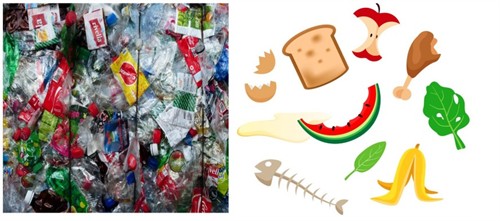
Non-biodegradable and biodegradable waste
Biodegradable wastes:
These can be broken down naturally by bacteria and fungi.
Example:
Food scraps, paper, cotton, wool, leather, wood.
Non-biodegradable wastes:
Non-biodegradable wastes cannot be decomposed naturally.
Example:
Plastics, metals, glass, synthetic fibers, and pesticides
Sources of wastes
1. Domestic wastes: Generated from households, including paper, plastics, vegetable peels, glass, and textiles.
2. Commercial wastes: Produced by shops, offices, printers, and warehouses, e.g., packing materials, polythene, paper, and food scraps.
3. Animal wastes: Dung and waste left by stray animals on streets.
4. Biomedical wastes: From hospitals and clinics, such as expired medicines, syringes, and surgical dressings, which may be infectious.
5. Construction wastes: Debris from construction activities, like metal rods, cement, concrete, and sand.
6. Sewage wastes: Wastewater from sewers and drains, which can pose health hazards.
7. Hazardous wastes: Wastes that are toxic, combustible, corrosive, explosive, or radioactive.
8. Electronic wastes (E-wastes): Discarded electronic devices such as computers, cellphones, TVs, refrigerators, containing toxic metals and chemicals harmful to humans and the environment.
Waste management
Harmful effects:
Improper waste disposal pollutes streets and lands, attracts pests, spreads diseases, and introduces toxic chemicals into the food chain, causing biomagnification.
Management:
Waste management involves collecting, transporting, recycling, and disposing of waste. The 3R principle – Reduce, Reuse, Recycle helps minimize waste and protect the environment.
Bioplastics:
Made from renewable sources like corn starch or cassava, some bioplastics are biodegradable and used for bags, trays, bottles, and daily items, offering an eco-friendly alternative to conventional plastics.
Waste management methods
Reduce and recycle: People should minimize waste generation and use recycled products.
Energy recovery: Waste can be converted into energy for cooking, heating, or running machinery.
Biological processing: Biodegradable waste can be turned into manure through composting, or into nutrient-rich compost through vermicomposting using earthworms.
Sanitary landfill: Waste is dumped in low-lying areas and covered with soil; once filled, the land can be converted into parks or playgrounds.
Incineration: Waste is burned at high temperatures, reducing its volume, and the remaining ash is safely disposed of.
Sewage treatment: Wastewater is treated to remove solids and harmful microorganisms before being discharged or reused.
Bioremediation: Microorganisms and plants are used to clean pollutants like hydrocarbons and heavy metals from the environment.

Process of recycling of plastic