

Changes and Life Around Us:
Science as a tool to Understand change:
- Science enables the observation and understanding of changes occurring in the surrounding environment.
- It provides explanations for changes in daily life, ranging from simple phenomena such as melting ice to complex natural processes like the water cycle, by clarifying how and why these changes take place.
Changes around us:
Many changes are observable in daily life. These changes may involve:
- Change in shape (cutting paper)
- Change in state (melting ice)
- Change in size or form (growth of plants)
Examining these changes establishes a foundation for understanding both simple events and major natural processes.
Types of Changes:
Reversible changes:
These are changes in which the original substance can be obtained again.
Characteristics:
- Temporary
- No new substance is formed.
- Can be reversed easily
Examples:
- Melting and freezing of ice
- Stretching a rubber band
- Folding and unfolding paper
Irreversible changes:
These are changes from which the original substance cannot be recovered.
Characteristics:
- Permanent
- A new substance is formed.
- Cannot be reversed at all.
Examples:
- Burning paper
- Cooking food
- Ripening of fruits
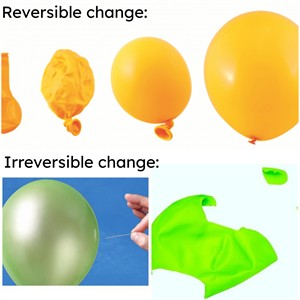
Blowing a balloon and bursting a balloon
To understand the causes of change, it is important to examine the role of heat in these processes.
Heat is a form of energy that flows from a hotter object to a colder object.
Effects of Heat:
Heat can cause:
- Change in state
- Expansion of substances
- Chemical changes (like cooking)
Example: Melting of Ice
- Ice absorbs heat from its surroundings.
- Changes into water (solid to liquid)
- This process represents a reversible change, since the original substance can be recovered.
Large-Scale Example: Melting of Glaciers
- Glaciers melt due to increased heat from the environment.
- This contributes to rising sea levels.
- This example demonstrates how heat can cause changes on a global scale.
The Water Cycle:
The water cycle is a continuous natural process driven by solar heat.
Steps in the Water Cycle:
- Evaporation – Water changes into vapour due to heat.
- Condensation – Water vapour cools to form clouds.
- Precipitation – Water falls as rain.
- Collection – Water gathers in rivers, lakes, and oceans.
This cycle illustrates how heat drives continuous changes in natural systems.
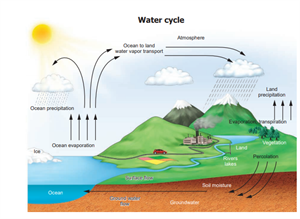
Water cycle
Life Processes in Living Organisms:
All living organisms carry out basic processes to survive.
Plants:
Make their own food using sunlight (photosynthesis)
Absorb water and minerals from the soil.
Animals:
Depend on plants or other animals for food.
Obtain energy through digestion.
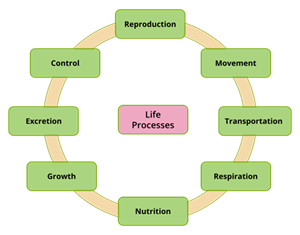
Life processes
Common Life Processes:
- Nutrition
- Respiration
- Growth
- Excretion
- Reproduction
Growth and Changes:
Growth refers to a permanent increase in the size and development of an organism.
Stages of Life
In Humans:
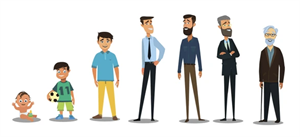
Stages of life in human
In Frog:
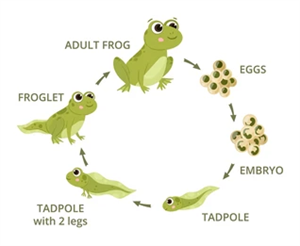
Stages of life in frog