

Investigating Materials Using Electric Current:
Concept Overview
- The electrical properties of materials can be explored using basic components such as electric batteries, bulbs, and connecting wires.
- These simple experiments help us determine whether a material allows an electric current to pass through it.
Experimental Setup: Simple Electric Circuit
You can construct a simple electric circuit using the following materials:
- An electric battery (source of energy)
- Connecting wires (path for current flow)
- A small electric bulb (indicator)
A gap is intentionally left in the circuit; this is where you place the material to be tested to check if it completes the circuit.
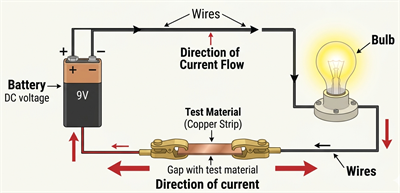
Simple electric circuit used to test electrical properties of materials
Observation and Interpretation:
- If the bulb glows, it means that the material allows an electric current to pass through it. Such materials are called conductors.
- If the bulb does not glow, it means the material does not allow an electric current to pass. These materials are known as insulators.
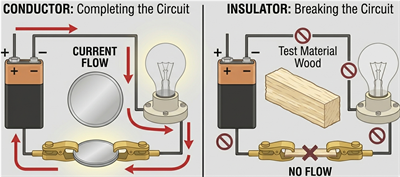
Conductors allow current (bulb glows), insulators do not
Scientific Understanding:
The bulb glows only when the circuit is complete, indicating a conducting path. This method is widely used to test whether materials are conductors or insulators.
Materials Required to Make a Lamp Glow:
For a bulb to glow, the following conditions must be fulfilled:
Essential Requirements:
- A source of electricity (battery or cell)
- A closed circuit (continuous path for current flow)
- A conducting material to allow current to pass through the circuit
Role of Materials in the Circuit:
| Battery | Supplies electrical energy |
| Wires | Provide a path for current |
| Bulb | Glows when current flows |
| Test Material | Determines whether current can pass |
Conductors and Insulators
Conductors:
- Conductors are materials that allow electric current to flow easily through them.
- Examples: Copper, aluminium, and iron
- Application: Conductors are used to make electrical wires and circuits because they efficiently transmit electricity.
Insulators:
- Insulators are materials that do not allow electric current to pass through them.
- Examples: Rubber, plastic, and wood
- Application: Insulators are used to cover wires and electrical plugs, helping prevent electric shocks and ensuring safety.
Key Insight
The bulb glows only when a conductor completes the circuit. If an insulator is used, the bulb will not glow because the circuit is incomplete.
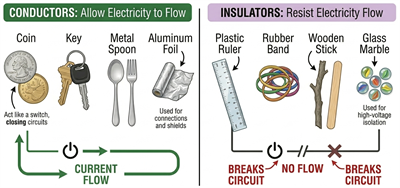
Examples of conductors and insulators
Classification of Materials: Metals and Non-Metals
Materials can also be classified as metals and non-metals based on their ability to conduct electricity.
Metals:
- Metals are materials that generally conduct electricity very well.
- Electrical Property: Metals are good conductors of electric current.
- Examples: Copper, aluminium, iron
- Application: Metals are widely used in electrical wiring and appliances because they conduct electricity efficiently.
Non-Metals:
- Non-metals are materials that generally do not conduct electricity.
- Electrical Property: Non-metals are usually poor conductors (insulators) of electricity.
- Examples: Sulphur, oxygen, and plastic
Exception
- Certain non-metals, such as graphite (a form of carbon), can conduct electricity.
- This shows that classification depends on the observed properties of materials, not just their category.
Applications in Everyday life:
- Copper is used in electrical wires because it is a good conductor.
- Plastic and rubber are used as coverings because they are insulators.
- Electrical appliances use both conductors and insulators for safe functioning.
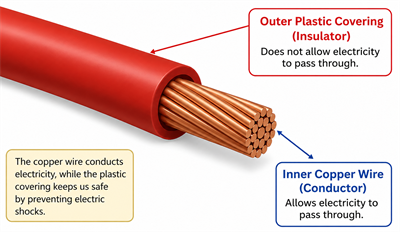
Structure of an electric wire showing conductor and insulator
Conclusion:
- Electrical properties help us classify materials into conductors and insulators, and further into metals and non-metals.
- This classification is essential for understanding and safely using electricity in daily life.