

Importance of Questioning in Scientific Thinking:
Questioning is the skill of asking insightful questions to explore and comprehend scientific concepts and phenomena.
The Importance of Questioning:
- It serves as the foundation for every scientific discovery.
- Enables a deeper understanding of scientific concepts.
- Promotes logical reasoning and critical thinking.
- Inspires experiments and investigative research.
Example:
When Isaac Newton saw an apple fall from a tree, he questioned why it fell straight down. His curiosity led to the groundbreaking discovery of gravity.

Isaac Newton Beside The Apple Tree
Key Idea:
Asking good questions fosters deeper understanding and drives scientific breakthroughs.
Relating Answers to Real-Life Situations:
Concept:
Science learning becomes meaningful when we relate answers to real-life situations by crafting relevant questions.
Strategies for Framing Questions:
- Start from a given answer.
- Consider how and where it occurs in everyday life.
- Frame a clear and relevant question.
Examples:
- Answer: Metals expand on heating
- Question: Why do railway tracks have gaps between them?
- Answer: A plant kept near a window bends towards the light.
- Question: Why do plants near a window bend towards sunlight?

Phototropism
Benefits:
- Makes learning practical, relevant, and engaging.
- Facilitates the application of knowledge to real-life situations.
- Strengthens analytical and problem-solving skills.
Developing Curiosity and Creativity:
Curiosity:
A strong desire to ask questions and gain a deeper understanding of the world.
Creativity:
The capacity to think in innovative and imaginative ways.
How to develop them?
- Formulate open-ended questions to encourage exploration.
- Challenge assumptions by asking questions like “What if…?” and “Why not…?”
- Visualise alternative possibilities and outcomes.
Examples of Thoughtful Questions:
- What if there were no gravity on Earth?
- What would happen if plants could talk?
- How would life change if there were no water?
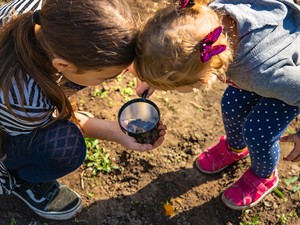
Children examining the soil
Importance:
- Encourages innovation, new ideas, and creative solutions.
- Makes science enjoyable and engaging.
- Cultivates a strong scientific mindset and attitude.
.