

History of Time Measurement:
Time measurement is the process of tracking the passage of time using natural events or instruments.
Early Methods of Measuring Time:
Using the Sun (Natural Method):
- Early humans observed the Sun's position in the sky.
- The length and direction of shadows changed throughout the day.
- This led to the invention of the sundial.
Sundial:
- A sundial uses the shadow cast by a stick called a gnomon, which is an upright rod or pole, to indicate time.
- Works only during the daytime and in sunlight.
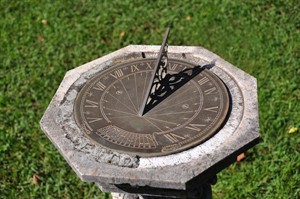
Sundial
Other ancient time-measuring devices:
|
Water Clock (Clepsydra)
|
Measures time by flow of water
|
Not very accurate
|
|
Sand Clock (Hourglass)
|
Sand flows from one bulb to another
|
Fixed duration only
|
|
Candle Clock
|
Burning length indicates time
|
Affected by wind
|
Modern Time Measurement:
- Mechanical clocks: Use gears and springs.
- Electric clocks: Powered by electricity.
- Digital clocks/watches: Display time numerically (hours, minutes, seconds).
- Atomic clocks: Most accurate (used in satellites and science).
Important:
Modern devices measure time based on standard units (seconds, minutes, hours).
Modern devices measure time based on standard units (seconds, minutes, hours).
Movement of Earth and Moon:
Day and Night:
Cause:
- The Earth rotates on its axis from west to east.
- One full rotation takes \(24\) hours.
Result:
- The side facing the Sun is Day
- The side away from the Sun is Night
Key concept:
- Day and night are caused by Earth’s rotation, not by the movement of the Sun.
- Seasons change due to Earth’s revolution.
- Eclipses occur when the Sun, Earth, and Moon align.
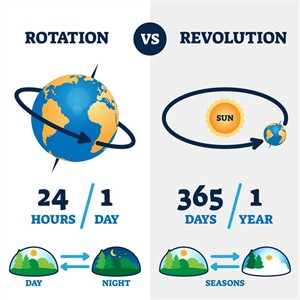
Rotation and revolution difference
Phases of the Moon:
- The Moon does not produce its own light.
- It reflects sunlight.
Phases include:
- New Moon
- Crescent Moon
- Half Moon
- Full Moon
Caused by: The position of the Moon relative to Earth and Sun.
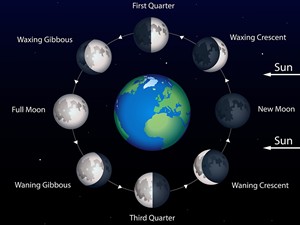
Phases of the moon
Eclipses:
Solar Eclipse:
- Occurs when the Moon comes between the Sun and Earth.
- The Moon blocks sunlight → Shadow falls on Earth.
- Happens only during New Moon
Lunar Eclipse:
- Occurs when the Earth comes between the Sun and Moon.
- Earth blocks sunlight → Shadow falls on Moon.
- Happens only during Full Moon
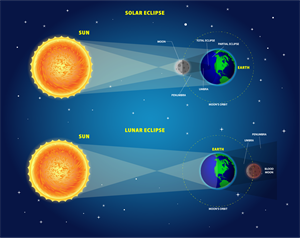
Important Points:
- Eclipses do not occur every month because of the orbital tilt.
- Never look directly at a solar eclipse without protection.
Light and Its Properties:
Light is a form of energy that enables us to see objects.
Examples of Sources of Light:
- Natural: Sun, stars, fireflies
- Artificial: Bulbs, torches, candles
How Light Travels:
- Light travels in a straight line.
- This is called Rectilinear Propagation of Light.
Visibility of Objects:
We can see objects when:
- Light falls on the object.
- And reflects in our eyes.
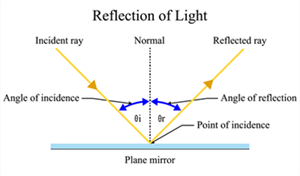
Reflection of Light
Shadows:
Formation of Shadows:
A shadow is formed when an opaque object blocks light
Conditions for Shadow Formation:
- Source of light
- Opaque object
- Screen or surface
Examples of Types of Objects Based on Light:
- Transparent: Glass window (lets all light through)
- Translucent: Frosted glass (lets some light through)
- Opaque: Wooden door (blocks all light)
Characteristics of Shadows:
- Always dark (no colour)
- The shape depends on the object.
- Size changes with distance from the light source.
- Formed on the opposite side of light
Umbra and Penumbra:
- Umbra: The darkest part of a shadow where all light is blocked.
- Penumbra: The lighter part of a shadow where some light still reaches.
Light in Darkness:
- In complete darkness, objects are not visible.
- Artificial sources like bulbs or torches help us see.