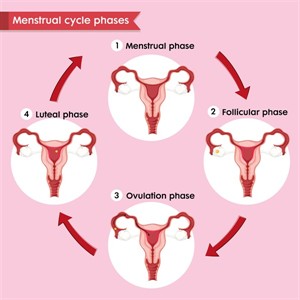
The menstrual cycle has four phases: Menstrual (days \(3\)–\(7\)), Follicular (days \(6\)–\(14\)), Ovulation (around day \(14\)), and Luteal (days \(15\)–\(28\)), each involving specific changes in the uterus and ovaries.
Adolescence: A stage of growth and change
The development stage between childhood and adulthood is called adolescence. It is a period of rapid growth and development, typically occurring between the ages of \(10\) and \(19\).
Puberty is the stage in which the body of a child undergoes observable and internal changes to develop into an adult capable of reproduction.
Significance of adolescence:
-
Organisms reproduce to maintain life and sustain their populations, and humans must grow and reach maturity to gain reproductive ability.
-
During growth and development, humans undergo noticeable physical changes as well as internal emotional and behavioural changes.
Changes that mark the onset of adolescence:
Common in boys and girls:
- Grow taller and gain weight
- Changes in facial skin: Appearance of pimples and acne
- Growth of hair in different parts, like the armpits and pubic region
Observed only in boys:
- Broadening of the shoulders and widening of the chest
- Hoarseness of voice
- Development of facial hair, chest hair and back hair.
Observed only in girls:
- Widening of the hips
- Shrillness of voice
- Development of breasts
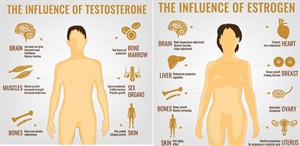
Secondary sexual characteristics in males and females
Secondary sexual characteristics in female:
Acne is a skin condition caused by increased oil secretion during adolescence, which clogs pores and leads to pimples and infections.
Some of these characteristic changes, like voice changes, the growth of facial and chest hair in boys, and the development of breasts in girls, are not directly involved in the process of reproduction.
Features that help to distinguish the male from the female but are not directly involved in reproduction are called secondary sexual characteristics.
The voice box grows during adolescence, forming the Adam’s apple, which is more prominent in boys and can cause a hoarse voice, while in girls, the change is less noticeable.
Emotional changes:
Emotional changes are simply new or stronger feelings that adolescents experience. These emotions can be exciting, confusing, or both.
Some common emotional changes include:
- Mood swings (feeling happy one moment and sad the next)
- Strong emotions (feeling things more deeply)
- New interests and passions.
Reasons for these changes:
- During adolescence, increased hormone release causes rapid physical and emotional changes, such as puberty, mood swings, and heightened curiosity, which are a normal part of growth and development.
- Emotional changes in adolescence offer opportunities for self-exploration, creativity, compassion, and making thoughtful decisions by understanding one’s emotions.
Menstruation:
The menstrual cycle recurs generally every \(28\)–\(30\) days and is more commonly known as ‘the period’. Many healthy girls have menstrual cycles that range from \(21\) to \(35\) days.
Menstrual cycle and beginning and end of menstruation: