

The human digestive system
Nutrition in humans is a complex process that involves five important steps, starting from ingestion, followed by digestion, absorption and assimilation, and finally ending in egestion.
The human digestive system is a long, continuous tube called the alimentary canal, extending from the mouth to the anus. Food passes through different organs in this canal, each contributing to digestion.
What happens after Ingestion?
Digestion:
The journey of the food we eat begins when it enters our mouth and is partially digested in the mouth. Mouth, tongue, teeth and salivary glands are present in the buccal cavity, which helps in digestion.
Mouth or buccal cavity:
Teeth:
Human teeth break down food into smaller pieces through the processes of crushing and chewing, and grinding the food. This process of initial breakdown of food in the mouth into fine pieces is called mechanical digestion. Teeth vary in appearance and perform different functions.
There are two sets of teeth in our lifetime. These include:
-
Temporary teeth or milk teeth develop in a child from \(5\) to \(6\) months till about \(2\) years of age.
-
Permanent teeth develop after the milk teeth fall off between the ages of \(6\) to \(8\) years.
There are \(4\) types of teeth,
-
Incisor
-
Canine
-
Premolar
-
Molar
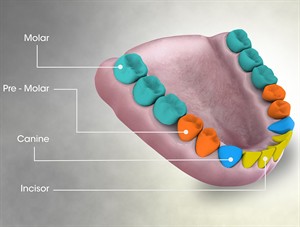
Types of teeth
|
Teeth type
|
Milk teeth
|
Permanent teeth
|
Function
|
|
Incisors
|
\(8\)
|
\(8\)
|
Cutting and biting food
|
|
Canines
|
\(4\)
|
\(4\)
|
Piercing and tearing food
|
|
Premolars
|
\(0\)
|
\(8\)
|
Crushing and rough grinding food
|
|
Molars
|
\(8\)
|
\(12\)
|
Fine grinding of food
|
|
Total
|
\(20\)
|
\(32\)
|
|
Tongue:
The tongue is a thick muscular organ that is covered with a mucous membrane and occupies the whole floor of the mouth when the jaws are closed. It is attached at the back to the buccal cavity and the floor of the mouth and is free at the other end. The tongue has many taste buds, which help identify different tastes of the food.
It plays a major role in the process of ingestion. The tongue rolls and pushes the food into the throat. It mixes the saliva with the food and also helps us in speaking.
Salivary glands:
Salivary glands are present in the mouth or buccal cavity and secrete a fluid called saliva, which is a digestive juice, consisting of an enzyme known as salivary amylase. This enzyme in the saliva breaks down the starch into sugar.
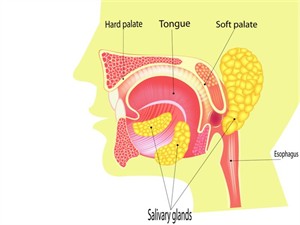
Salivary glands in the mouth
Experiment to demonstrate the action of saliva on starch
Aim: To study the activity of saliva on starch present in the food
Materials required:
- Two test tubes and a test tube holder
- Boiled rice
- Dilute iodine solution
- Water
- Dropper and stirrer
Procedure:
1. Take two test tubes and label one as ‘\(A\)’ and another as ‘\(B\)’.
2. Take one teaspoonful of boiled rice in test tube \(A\) and test tube \(B\).
3. Take a spoonful of boiled rice and add it to the test tube labelled as \(A\).
4. Take another spoonful of boiled rice, chewed for \(30\)–\(60\) seconds. And add it to the test tube labelled \(B\).
5. Add \(3\) to \(4\)\(ml\) of water in both the test tubes.
6. Note the initial colour of the rice-water mixture.
7. Now add \(3\) to \(4\) drops of iodine solution in each of the test tubes with the help of a dropper.
8. Mix the contents of each test tube separately and thoroughly, and observe the colour change.
Observation: A blue-black colour is produced in the test tube that is labelled as \(A\). There is no colour change seen in the test tube labelled as B.
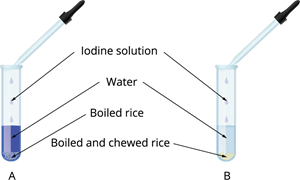
Inference: Starch in the boiled rice in test tube A gives a blue-black colour with iodine. As saliva digests starch, test tube B does not turn blue-black colour, indicating the starch has already been broken down into simpler sugars due to the action of salivary enzyme amylase (if there is a slight colour change that fades in a little while, it indicates that starch is present only in a very small amount).
Oral Hygiene: Brush your teeth and clean your tongue twice a day. Rinse your mouth with water after each meal to prevent tooth decay and bad smell in the mouth.
Oesophagus (Food pipe):
The oesophagus is a long, muscular pipe that connects the buccal cavity to the stomach. It is also called the food pipe. It runs along the neck and the chest. It is about \(30\)\(cm\) in length.
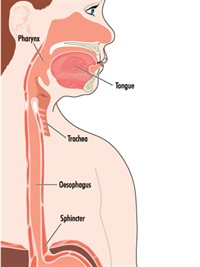
Oesophagus
Muscles of the Oesophagus gently contract and relax in a wave-like motion to pipe push food coming from the mouth down towards the stomach. This wave-like movement is called peristalsis.
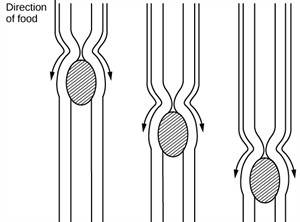
Peristalsis
Stomach:
The stomach is a thick-walled, \(J\)-shaped, bag-like structure present on the left side of the abdomen. The food is churned in the stomach by the contraction and relaxation of the stomach walls and is further broken down into smaller pieces, resulting in a semi-solid paste. The stomach's inner lining secretes mucus, hydrochloric acid (HCl) and digestive juices.
- The mucus protects the stomach's lining from the acidic environment.
- The hydrochloric acid is necessary for protein digestion in the stomach.
- The acid also kills the bacteria that might enter along with the food from the mouth.
- The enzymes in the digestive juices convert complex food molecules (proteins, carbohydrates, and fats) into simpler forms.
How did scientists discover how the human body digests food?
It was by accident that the mechanism of the stomach was discovered. A man named Alexis St. Martin was accidentally shot with a shotgun in the stomach in \(1822\), and he was treated by a doctor named William Beaumont. Alexis St. Martin's wound, however, never completely healed, leaving a tiny permanent hole in his stomach. Dr. Beaumont was able to watch the stomach's digestion process happen because of this opening. He examined the effects of emotions on digestion and performed studies on the breakdown of various foods.
The small intestine is a long and narrow tube about \(6m\) in length. It is arranged in the form of a highly coiled tube, which is the site of complete digestion of food and also absorption.
The partially digested food from the stomach comes into the small intestine. The small intestine is the longest part of the alimentary canal, and it is called small because of its smaller diameter than the large intestine. Digestion is completed here with juices from the liver, pancreas, and intestine.
- The liver secretes bile juice, which is mildly basic in nature. It is stored temporarily in a sac called the gall bladder. Bile plays a vital role in neutralising acids and fat digestion. Bile breaks down fats into tiny droplets, making further breakdown easier.
- Pancreatic juice is also basic in nature and helps neutralise acids in food. It completely breaks down the fats into fatty acids and glycerol.
- Intestinal juice completely breaks down the starch (carbohydrate) into the simplest sugar, glucose and proteins into amino acids.
Digestion is completed here in the small intestine, and the end products of digestion are ready for absorption.
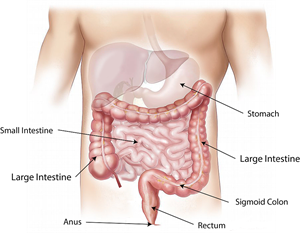
Stomach, Small Intestine, Large Intestine
Absorption:
Absorption:
The digested food now passes into the blood vessels present in the wall of the intestine. This process is called absorption.
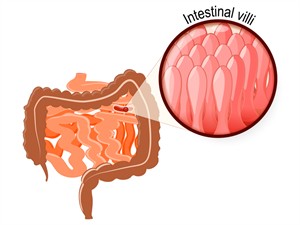
Villi in the Small Intestine
Celiac Disease: Gluten is a type of protein found naturally in certain grains like wheat, barley, and rye. It gives dough its stretchy and chewy texture, helping bread and other baked goods rise and keep their shape. In some people, their bodies' immune system reacts badly to gluten. This condition is called celiac disease. In such cases, it causes damage to the small intestine's inner lining, which is crucial for absorbing nutrients from food. Because of this, the intestine fails to function well. To manage this, people with celiac disease must avoid eating foods that contain gluten. They can prefer millets like jowar, bajra, and ragi, which are great alternatives because they don't contain gluten.
Assimilation:
The absorbed nutrients are transported through the blood to the various parts or organs of the body for utilisation, for various life processes and metabolic activities.
The incorporation of absorbed nutrients into the cell components is called assimilation.
What happens to the undigested food?
Egestion:
The undigested, semi-solid waste from digestion is expelled from the body through the anus. This is called egestion.
Large Intestine:
The large intestine is nearly 1.5 metres in length. It is considerably wider than the small intestine, but is shorter. It is called so because of its diameter (width). Digestion does not take place here. The large intestine helps in absorbing most of the water and also some salts from the undigested food, leaving the undigested food as a semi-solid.
The rectum, a part of the large intestine, is the place for the temporary storage of undigested food, i.e., semi-solid faeces.
Anus is the last part of the large intestine and the alimentary canal. The primary function of the anus is to expel solid faeces out of the body.Digestive Health:
The large intestine has many friendly microorganisms, like bacteria, that help with digestion. These bacteria keep our digestive system healthy by breaking down food that our body can't digest, especially fibre, and help produce essential nutrients for us. Eating foods rich in fibre and fermented foods, such as curd, buttermilk, shrikhand, kanji, pickles, gundruk, and poita bhat, is good for keeping our digestive system healthy and strong.
For many years, people have understood that digestion is very important for staying healthy. An ancient Ayurvedic book called the Charaka Samhita talks about eating foods that are easy to digest and using spices like ginger, black pepper, and cumin wisely to help digestion. Modern science also tells us that eating meals on time, paying attention while eating, and not eating too much are important habits for good digestive health.

