

Life processes in animals:
How do you decide whether something is living or dead? We can observe certain characteristics or activities; for example, we can look for signs such as breathing, movement, growth, or response to the environment. These signs are not random; instead, they are the result of a set of coordinated activities taking place within an organism. Such essential activities are called life processes.
By studying these processes, we can not only distinguish living things from non-living matter but also better understand what it means to be alive.
Life processes are the essential activities that all living organisms perform to stay alive. These include:
-
Nutrition – how organisms take in and use food.
-
Respiration – how organisms release energy from food.
-
Excretion – how organisms remove waste.
-
Reproduction – how organisms produce new individuals.
Life processes are certain life-sustaining biological processes essential for the survival of living organisms.
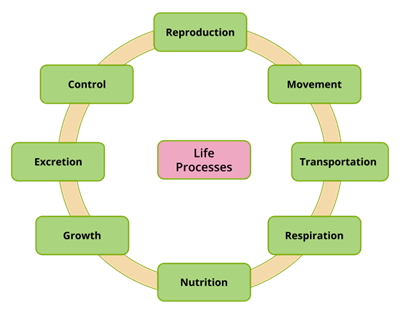
Life processes
Nutrition:
In order to survive, all living organisms require food for obtaining energy for growth and repair. The process through which living organisms obtain the energy necessary for growth, development and maintenance is called nutrition.
Chemical substances present in food, such as carbohydrates, proteins, fats and vitamins, are called nutrients.
Plant can make their own food with the help of the green pigment chlorophyll and sunlight (autotrophic nutrition), but not all organisms are capable of preparing their food to produce energy like plants. So, except for autotrophs, all organisms are called heterotrophs.
Heterotrophic nutrition:
A mode of nutrition where organisms cannot prepare their own food and obtain it from outside sources, like plants or other animals, is called heterotrophic nutrition. All animals follow heterotrophic nutrition, but the form of nutrition differs based on the availability and type of food and how the organism obtains it.
Types of heterotrophic nutrition:

Heterotrophic nutrition
Nutrition in animals:
Nutrition in animals is a complex process that involves five important steps, which are given below:
-
Ingestion: It is the process of taking food into the body. Animals have different ways to ingest food depending on their habitat and body structure.
-
Digestion: After ingestion, the food is broken down into smaller, simpler molecules that the body can absorb.
-
Absorption: The simple nutrients are absorbed into the bloodstream or cells for distribution throughout the body.
-
Assimilation: The absorbed nutrients are used by cells to produce energy, grow, and repair tissues.
-
Egestion: Finally, any undigested and unabsorbed food is removed from the body as waste.

Steps of holozoic nutrition
Ingestion:
The process of in-taking food with the help of the mouth part is called ingestion.
The mode of ingestion in a few organisms:
|
Animal
|
Mode of feeding
|
|
Insects (like honey bees) and birds (like sunbirds)
|
Collect (suck/siphon) nectar from flowers on plants respectively
|
|
Insects (like cockroaches)
|
Bite and chew
|
|
Snakes (like python) and birds (like eagle)
|
Swallow their food
|
|
Dogs and other animals
|
Chew and swallow their food with their mouth
|
|
Lice and mosquito
|
Feeds by sucking blood from the skin of other animals
|
|
Frogs and some reptiles
|
Use a long, forked tongue to catch insects
|
|
Infants of humans
|
Feeds on mother's milk by using their mouth
|
|
Adult humans
|
Chew and swallow their food with their mouth
|
Digestion:
Food ingested by the animals contains complex insoluble nutrients, and the body cannot use them directly to obtain energy in their complex form. So this ingested solid food is converted into a simple soluble form so the body can absorb, store and utilise it.
Carbohydrates → Glucose (simple sugar)
Proteins → Amino acids
Fats → Fatty acids and glycerol
Proteins → Amino acids
Fats → Fatty acids and glycerol
This process of converting complex or large food substances (polymers) into smaller parts (monomers) is called digestion.

Breaking down of complex substance into simpler substances
Nutrition in humans:
The food in humans that has to be digested passes through a long, continuous tube/canal running down from the mouth or buccal cavity to the anus. This canal can be divided into six compartments:
-
Mouth or buccal cavity
-
Oesophagus or food pipe
-
Stomach
-
Small intestine
-
Large intestine
-
Rectum and anus
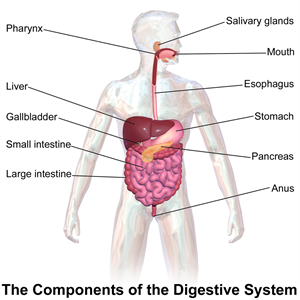
Human digestive system
All these parts together form the alimentary canal, otherwise known as the digestive tract. The alimentary canal is the site where digestion and absorption of food take place. The digestive tract, along with the associated glands (salivary glands, the liver and the pancreas), together comprise the digestive system.
Reference:
https://commons.wikimedia.org/wiki/File:Blausen_0316_DigestiveSystem.png