

The mechanism of breathing:
Breathing is something we do every moment without even thinking about it, but have you ever wondered how it actually happens?
Breathing is one of the most important processes that keeps us alive. It allows our body to take in fresh oxygen from the air and get rid of harmful carbon dioxide produced inside us. This oxygen is essential because it helps our body produce the energy needed for everything we do—walking, talking, playing, and even thinking!
Here we will explore how breathing works, why it is important, how gases are exchanged in our lungs, and the impact of habits like smoking on our respiratory health.
To understand how breathing works, let's explore the mechanism step by step by creating a simple model and then relating it to how our lungs function.
Model to demonstrate breathing:
Materials required:
-
A wide transparent plastic bottle with a removable bottom
-
A lid with a small hole
-
One Y-shaped hollow tube
-
Two deflated balloons
-
Thin rubber sheet (like a balloon piece)
-
Rubber bands
-
Soft clay or adhesive to seal
-
Scissors or a cutter
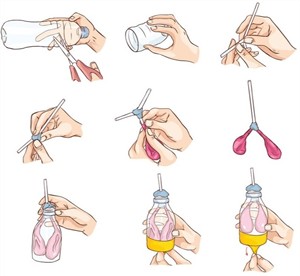
Construction of the lung model
Procedure:
-
Remove the bottom of the plastic bottle.
-
Attach two deflated balloons to the two open ends of the \(Y\)-shaped tube's fork. Fix the balloons tightly using rubber bands to make sure no air leaks.
-
Insert the single straight end of the \(Y\)-tube through the hole in the bottle lid.
-
Seal the lid tightly using clay, ensuring the tube is snug and airtight.
-
Cover the open end of the bottle with the thin rubber sheet and secure it with a large rubber band.
-
Hold the thin rubber sheet at the bottom and pull it downwards slowly, and observe the balloons.
-
Then release or push the thin rubber sheet at the bottom, up and observe balloons.
Observation and Explanation:
Observation 1: When the rubber sheet is pulled downwards, the balloons inside the bottle inflate.
Explanation 1: Pulling the rubber sheet increases the volume inside the bottle, creating a lower pressure (like air pressure inside lungs), so air rushes into the balloons through the tube, inflating them.
Observation 2: When the rubber sheet is released, it moves back up, and the balloons deflate.
Explanation 2: Releasing the rubber sheet decreases the volume, increasing pressure, forcing air out of the balloons, causing them to deflate.
Inference (Relating the model to human breathing):
The ribs move up and out during breathing in, expanding the chest cavity. The diaphragm, a dome-shaped muscle under the lungs, moves downward. These movements increase the chest cavity volume, lowering air pressure inside the lungs, so air flows in.
During breathing out, the ribs move down and in, and the diaphragm moves up, decreasing the chest cavity volume, pushing air out. Thus, breathing happens because of pressure changes created by the movements of the diaphragm and ribs, just like the rubber sheet in the model.
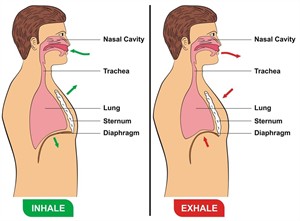
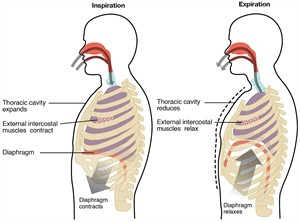
Inhalation and exhalation
Process of Breathing:
| Inhalation (Inspiration) | Exhalation (Expiration) |
| Process of taking air into the lungs | Process of expelling air from the lungs |
| Diaphragm contracts and moves downward, while the muscles of ribs contract and move the rib cage upward and outward | Diaphragm relaxes and moves upward, while the muscles of ribs relax and move the rib cage downward and inward |
| Volume of the chest cavity increases, creating space that draws air into the lungs | Volume of the chest cavity decreases, compressing the lungs |
| Primarily bring in oxygen-rich air | Primarily expels carbon dioxide-rich air |
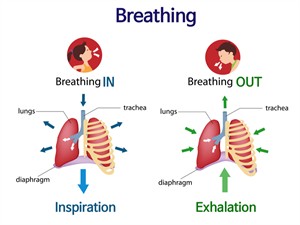
Inspiration and Expiration
Breathing exercises and their benefits:
Breathing is not only important but can also be controlled and trained for better health. Breathing exercises involve consciously controlling the rate and depth of breath, which can help improve lung function and overall well-being.
-
Pranayama (India): A set of controlled breathing techniques to improve lung capacity, relax the mind, and sharpen focus.
-
Tummo Breathing (Ladakh): Helps people keep warm in very cold environments by activating internal heat and improving lung function.
-
Many cultures combine slow, rhythmic breathing with meditation or chanting to reduce stress and enhance mental clarity.
Benefits of Breathing Exercises:
-
Strengthen our respiratory muscles
-
Increase lung capacity
-
Improve oxygen supply to our body
-
Help reduce stress, anxiety and promote relaxation
-
Enhance concentration and mental clarity
Composition of exhaled air:
What we breathe out: While we breathe in fresh air rich in oxygen, the air we breathe out contains carbon dioxide, which is a waste product from our bodies.
In order to prove that carbon dioxide is the gas that we breathe out, we can try this activity.
Activity: Using lime water to detect carbon dioxide
Materials required:
-
Two test tubes (or small clear containers)
-
Freshly prepared lime water (calcium hydroxide solution)
-
Straw
-
Pump or syringe
Procedure:
-
Fill both test tubes with equal amounts of lime water.
-
Label the test tubes.
-
In the first test tube (\(A\)), pass air from the outside environment by using a pump or syringe.
-
In the second test tube (\(B\)), blow air out from your mouth into the lime water repeatedly through a straw.
Observation:
The lime water in test tube \(B\) turns milky ( or cloudy ), but the lime water in test tube \(A\) does not and remains clear.
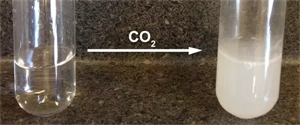
Lime water turns milky
Inference: Lime water reacts with carbon dioxide (CO₂) to form calcium carbonate, which causes the lime water to become cloudy or milky.
Result: The activity shows that exhaled air contains a significant amount of carbon dioxide, while inhaled air contains more oxygen and very little CO₂.
Percentage of oxygen and carbon dioxide in inhaled and exhaled air:
Gaseous exchange:
How does oxygen enter our blood and carbon dioxide leave?
The process of gaseous exchange is carried out by simple diffusion.
The movement of substances (gas, liquid or solid) from a region of higher concentration to a region of lower concentration is known as diffusion.
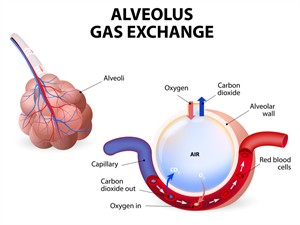
Alveolus gas exchange
Our lungs contain millions of tiny air sacs called alveoli. These alveoli have very thin walls and are surrounded by networks of capillaries (tiny blood vessels).
-
When we inhale, air rushes in through the respiratory tract and finally fills the alveoli.
-
Oxygen from this air passes through the thin alveolar walls into the blood in the blood capillaries.
-
At the same time, carbon dioxide from the cells all over the body is carried back by the blood and allows it to pass into the alveoli.
-
When we exhale, this carbon dioxide is pushed out of our lungs.
This exchange supplies oxygen to our body’s cells and removes carbon dioxide, keeping our blood clean and healthy.
The need for oxygen:
Breathing brings oxygen to our body cells, but why is this oxygen required for our bodies? What exactly is its role in helping us survive?
Respiration is a chemical process where our body breaks down glucose (sugar obtained from food) in the presence of oxygen to produce energy.
The chemical equation for cellular respiration (aerobic respiration) is:
The energy released is used to perform activities like walking, running, thinking, growing and all metabolic activities. Carbon dioxide and water are produced as waste products during this process and need to be removed by breathing out.
Anaerobic respiration in humans:
As we learnt earlier anaerobic respiration is where this process happens in the absence of oxygen. Anaerobic respiration also occurs in human muscle cells when oxygen levels are low. This happens during intense physical activities such as heavy exercise, prolonged fasting, cycling, or walking for extended periods, where the energy demand is very high. Under these conditions, glucose is broken down in the muscle cells to produce lactic acid.
Due to the accumulation of this lactic acid in the muscles, it results in muscle cramps. To relieve cramps, treatments like hot water baths or massages are effective as they improve blood circulation. Enhanced blood flow increases the oxygen supply to muscle cells, allowing them to return to aerobic respiration and reducing the buildup of lactic acid.
Breathing is a physical process of moving air in and out of the lungs. While Respiration is a chemical process that occurs inside cells, it releases energy from food. Both processes are important for maintaining life!
What happens after Nutrition and Respiration?
The human body possesses a specialised system responsible for transporting nutrients, oxygen, and various other materials. This is known as the circulatory system, which consists of the heart, blood, and blood vessels. The heart functions as a pump, circulating blood through the vessels to deliver essential substances throughout the body and remove waste products.
The danger of smoking:
Smoking hurts a person's lungs and body badly. It can cause serious illnesses like lung cancer and make it hard to breathe. Smoking also makes the smoker cough a lot and get infections often.
Even if a person who doesn’t smoke breathes in smoke from others (called passive smoking), it can harm the person, especially if that person is a child, pregnant, or elderly. To keep one's lungs and body healthy, it’s best to avoid smoking and stay away from cigarette smoke and places where people smoke.
It is also important to encourage others around you not to smoke. Practice healthy habits like regular exercise and breathing exercises, which also lead to a healthy, long life.