

Respiration in animals
What makes you feel alive? Pause for a moment, take a deep breath and try to answer the question. You just noticed air rushing into your body through your nostrils, didn't you? We are all alive because we breathe.
Living without food for a week is challenging; without water for a day or two, even more so, but surviving without breathing is impossible. Ever wondered why? The oxygen we breathe in plays a major role in helping us survive by producing energy from the nutrients gained through the process of nutrition.
Just like nutrition, respiration is yet another important life process that helps us stay alive; it includes breathing, the exchange of gases, and cellular respiration.
Respiration:
Respiration is a process through which all living organisms derive their energy from food. Breathing is part of the process of respiration. The air we breathe contains oxygen, and the air we breathe out contains carbon dioxide. The oxygen we breathe is transported to all the cells in the body.
The process in which the oxygen in the air helps to break down the food to release energy is known as cellular respiration.
The process of cellular respiration takes place in the mitochondria of the cells. Hence, they are known as the 'powerhouses of the cell'.
The process of respiration is of two types based on the presence or absence of oxygen.
They are
-
Aerobic respiration
-
Anaerobic respiration
Aerobic respiration:
The process of respiration in which the food (carbohydrates or glucose) we eat is broken down into carbon dioxide and water in the presence of oxygen is known as aerobic respiration.
\(Glucose\) \(Carbon dioxide\) + \(Water\) + \(Energy\)
In this mode of respiration, a high amount of energy is released in the living organisms. Human beings and most animals undergo aerobic respiration.
Anaerobic respiration:
The process of respiration that occurs in the absence of oxygen is known as anaerobic respiration.
During anaerobic respiration, the food (glucose) consumed by the anaerobes is broken down to alcohol and carbon dioxide, as represented below.
\(Glucose\) \(Alcohol\) + \(Carbon dioxide\) + \(Energy\)
The organisms in which this mode of respiration is observed are known as anaerobes. Yeasts are single-celled organisms that undergo anaerobic respiration and are hence known as anaerobes. As yeasts produce alcohol during their respiration, they are used in the manufacture of wine and beer.
The respiratory system is made up of several components. Within this system, gas exchange occurs along a defined route. The pathway through which air is breathed in and out passes through different parts of the respiratory system, facilitating the processes of breathing and respiration.
Human respiratory system:
The system involved in the exchange of respiratory gases and helps in breathing is known as the respiratory system. The human respiratory system consists of the nostrils, the nasal cavity, the pharynx, the larynx, the trachea, the bronchi, and the lungs.
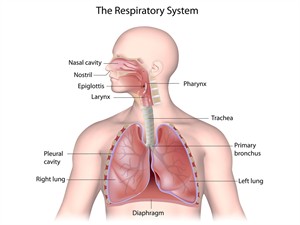
Human respiratory system
Organs of the respiratory system:
1. Nostrils:
These are the two openings found in the nose. Air is inhaled and exhaled through the nostrils. Inside the nostrils, there are tiny hairs that, along with mucus, help trap dust and dirt from the air we breathe. This is why breathing through the nose is preferable to breathing through the mouth.
2. Nasal cavities or passages:
These are channels behind the nose that get filled with air. In these cavities, the temperature and the humidity of the air we breathe in are regulated.
3. Larynx:
It is also known as the voice box, as it is the organ involved in the production of sound. It is the structure that connects the throat (pharynx) to the trachea.
4. Trachea:
It is also known as the windpipe, as it serves as the passage for air. The trachea is a tube that is supported by cartilaginous rings. It connects the pharynx and larynx to the lungs, moistens and warms the air before it passes into the lungs. It splits into two branches called bronchi, entering each lung.
5. Bronchi:
It is a structure that serves as the main passageway into the lungs. It divides further and further smaller as it moves into the lungs.
6. Lungs:
A pair of lungs surrounds the heart and is found in the chest cavity. These are the main organs of the respiratory system. The lungs are covered by a double-layered membrane known as the pleura and are also protected by the rib cage.
Inside the lungs, the left and the right bronchi divide further and end in small air sacs called alveoli. The diffusion of gases such as oxygen and carbon dioxide occurs across the alveolar membrane.
Sneeze: The air we inhale carries many unwanted particles like smoke, dust, and pollen. These particles often get caught in the hairs inside our nasal cavity as we breathe in. Occasionally, they irritate the nasal lining, causing us to sneeze. Therefore, sneezing serves as a way to expel these foreign particles from the nose. It is important to cover the nose while sneezing to prevent others from inhaling the expelled particles. While a lot of the dust is filtered out of the inhaled air, small infectious particles can often get through to the lungs. For example, during the COVID-19 pandemic, the SARS-CoV-2 virus affected the respiratory system, leading to breathing difficulties and often causing serious lung problems.