

Nutrition in other animals
As you have already studied in the previous class, unlike plants, animals cannot produce their own food. Animals always depend either directly or indirectly on plants for their food. Since animals cannot prepare their own food, animals are called Heterotrophs.
Since different animals eat different kinds of food, animals are classified into three types based on their food habits.
They are:
- Herbivorous animals
- Carnivorous animals
- Omnivorous animals
|
Category
|
Nutrition
|
Examples of animals
|
| Herbivorous | Eat plants and plant products, also called "plant-eaters" or "grass-eating animals" | Cow, buffalo, deer, goat, sheep, and elephant |
| Carnivorous | Eat the flesh of other animals, also called "meat-eaters" or "flesh-eating animals" | Lion, tiger, eagle, snake, cheetah, wolf, and fox |
| Omnivorous | Eat both plants and the flesh of other animals | Crow, sparrow, dog, mouse, pig, human being, rats and bear |
Herbivorous animals:
Animals that eat plants for nutrition are called herbivores or herbivorous animals.
Herbivores feed directly on plants. They have sharp, cutting incisor teeth in their jaws to cut the plant parts. To chew plant parts, they also have well-developed grinding teeth.
Example:
Cows, buffalo, deer, goat, sheep, and elephants are examples of herbivores.
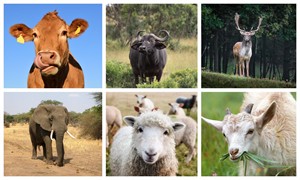
Herbivorous animals
Ruminants:
Ruminants are herbivorous animals that digest plant-based food by processing it in a series of chambers in their stomachs. They differ from non-ruminants because they have a unique four-chambered stomach. Ruminants include cattle, goats, sheep, giraffes, deer, camels, etc.
Digestion in ruminants:
The digestion in ruminant herbivores or grass-eating animals is different from the digestion in other animals like non-ruminants, carnivores and humans. They have a uniquely designed special stomach to digest the complex substance cellulose present in the grass.
Cellulose is a complex carbohydrate. It's the main structural component of plant cell walls and provides support and rigidity to plants. It is made up of many glucose molecules linked together. That makes cellulose a very hard substance to digest.
The stomach of ruminants is large and consists of four chambers or compartments. The four compartments are called the rumen, the reticulum, the omasum, and the abomasum.
The first compartment is the biggest and is called the rumen. The rumen is a large sac-like structure (muscle) present between the large intestine and the small intestine of a ruminant. When a cow or any ruminant eats grass as food, it does not chew it completely. It swallows as much grass as it can, quickly and stores it in the rumen. The rumen has microorganisms, particularly bacteria produce enzymes (cellulases) that break down cellulose into simpler sugars. After partial digestion, the partially digested food is called the cud.
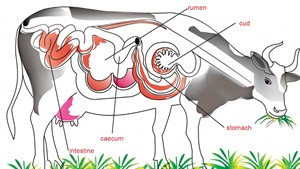
Cow's digestive system
The cud from the rumen is brought back to the cow's mouth in small lumps when the cow is resting and is chewed again thoroughly. That is why we can see a cow moving its jaw and chewing even when it is resting.
The process where the cud is brought back from the stomach to the animal's mouth and chewed again is called rumination. The animals that chew the cud are called ruminants. A cow spends about 8 hours a day just chewing its food.
Once the cud is thoroughly chewed in the mouth, it is swallowed again. The chewed cud now does not return to the rumen but instead moves to the other compartments of the stomach and then into the small intestine for digestion and absorption.
Digestion in birds:
We know that birds do not have teeth, they only have a beak and a tongue as their mouthparts. They swallow food whole. They have a pouch in the oesophagus that acts as a temporary storage area called the crop, which allows them to take large quantities of food.
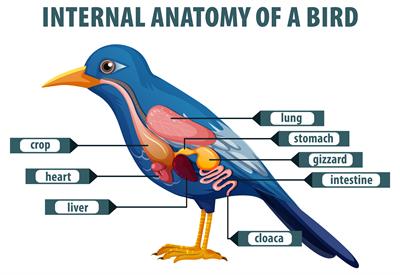
Internal anatomy of a bird
In the crop, the food is first stored and softened, then it moves to the first part of the stomach, where digestive juices are added. These secreted juices initiate the chemical digestion. And, the food moves to the gizzard for mechanical breakdown.
The gizzard, in birds, is the second part of the stomach. It is a highly muscular organ. Many birds swallow small stones or grit, which are stored in the gizzard and help grind food, especially seeds and grains, into smaller, digestible parts.
Here, in the gizzard chamber, the food is broken down by the contraction and relaxation of the walls of the gizzard, with the help of grit (small stones) that the birds swallow along with their food. Finally, the undigested food material passes through the intestines, where nutrients are absorbed, and then it exits the body through the cloaca (like the anus in other organisms).