

Life processes in plants
Imagine you have a small plant at home—maybe a money plant or a sunflower seed you planted in a pot. Every day, you water it and keep it near a window where it gets sunlight. Over days and weeks, you start noticing something amazing: the tiny seedling grows taller, new leaves begin to appear, and the stem becomes strong and thick.
Just as humans and animals are living organisms, plants are also considered living organisms. Which means, they also perform all life processes necessary to keep them alive and active.
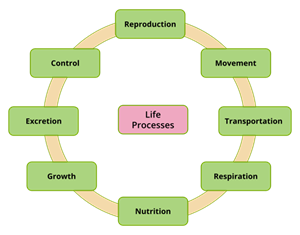
Life processes
Growth in plants:
It is the characteristic feature of all living organisms to become bigger, taller and heavier in size over a period of time. And plants, unlike animals, can grow throughout their lifetime.
Growth can be defined as the continuous, irreversible increase in the organism's body size (of a part or even of a single cell) and mass with time.
Plants, like all living things, go through a life cycle and exhibit significant growth. As a plant grows, you see new leaves unfolding and new branches extending from the main stem. The plant's height increases, making it taller. The main stem and older branches become thicker and stronger. Many plants also develop flowers and produce fruits or seeds as they mature.
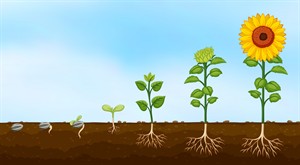
Stages of plant growth
These changes are caused by both external and internal factors, and by the plant constantly creating new cells, which require many essential components.
|
Factors (required for growth)
|
Function (role in growth)
|
|
Water
|
Provides Hydration & Transport: Carries minerals and nutrients; essential for chemical reactions.
|
|
Sunlight
|
Provides Energy: Helps plants make their own food.
|
|
Soil
|
Provides minerals: Building blocks for new cells, leaves, and stems.
|
|
Air
|
Provides carbon dioxide and oxygen:
Carbon dioxide for food-making; oxygen for energy use.
|
Water:
-
Water is essential for plant growth from its seed stage, and it is a key ingredient in making food.
-
Water dissolves the nutrients in the soil and helps transport nutrients and food all across the parts of the plant.
Sunlight:
-
Plants use the energy from sunlight to make their own food in a process called photosynthesis. This food (glucose, a type of sugar) provides the energy needed for the plant to grow taller, wider, and produce new leaves.
-
Sunlight also helps the plant know which way to grow; it causes the stem to grow upwards towards the light.
Nutrients (minerals):
-
While plants make their own food (sugar) using sunlight, they need substances like Nitrogen, Phosphorus, Potassium, etc., that they absorb from the soil through their roots.
-
These nutrients act like building blocks that plants use to create new cells, leaves, and stems, allowing them to grow bigger and stronger.
Air:
-
Carbon Dioxide: Plants take Carbon Dioxide from the air to perform photosynthesis (food-making).
-
Oxygen: They also need Oxygen from the air (absorbed through the roots and leaves) for respiration, which is the process of using the food they made to get energy for growth.
Experiment to test essential components for growth:
Instruction:
- Take three earthen pots (or used bottles/containers) of the same size filled with garden soil. Plant saplings of similar sizes of a fast-growing plant like mustard, chilli or tomato in each pot. Label the pots A, B, and C.
- Count the number of leaves on each sapling and record your observations.
- Place pot A in direct sunlight. Keep the soil in this pot slightly moist by watering it every day.
- Place pot B in direct sunlight, without watering.
- Place pot C in the dark. Keep the soil in this pot slightly moist by watering it every day.
- Observe the plants for two weeks and record changes in their height, number of leaves, colour of leaves, and any other changes that may appear.
- Record any changes observed in the following parameters: Height of the plant (in cm), Number of leaves, Colour of the leaves (e.g., green, pale, yellow, brown), any other notable changes (e.g., wilting, stem thickness, flowering).
Observation:
| Pots kept under different conditions | Availability of sunlight and water | Height of plant (cm) | Number of leaves | Colour of leaves |
| Pot A: In direct sunlight, with water |
Sunlight: Yes
Water: Yes
|
Day 1: 10 cm
End of week 2: 35 cm
|
Day 1: 5
End of week 2: 10
|
Lush Green |
| Pot B: In direct sunlight, without water |
Sunlight: Yes
Water: No
|
Day 1: 10 cm
End of week 2: 11 cm
|
Day 1: 5
End of week 2: 4
|
Yellow and Wilting |
| Pot C: In the dark, with water |
Sunlight: No
Water: Yes
|
Day 1: 10 cm
End of week 2: 13 cm
|
Day 1: 5
End of week 2: 5
|
Pale yellow |
(Note: The numbers are examples to show the expected result)
Result:
-
Pot A (Normal conditions): Shows the most growth (increase in height and new leaves) and will be green in colour because it has both sunlight (for making food) and water (for transport and structure).
-
Pot B (Lacks water): The plant may survive but will show very little or no growth. It will start to wilt (droop), and the leaves will turn yellow or brown because it cannot transport nutrients or maintain its structure without water, even though it has sunlight.
-
Pot C (Lacks sunlight): The plant will barely grow, its leaves will become pale yellow, and eventually die.
Inference:
This experiment demonstrates that both sunlight and water are necessary for a plant's healthy growth and survival. Removing either one severely limits or stops the plant's ability to grow.
“Trees do not produce fruits and flowers merely because they are planted.”
- Vrikshayurveda
Ancient Indian text Vrikshayurveda shows records about plant growth, soil, and agricultural practices, documented many years before modern science. It contains valuable observations about plant growth, soil management, and farming techniques. And reflects practical knowledge gained through experience and careful observation, systematically documented to guide farmers in improving crop health, growth, and yield. For example, it includes detailed methods for preparing organic manure, showing an early understanding of sustainable agriculture.