

All living things grow, and to grow, they need food. In the last chapter, we learned how animals get their food and nutrition. Animals eat to get energy and grow bigger. But have you ever seen plants that are also considered living, eating food like animals? Of course not!
Most plants make their own food with the help of sunlight a few rely on other organisms.
Nutrition is defined as the process by which living organisms take in food and utilise it to obtain energy for growth, repair of damaged tissues, and carrying out life processes.
Types of nutrition in plants:
Autotrophic nutrition:
Plants that have the green pigment chlorophyll can perform photosynthesis and prepare their own food; this mode of nutrition is called Autotrophic nutrition. This is the most common mode of nutrition in plants.
Heterotrophic nutrition:
Certain plants in nature do not have chlorophyll and hence cannot produce their food. These plants depend on external sources to derive nourishment for their survival, which is called heterotrophic nutrition. In heterotrophic nutrition, organisms directly or indirectly depend on autotrophs for food.
There are three types of heterotrophic nutrition in plants:
-
Parasitic nutrition
-
Saprophytic nutrition
-
Insectivorous nutrition
Parasitic nutrition:
In this mode of nutrition, the organism takes food from another living organism and sometimes may even kill the organism on which they lives (host organism). They can either live inside or outside the body of another organism. Such organisms are called parasites.
Parasitic plants: A parasitic plant is a plant that derives some or all of its nutrition from another living plant.
Cuscuta (commonly known as dodder or amarbel) is a yellow parasitic plant that twists and creeps around the stems and branches of a tree or a plant. It does not have chlorophyll and hence cannot make its own food. It climbs on its other host plant and absorbs the available food.
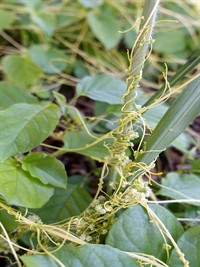
Cuscuta plant
Saprophytic nutrition:
Some organisms, like fungi, feed on dead and decomposing matter from dead organisms, and these organisms are known as saprophytes.
They produce spores that can be present in the air unnoticed until conditions are unfavourable (dry). Once they find a damp and moist environment, they fall on the dead and decaying matter and germinate. Then they grow cotton candy-like patches on the food, pickles, leather, wooden items, and even clothes (anything containing moisture) during the humid and rainy season.
Example: Yeast and mushrooms
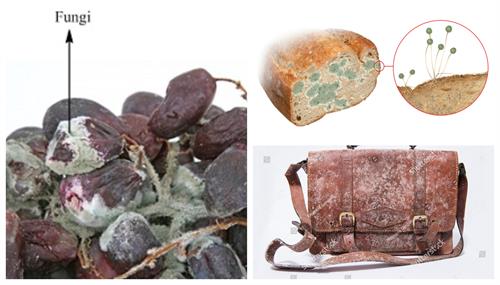
Fungal growth on several materials
Important!
Note: Yeast and mushrooms are fungi; fungi are neither plants nor animals.
Insectivorous plants:
A rare type of plant feeds on insects and is considered carnivorous, and is called an insectivorous plant.
But these plants also have chlorophyll and can synthesise their food by photosynthesis (partial heterotrophs), but they feed on insects for their need of nitrogen, as they cannot get nitrogen from the soil. These plants have special structures that attract insects and trap them. They secrete digestive juices that digest the trapped insects.
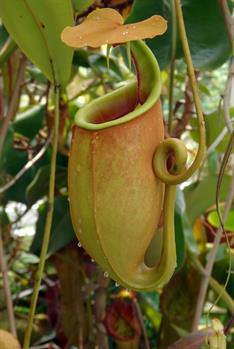
Leaves of a pitcher plant
Autotrophic nutrition:
Most plants are autotrophs and appear green because of the presence of a green pigment called chlorophyll, which helps in capturing sunlight efficiently. The broad and flat leaves of plants are called the ̒ food factories’ or the kitchen of the plant, as they are the main site of photosynthesis. Through photosynthesis, they prepare food, glucose, and then plants store that formed food in the form of starch (a type of carbohydrate).
Role of chlorophyll in the preparation of food:
Activity: To test for the presence of starch in a leaf
Steps:
-
Place a leaf in boiling water for about five minutes to make it soft.
-
Transfer the boiled leaf into a test tube containing alcohol.
-
Keep this test tube inside a beaker of hot water.
-
Allow the leaf to lose its green colour (Removing chlorophyll helps to notice the colour change easily when testing for starch).
-
Take out the leaf carefully and spread it on a plate.
-
Add a few drops of dilute iodine solution onto the decolourised leaf using a dropper. Wait a short while and observe any change.
Observation and result: If the leaf turns blue‑black, starch is present. If it remains colourless, then it shows the absence of starch.
Conclusion: The chlorophyll pigment in the plants helps capture sunlight, and with the help of carbon dioxide and water, plants prepare glucose, which can be turned into starch as their stored food. Without chlorophyll, plants won't be able to form starch.
Caution: Never heat alcohol directly over a flame, as it is highly flammable and may cause fire or injury.
Role of sunlight in the production of starch:
Activity: To show that sunlight is needed for making starch in leaves
Steps:
-
Take two potted plants with both having leaves that are green with non-green patches (variegated leaves). Keep one plant in sunlight and another in the dark for \(36\) hours.
-
Pick one leaf from each plant. Choose a leaf with green and non-green parts.
-
Trace and mark the green and non-green areas on paper.
-
Immerse the leaf in boiling water and then in alcohol (chlorophyll content gets removed), and test for starch using iodine solution.
-
Wait and note any colour change. And now compare the leaf with the drawing made. Observe which parts turn blue-black (showing starch) and record your results.
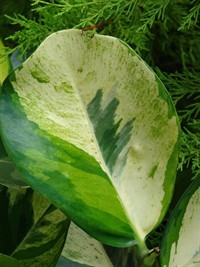
Variegated leaf
Observation:
The leaf from the plant kept in darkness did not show a blue-black colour, even on the green parts, showing that no starch was produced without sunlight. The non-green parts of the leaf kept in sunlight also did not turn blue-black. This means those parts do not have enough chlorophyll to make starch.
Conclusion:
Sunlight is necessary for the formation of starch in green leaves.
Starch is produced only in parts of the leaf that contain chlorophyll and are exposed to sunlight. Therefore, chlorophyll and sunlight are both essential for photosynthesis (the process that produces food/starch in plants).
Do other coloured leaves contain chlorophyll?
Some leaves appear red, violet, or brown because they have other coloured pigments that hide the green colour of chlorophyll; the green colour is just masked by other pigments such as anthocyanins (red/violet) or carotenoids (yellow/orange). In such cases, these leaves can still perform photosynthesis as they have chlorophyll and will test positive for starch if exposed to light.
Reference:
https://pixabay.com/photos/pitcher-plant-nepenthes-bicalcarata-3362417/