

All living beings, including plants, respire to obtain energy. Plants respire continuously, both day and night, by breaking down glucose with oxygen to release carbon dioxide, water, and energy in the form of ATP, just like humans. This cellular respiration powers growth, repair, and other life processes in every plant part, green or non-green.
Respiration:
Respiration is a process through which all living organisms, including plants, derive their energy from food, the food that they obtain from nutrition. Plants undergo aerobic respiration.
The process in which the oxygen in the air helps to break down the food to release energy is known as cellular respiration.
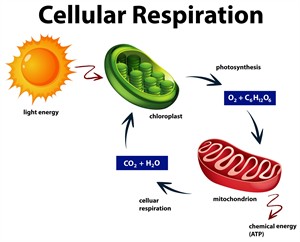
Cellular respiration
Aerobic respiration:
The process of respiration in which the food (carbohydrates or glucose) that plants prepare during photosynthesis is broken down into carbon dioxide, water and energy in the presence of oxygen is known as aerobic respiration.
In order to prove this, let us do an experiment.
Activity: To observe respiration in plants
Materials needed:
-
\(40g\) moong beans (for soaking)
-
Conical flask (500mL), two-holed cork, two glass tubes, rubber tubing
-
Cotton wool, lime water (Ca(OH)₂ solution), two test tubes with corks (one-holed)
-
Distilled water, marker, ruler, stopwatch
Procedure:
-
Prepare seeds: Weigh some (40g) moong beans, soak in water overnight (12-24 hours) to germinate and boost respiration. Drain excess water.
-
Set up flask: Moisten the cotton layer in the flask base, and add the soaked seeds on top. Fit a two-holed cork; insert tube A (to lime water) and tube B (open to air).
-
Prepare test tubes: Fill two test tubes with lime water. Cork one with a hole for tube A connection via rubber tubing; leave the second open as a control.
-
Assemble and incubate: Connect systems airtight, place in dark (to remove confusion with Photosynthesis) at room temperature for 24-48 hours undisturbed.
-
Observe: Check the tubes and note the colour change.
Results:
The experimental setup shows that the lime water turns milky due to \(CO₂\) released by the process of respiration from the germinated seeds, reacting with the lime water. Controls stay clear; this confirms respiration.
Structures for the exchange of gases:
Plants respire just like humans in terms of the gases, they take in Oxygen and give out Carbon dioxide, both during day and night.
Important!
Don't confuse photosynthesis with respiration. Photosynthesis is a life process of nutrition that takes in carbon dioxide and releases oxygen, while respiration is another life process that takes place simultaneously and takes in oxygen and gives out carbon dioxide. Respiration in plants happens both during the day and night.
So even for plants, respiration is an important process as it provides energy and supports plant metabolism. Plants respire independently in their different parts, like leaves, stems, and roots. Animals have a centralised and faster way of doing this since they have a dedicated organ, like lungs. Unlike animals, plants respire slowly across all tissues, balancing energy needs with glucose produced by photosynthesis. So if they don't have nostrils and lungs, how are they exchanging gases?
-
Stomata in leaves: Tiny pores on the surface of the leaves open for \(O₂\) intake and \(CO₂\) release, in addition to their help in photosynthesis, transpiration.
-
Lenticels in woody stems: Lens-shaped openings of loose dead cells allow gas diffusion; these are usually fewer than stomata, and they enable lenticular transpiration too.
-
Root hairs in roots: Absorb \(O₂\) from air spaces between soil particles, fueling underground respiration, which is also important for nutrient uptake.
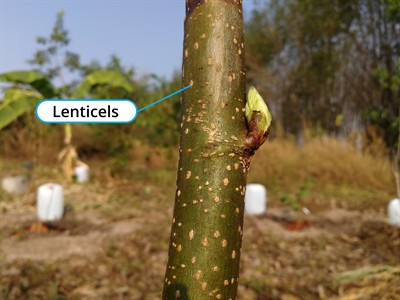
Lenticels

Root hairs
All parts respire at varying rates, roots often high due to growth demands, using these for efficient, decentralised gas exchange. Plants lack specialised breathing organs, relying on diffusion through surfaces for slower respiration rates. Energy from respiration drives transport and synthesis, essential for survival.