

Now we know that leaves are the kitchen of a plant, where food is prepared through the process of photosynthesis. Plants obtain water from the soil through their roots, but how do both the food and water get transported to all the different parts of the plant?
Plants possess a vascular system (vascular means vessels) comprising xylem and phloem for transporting essential substances. Xylem carries water and minerals from roots to leaves and other parts upwards, while phloem distributes food produced in leaves to the entire plant. This system ensures plants grow, photosynthesise, and store nutrients effectively.
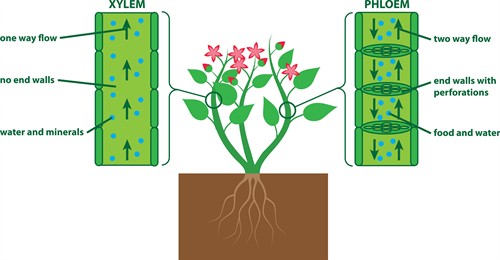
Xylem and Phloem
Importance of water and minerals:
All living organisms require water for growth, and plants specifically use it in photosynthesis to produce food. Roots absorb water and dissolved minerals from the soil, which serve as vital nutrients for healthy development. These substances must reach stems, leaves, branches, and flowers to support various plant functions.
The need for water and minerals for plants
Activity: Experiment to observe water transport
Materials needed:
-
Two glass tumblers (label \(A\) and \(B\))
-
Water
-
Red ink
-
Twigs from two similar tender plants with white flowers (e.g., white sadabahar or balsam)
Procedure:
-
Fill each tumbler one-third with water; add a few drops of red ink to tumbler \(B\).
-
Cut the stems of the plant of choice slantwise at the base while keeping the plants in water, then place one in each tumbler.
-
Observe the next day: red colour appears in the stem, leaves, and flowers of the plant in tumbler \(B\), but not in \(A\).
-
Cut the upper stem (not in water) and examine under a magnifying glass to see red in thin tubes.
Observation and conclusion:
Red ink moves upward through xylem, thin tube-like structures in stems, branches, and leaves, mimicking the transport of water and minerals.
Transport of water - Role of xylem:
Xylem is the vascular tissue responsible for the transport of water and dissolved minerals from roots to leaves and other parts, unidirectionally, in the upward direction. This is a one-way flow, and the water transported this way supports photosynthesis, maintains turgidity (swollen or firm, when a plant cell is full of water and under pressure), and enables transpiration (the loss of excess water as vapour from the plants to maintain water balance). Minerals that are taken up along with water provide essential nutrients for growth and metabolism.
In a labelled diagram of a plant stem or root cross-section, the xylem is usually located towards the inner side. Its vessel elements are long, hollow tubes with thick, lignified walls that provide support and allow efficient water movement. You may see star-shaped or circular patterns depending on the plant type. Thin strands of xylem extend through the stem, branches, and leaves, connecting the entire plant’s water transport system.
Transport of food - Role of phloem:
Phloem is the vascular tissue that is responsible for the food, mainly sugars, manufactured in leaves through photosynthesis, another set of vessels or tube-like structures. Phloem carries this soluble food to roots, seeds, fruits, and growing regions, and this transport happens in both upward and downward directions. So, transport through phloem is considered two-way or bidirectional transport. Excess food gets stored in roots, seeds, or fruits for later use in the form of starch, a plant’s reserve food material.
In a stem or root cross-section diagram, phloem is located outside the xylem, towards the outer side. Phloem cells (a component of phloem) form sieve tubes, which are elongated cells with pores in the end walls to allow food flow. Companion cells (a component of phloem) assist in the transport process. The phloem works bidirectionally to move food to growing regions and storage organs such as roots and seeds.
Both tissues are shown together in typical diagrams, with xylem inside and phloem outside, clearly labelled to illustrate their distinct roles in plant transportation.
Key differences: Xylem vs Phloem
|
Feature
|
Xylem
|
Phloem
|
|
Direction
|
Upwards only
|
Upwards and downwards
|
|
Transport
|
Water and minerals
|
Food (glucose)
|
|
Location
|
Stems, roots, leaves
|
Stems, roots, leaves
|
Transpiration:
Transpiration (plant's version of sweating) is the process by which plants lose excess water as water vapour (a gas) into the air through tiny openings called stomata (singular: stoma) on the surface of the leaves (especially on the underside of the leaves).
Importance of Transpiration:
Transpiration helps the plant in very important ways:
Water balance: It helps the plant to get rid of excess water and maintain a water balance.
Water balance: It helps the plant to get rid of excess water and maintain a water balance.
Water Movement (Suction pull): As water evaporates from the leaves, it creates a suction pull (like drinking through a straw). This pull helps the plant absorb new water from the roots and draws the water upward all the way to the leaves through the xylem.
Temperature regulation: When water evaporates from the leaves, it uses up some of the heat from the plant. This helps to cool the plant down, especially on a hot, sunny day.
Temperature regulation: When water evaporates from the leaves, it uses up some of the heat from the plant. This helps to cool the plant down, especially on a hot, sunny day.