

Science is not just a subject found in textbooks; it is a way of understanding the world around us. From the motion of vehicles to the blowing of winds and the formation of storms, science helps us explain everyday phenomena through simple principles like force, pressure, and the nature of matter.
What is Force?
Force is a push or pull that can change the state of motion of an object. It can make an object start moving, stop moving, change direction, or even change its shape.

Forces: push and pull, change direction of the ball(object), magnetic force and gravitational force (clockwise)
Effects of Force on Motion
1. Change in Speed: A force can make an object move faster or slower.
2. Change in Direction: A moving object can change its path when a force is applied.
3. Start or Stop Motion: Force can set a stationary object into motion or bring a moving object to rest.
4. Change in Shape: Some forces can deform objects (like stretching a rubber band).
Understanding forces helps explain why a ball thrown upward comes back to the ground or why a car slows down when brakes are applied.
While force explains motion, it also leads us to another important concept called pressure.
What is Pressure?
Pressure is the amount of force applied on a unit area of a surface. It tells us how force is distributed over an object.
Pressure is the amount of force applied on a unit area of a surface. It tells us how force is distributed over an object.
SI unit of pressure is Newton per square metre \((N/m²)\), also called \(pascal (Pa)\).
Pressure helps us understand how force is applied over a surface. When the same force is applied over a smaller area, the pressure increases, and when it is spread over a larger area, the pressure decreases.
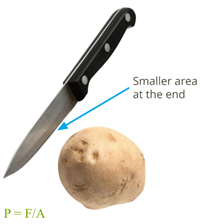
Sharp knife
For instance, a sharp knife cuts better than a blunt one because the force is concentrated over a very small area, creating high pressure. In this way, pressure is simply the distribution of force over an area, linking it directly to the concept of force.
Force, Pressure, and Natural Phenomena
The concepts of force and pressure are not limited to objects; they also explain natural events around us.
The concepts of force and pressure are not limited to objects; they also explain natural events around us.
1. Movement of Air (Winds)
- Air moves from regions of high pressure to low pressure.
- Small pressure differences cause gentle breezes.
- Large pressure differences result in strong winds.
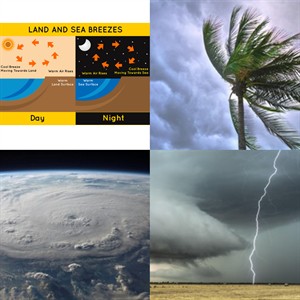
Land and sea breeze, high-speed wind, causes climate and weather changes, such as thunder and cyclones (clockwise).
2. Formation of Cyclones
- Cyclones are formed due to large differences in air pressure.
- Warm air rises, creating a low-pressure region.
- Surrounding high-pressure air rushes in, causing strong winds.
- These winds spiral, forming powerful storms that can impact human life and agriculture.
Thus, the concepts of force and pressure are directly connected to weather phenomena that affect our daily lives.
To understand how air creates pressure or why substances behave differently, we need to look deeper into what matter is made of.
Matter
Everything around us is made up of matter. Matter is composed of tiny particles that are too small to be seen with the naked eye.
Nature of Particles in Matter
Nature of Particles in Matter
1. Particles are very small: Matter is made of tiny units called particles.
2. Particles have space between them: This space varies in different states.
3. Particles are in constant motion: They move more freely in gases than in solids.
4. Particles attract each other: The force of attraction is strongest in solids and weakest in gases.
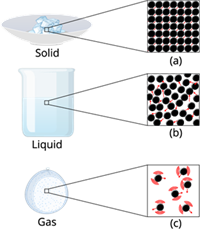
Solid, liquid, and gaseous states of matter
States of Matter
Solids: Particles are tightly packed and cannot move freely.
Liquids: Particles can move but remain close together.
Gases: Particles move freely and are far apart.
Liquids: Particles can move but remain close together.
Gases: Particles move freely and are far apart.
Classification of Matter
Understanding particles also helps us classify matter based on its composition. Matter can be grouped into elements, compounds, and mixtures.
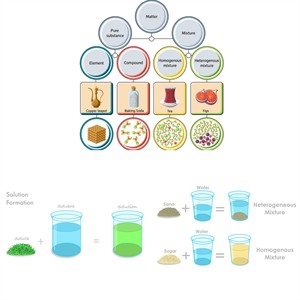
Matter classification, solution and mixture types (counter-clockwise)
- Elements are pure substances made of only one type of atom and cannot be broken down further by chemical means.
- Compounds are formed when two or more elements chemically combine in fixed proportions, resulting in new substances with different properties.
- Mixtures, on the other hand, are combinations of substances that are not chemically bonded and can be separated by physical methods.
This classification helps us understand how different materials behave and interact with each other in everyday life.
Solutions and Everyday Connections
When we understand mixtures, we can further explore solutions. A solution is formed when one substance dissolves in another, such as sugar in tea. The particles of sugar spread evenly among the particles of water due to their constant motion, making the solution uniform.
Important!
Force leads to the understanding of pressure, pressure explains natural phenomena like winds and cyclones, and these phenomena can only be fully understood by studying the particle nature of matter. All these concepts are deeply interconnected and help us explain the world scientifically. By linking these ideas step by step, we learn to observe, question, and understand the natural world in a logical and connected way, just like scientists do.