

Science is more than rote memorization, it is a way of understanding the world around us. From the reflection of light in mirrors to the bending of light in lenses and even the phases of the Moon in the night sky, science helps us explain everyday phenomena through simple but powerful principles like light behavior, celestial motion, and scientific observation.
What is Light?
Light is a form of energy that helps us see objects. It travels in straight lines and interacts with objects in different ways such as reflection and refraction. These interactions explain many natural and man-made phenomena around us.
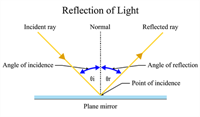
Reflection of light
Reflection of Light:
Reflection is the bouncing back of light when it strikes a surface. It occurs on smooth as well as rough surfaces.
- Smooth surfaces like mirrors give clear images.
- Rough surfaces also reflect light but scatter it in different directions.
- Even the Moon reflects sunlight and appears bright at night.
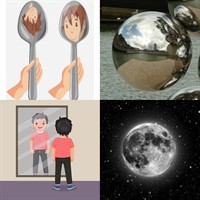
Reflection in a spoon, sphere, moon, and mirror (clockwise)
Applications of Reflection:
- Mirrors help us see our image.
- Rear-view mirrors in vehicles help drivers see behind.
- Reflection from surfaces like spoons shows curved images.
Thus, reflection helps us understand how light returns after striking a surface and how images are formed.
Refraction of Light:
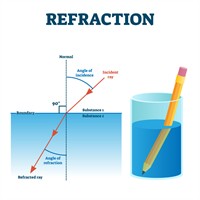
Refraction
Refraction is the bending of light when it passes from one medium to another.
- Light bends due to change in speed.
- It explains how lenses focus light.
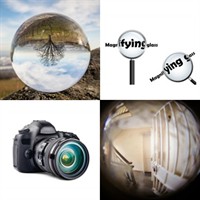
Rain water, Magnifying glass, Door peepholes and Camera (clockwise)
Applications of Refraction:
- Spectacles correct vision problems.
- Magnifying glasses enlarge objects.
- Cameras use lenses to form clear images.
In this way, refraction helps us understand how light changes direction and how optical devices work.
Phases of the Moon:
The Moon does not produce its own light; it reflects sunlight. As the Moon revolves around the Earth, different portions of its surface are illuminated, leading to the phases of the Moon.
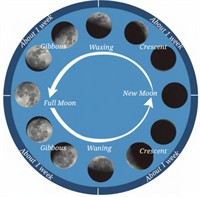
Waxing and waning period of the Moon
- New Moon: Moon is not visible.
- Crescent: Small portion is visible.
- Half Moon: Half of the Moon is visible.
- Full Moon: Entire face is visible.
These phases repeat in a regular cycle and help us understand time patterns in nature.
Phases of the Moon and Calendars:
The regular cycle of Moon phases has helped humans develop early lunar calendars. By observing the Moon along with sunrise and sunset patterns, ancient civilizations were able to measure time and organize days, months, and festivals.
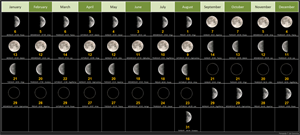
Lunar calendar
Thus, the Moon plays an important role in timekeeping systems on Earth. Earth supports life because it has the right conditions liquid water, a protective atmosphere, and suitable distance from the Sun but human activities can disturb this balance and affect climate.
Scientific Investigation in Everyday Life:
Scientific investigation is not limited to laboratories; it can be done using simple observations from a student’s daily life. It involves asking questions, testing ideas, changing one factor at a time, and recording results carefully.
- Seed germination: Seeds sprout differently depending on water, light, and soil conditions.
- Plant growth: Plants bend towards light due to phototropism.
- Sugar dissolving: Sugar dissolves faster in hot water than cold.
- Floating objects: Objects float or sink based on their density.
- Evaporation: Water evaporates faster in sunlight due to heat.
- Sound vibration: Tighter rubber bands produce higher-pitched sounds.
- Ice melting: Ice melts faster in higher temperatures and on metal surfaces.
- Shadow formation: Shadow size changes with the position of the light source.
- Bulb brightness: Increasing batteries increases bulb brightness.
Science around us