

Human beings are naturally curious and constantly explore the world around them. In the previous chapter on exploring the investigative world of science, we learned that scientific investigation helps us observe, question, and discover new things.
In this chapter, we take that journey further. We explore a world that cannot be seen with our naked eyes, but exists all around us!
Discovering the Invisible World of Life:
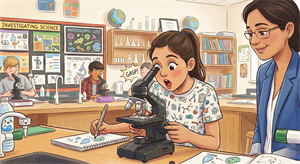
Humans and discovery
For a long time, humans could only observe objects that were large enough to be seen with the naked eye. The human eye has a limit; it cannot detect extremely small objects. Because of this limitation, countless tiny living organisms remained hidden and unknown. Even though they existed everywhere in water, air, and soil, people could not see them.
Smallest visible and invisible life:
- Some organisms, like ants, are barely visible to the naked eye.
- Many organisms, such as bacteria and protozoa, are completely invisible without the aid of tools.
- This shows that life exists beyond the limits of human vision.
Discovery of Lenses and Magnification:
Activity:
Fill a round-bottom glass flask with water and close it with a cork, then place it over the page of a book and look through it like a mini magnifying glass; watch how the letters magically appear bigger and clearer as we explore this simple science trick!
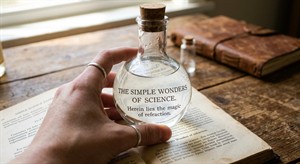
Round-bottom flask
Humans discovered that a curved piece of glass could make objects appear bigger. This curved glass, called a lens, is thick in the middle and thin at the edges.
How lenses help:
How lenses help:
- Lenses enlarge small objects and make them clearer.
- A water-filled flask can act like a magnifying lens.
- Magnifying glasses and reading glasses improve the visibility of small details.
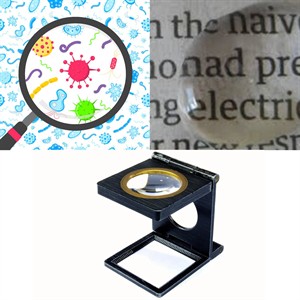
Magnifying glasses, water-droplet, and single lens microscope.
Development of tools:
- Simple lenses led to the invention of magnifying glasses.
- Improved lenses led to powerful instruments called microscopes.
Microscopes: Opening the Invisible World:
Microscopes allow scientists to observe objects too small to be seen with the naked eye.
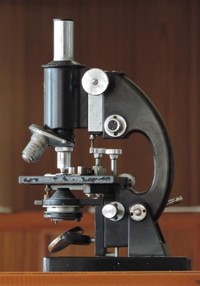
Compound microscope
Importance of microscopes:
- Help in observing microorganisms and cells.
- Reveal structures that are otherwise invisible.
- Open a new world of scientific discovery.
For very detailed observation, an electron microscope is used. It offers extremely high magnification up to \(10,00,000\ times\). This allows scientists to see subcellular components clearly. Thus, different microscopes serve different scientific purposes. The invention of the microscope marked a major turning point in understanding life on Earth.
Scientific Contributions:
Robert Hooke:
Robert Hooke played a crucial role in opening the microscopic world to science through careful observation and documentation.
- He observed a thin slice of cork under a microscope and identified small box-like compartments, which he named cells.
- He published Micrographia in \(1665\), where he presented detailed drawings of microscopic observations.
- He used an early compound microscope to magnify objects (\(200–300\ times\)) and helped establish the importance of microscopic study in biology.
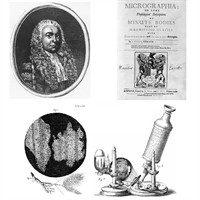
Robert Hooke and his experimental setup
Significance:
- Introduced the concept of cells as the basic unit of life.
- Demonstrated the importance of microscopic observation in science.
- Inspired future scientists to explore deeper into the structure of living organisms.
Antonie van Leeuwenhoek:
Antonie van Leeuwenhoek made groundbreaking discoveries by observing living microorganisms for the first time.
- He built powerful single-lens microscopes and was the first to observe living microorganisms, which he called animalcules.
- He discovered and described bacteria, protozoa, and blood cells through careful observation of natural samples.
- He documented his findings and shared them with the scientific community, establishing the foundation of microbiology.
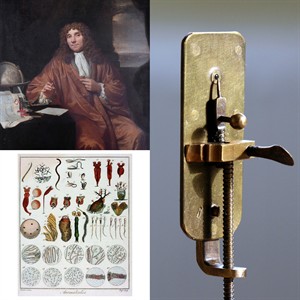
Antonie van Leeuwenhoek
Significance:
- Known as the Father of Microbiology.
- First to prove the existence of microscopic living organisms.
- Opened a completely new field of study called microbiology.
- Helped scientists understand that life exists beyond what the naked eye can see.
Important!
Their discoveries proved that even the smallest forms of life play an important role in the living world.
Diversity of Living Organisms:
All living beings are called organisms. Organisms vary greatly in size, shape, and structure.
Variation among organisms:
- Some organisms are large and visible, like trees and animals.
- Some are extremely small and require microscopes to be seen.
- Organisms differ in structure but share characteristics of life.
Range of life forms:
- From microscopic bacteria to large animals like elephants.
- From simple structures to complex organisms.
Thus, the journey that began with simple curiosity led to a profound understanding. By using tools like lenses and microscopes, humans expanded their vision beyond natural limits and uncovered a hidden world teeming with life.