

In the previous session, we discovered that an invisible world of life exists all around us, even though we cannot see it with our naked eyes. To understand this hidden world better, we must now explore what all living things are made of.
All living organisms, whether tiny microorganisms or large plants and animals, are made up of cells, which form the basic unit of life.
All living organisms, whether tiny microorganisms or large plants and animals, are made up of cells, which form the basic unit of life.
What is a Cell?
All living things consist of small units called cells; cells are the smallest structural and functional unit of an organism.
- Every living organism is made up of one or more cells. Cells may differ in shape and size, but they perform similar essential activities required for survival.
- Cells can only be observed clearly using a microscope, which helps us explore structures that are invisible to the naked eye.
Activity:
Aim: To observe the structure of plant cells by preparing a temporary mount of onion peel under a microscope.
Materials required: Onion bulb, forceps, safranin stain, glycerin, glass slide, coverslip, microscope.
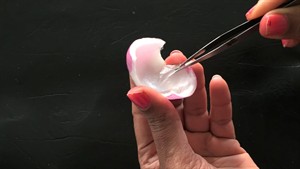
Peeling onion skin
Procedure: A thin onion peel is removed, stained with safranin, washed, mounted on a slide with glycerin, covered with a coverslip, and observed under a microscope.
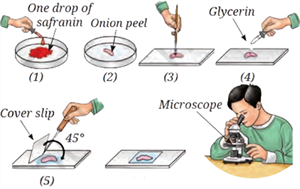
Procedure for the onion peel experiment
Observation: Rectangular, closely packed structures are seen clearly under the microscope.
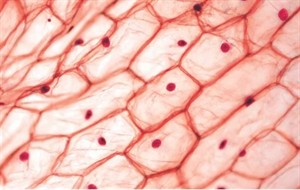
Onion peel skin under the microscope
Conclusion: These structures are onion cells, indicating that plant bodies are composed of many cells, and a microscope is needed to observe them.
Similarly, done for animal cells.
Activity:
Aim: To observe animal cells by preparing a temporary mount of human cheek cells.
The following supplies are needed: a coverslip, glycerin, a methylene blue stain, a glass slide, a clean toothpick, and a microscope.

Scraping of Cheek cells
Method: Cheek cells are carefully scraped, put on a water-filled slide, stained with methylene blue, mounted with glycerin, covered with a coverslip, and examined under a microscope.
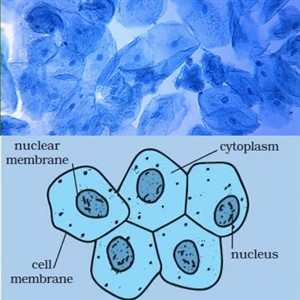
Microscopic and marked human cheek cells
Observation: A microscope reveals polygon-shaped cells with a clear nucleus.
In conclusion, these cheek cells show that cells compose animal bodies.
Cell Organelles and Their Functions:
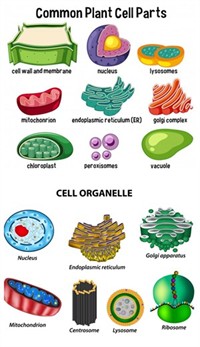
Plant and animal cell organelles
| Cell Organelles | Function |
|---|---|
| Cell membrane | Encloses the cell, separates it from other cells, and controls the entry and exit of substances. |
| Cytoplasm | Contains cell components and is the site where most life processes occur. |
| Nucleus | Controls all cell activities and regulates growth. |
| Cell wall | Provides rigidity, strength, and support to plant cells. |
| Vacuole | Stores food, water, and waste products and helps maintain the cell's shape. |
| Plastids (Chloroplasts) | Contain chlorophyll and help in photosynthesis in green plant cells. |
| Plastids (Leucoplasts) | Help store food substances in plant cells. |
| Plastids (Chromoplasts) | Contain coloured pigments other than chlorophyll and give colour to fruits and flowers. |
| Mitochondria | Release energy needed for various cellular activities. |
Differences Between Plant Cell and Animal Cell:
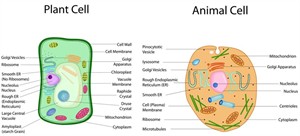
Plant Cell and Animal Cell
| Feature | Plant Cell | Animal Cell |
|---|---|---|
| Cell wall | Present | Absent |
| Cell membrane | Present | Present |
| Chloroplast | Present | Absent |
| Vacuole | Large and permanent | Small or absent |
| Shape | Usually rectangular | Usually round or irregular |
| Mode of nutrition | Makes its own food | Depends on others for food |