

Science begins with curiosity, the desire to understand the world by asking why and how. In earlier classes, students learned that science starts with wonder and grows by questioning.
In Class 8, science moves into an investigative stage where curiosity is supported by careful thinking and evidence.
Important!
Curiosity is the driving force that motivates scientists to explore unknown ideas and phenomena.
Investigative world of Science:
Scientific investigation in science is a systematic process of asking questions, observing, experimenting, and drawing conclusions.
Scientific thinking: From observation to explanation:
Science follows a step-by-step method:
-
Observation – Noticing changes or patterns
-
Questioning – Framing scientific questions to explore possible changes and outcomes.
-
Experimentation – Testing ideas by changing one factor at a time
-
Measurement – Recording time, size, temperature, etc.
-
Conclusion – Explaining results using logic and evidence
This process helps students become young scientists.
Science in everyday life:
Science is present everywhere, even in daily activities.
Example: Puffing of a Puri
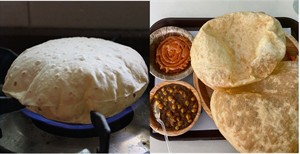
Puffing of a phulka and puri due to steam buildup
-
A puri puffs up due to steam formation inside the dough.
-
One side may become thinner due to uneven heat or thickness.
Scientific learning from the example:
-
Kitchen activities can be scientific experiments.
-
Everyday observations can lead to meaningful scientific questions.
-
Even common phenomena are not always fully understood.
Controlled experiment: An experiment in which only one factor is changed at a time, while all other conditions remain the same.
Why it Is important?
- Helps identify the exact cause of a result by isolating each factor in turn.
- Makes scientific conclusions reliable, accurate, and trustworthy.
Example variables in the Puri experiment:
- The thickness of the dough affects how evenly the puri puffs.
- The oil's temperature influences the speed and extent of puffing.
- The type of flour changes the texture and puffing behaviour.
- The method of placing the puri in oil affects heat distribution and expansion.
Let us delve into Exploring the natural world and the concepts we are going to cover
1. Microorganisms and health:
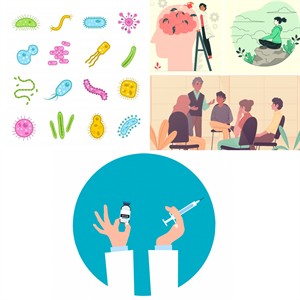
Microorganisms, healthy well-being, and vaccines
- Microorganisms are tiny living organisms that cannot be seen without a microscope.
- Some microorganisms are useful and help with digestion and the production of medicine.
- Others are harmful and cause diseases.
- The human body stays healthy through proper nutrition, exercise, medicines, and vaccines.
- Vaccines help the body develop immunity against diseases.
2. Electricity, forces, and motion:
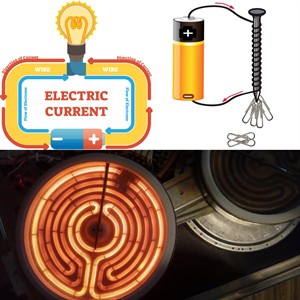
Electric current and its magnetic and heating effects
- Electric current is widely used in daily life.
- The heating effect of electric current provides warmth and light.
- The magnetic effect of electric current helps motors and machines function.

Forces: push and pull, change direction of the ball(object), magnetic force and gravitational force (clockwise)
- Force is a push or pull that can change the shape, speed, or direction of an object.
- Forces explain motion, such as a ball falling or a car stopping when the brakes are applied.
3. Pressure and weather:
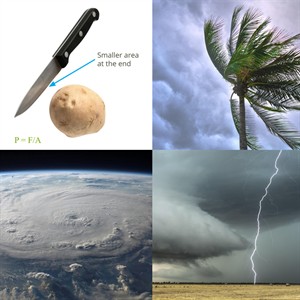
Pressure effects: A sharp knife, high-speed wind, causes climate and weather changes, such as thunder and cyclones (clockwise).
- Pressure depends on how force is distributed over a surface.
- A slight pressure differential causes gentle winds.
- Storms and cyclones can result from significant pressure differences.
- The force per unit area is called pressure.
- Changes in air pressure are directly related to weather events.
Important!
- Curiosity is where science starts, and it grows through asking questions and looking around.
- The scientific method involves a series of steps: observation, experimentation, measurement, and conclusion.
- Cooking and other daily tasks show how science works.
- Controlled experiments help identify causes by changing one factor at a time.
- Concepts like microorganisms, forces, electricity, pressure, and weather explain the natural world around us.