

How the body communicates
Our body is like a friend who speaks to us through symptoms and signs. These signals help us realise something is wrong, even if we don’t immediately know the exact problem.
Being unwell means the body or mind is not in its normal state of balance, making it harder to carry out daily activities with comfort and energy.
Symptoms and signs :
To understand illness, it is essential to distinguish between what we feel internally and what others can observe externally.
| Aspect | Signs | Symptoms |
|---|---|---|
| Meaning | Changes that can be observed or measured by others | Feelings or experiences reported by the patient |
| Nature | Objective (visible, measurable) | Subjective (felt personally) |
| Examples | Fever (measured with thermometer), rashes (seen on skin), swelling, cough | Headache, dizziness, nausea, fatigue, stomach pain |
| Detection | Detected by doctors, caregivers, or instruments | Felt and described by the patient |
| Reliability | Can be scientifically confirmed |
Relies on the patient’s description
|
Medical diagnosis is the process by which a doctor identifies a disease or condition based on signs, symptoms, physical examination, and laboratory tests.
Doctors diagnosis
The accurate diagnosis involves finding the real problem, correct treatment, preventing complications, saving resources, and preventing spread.
What is a disease?
Any abnormality or disturbance caused in our body is known as a disease.
The following are the reasons that may lead to the development of diseases:
- Infections caused by microbes.
- Lack of a balanced diet.
- Poor lifestyle and unhealthy habits.
- Malfunctioning of the body parts.
Differences between health and disease:
|
Health or disease-free
|
Disease or health-free
|
|
The state of physical, mental, and social well-being.
|
The state in which diseases are present. |
| It is based on the individual, physical, and social environment. | It is completely based on the individual. |
| The individual has good health. | The individual has poor health. |
| A healthy person can be disease-free. | A disease-free person can be healthy or unhealthy. |
Causes of diseases:
Every illness has a reason behind it. Sometimes we fall sick because of tiny living organisms entering our body, and sometimes because of the choices we make, like eating too much junk food or not sleeping enough. Understanding the causes of diseases is important because only then can we prevent them or treat them in the right way.
1. Biological causes:
These are tiny living organisms that invade our bodies and make us sick.
These are tiny living organisms that invade our bodies and make us sick.
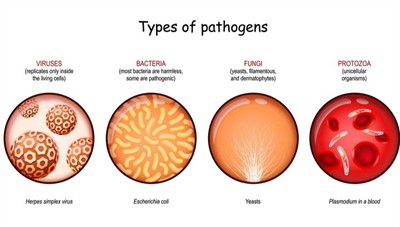
Types of disease-causing organisms
- Bacteria cause diseases like pneumonia and tuberculosis.
- Viruses cause diseases like influenza, measles, or COVID-19.
- Fungi cause skin infections like ringworm.
Parasites like tapeworms or malaria-causing protozoa live inside our bodies and harm us.
A pathogen is any microorganism (bacteria, viruses, fungi, parasites) that causes disease.
2. Nutritional causes:
Sometimes diseases are not due to germs but to a lack of nutrients in our food. They are known as deficiency diseases.
Sometimes diseases are not due to germs but to a lack of nutrients in our food. They are known as deficiency diseases.
- Lack of vitamin C causes scurvy.
- Lack of iron leads to anaemia.
- Overeating fatty foods may cause obesity.
3. Lifestyle causes:
The way we live also affects our health. Eating junk food and skipping exercise can lead to obesity.
The way we live also affects our health. Eating junk food and skipping exercise can lead to obesity.
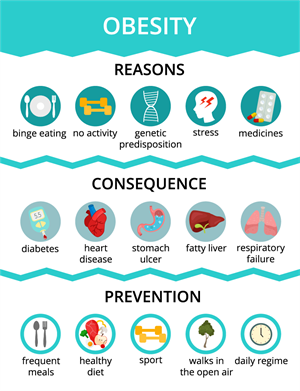
A picture explains the risk factors, reasons and prevention of obesity.
4. Environmental causes:
Pollution, unsafe water, or poor sanitation can cause us to become ill. Breathing polluted air can cause asthma. Drinking dirty water may cause cholera or diarrhoea.
5. Genetic disease:
Some diseases are inherited from parents through genes. Example: Haemophilia.
Classification of diseases:
Classification of diseases means arranging diseases into categories based on their nature, cause, duration, or the part of the body they affect.
- Based on duration:
Based on the duration of infection, diseases are classified into two types. They are as follows:
i. Acute diseases: The diseases that last for only short periods and are severe are known as acute diseases. The examples include cold, cough, cholera, typhoid, asthma, dysentery, bronchitis, and sore throat.
ii. Chronic diseases: Diseases that persist for an extended period are known as chronic diseases. The examples include Tuberculosis, arthritis, diabetes, cardiovascular diseases, elephantiasis, and cancer.
2. Based on the organ or system affected:
i. Organ-specific diseases: Affect only one organ.
i. Organ-specific diseases: Affect only one organ.
Example: Hepatitis (liver), Conjunctivitis (eye).
ii. Systemic diseases: Affect the whole body or multiple organs.
ii. Systemic diseases: Affect the whole body or multiple organs.
Example: Neoplasm and blood-borne infections.
3. According to the causes:
Diseases also can be classified in terms of what caused them:
i. Infectious diseases: Caused by pathogens, including bacteria, viruses, fungi, and parasites (e.g., Tuberculosis, malaria).
ii. Deficiency diseases: Caused by a deficiency of nutrients (e.g., Scurvy, rickets).
iii. Genetic diseases: Inherited from progenitors (e.g., Haemophilia, sickle-cell anaemia).
iv. Lifestyle diseases: Caused by unhealthy habits (e.g., Obesity, heart disease, diabetes).
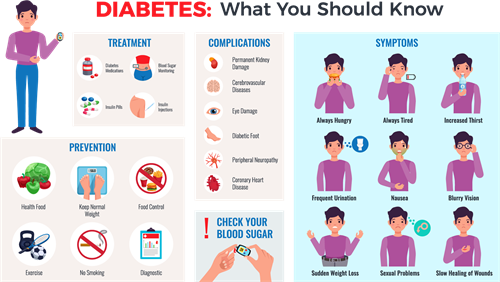
A picture explains the treatment, complications and symptoms of Diabetes Mellitus
4. Based on severity:
i. Minor ailments: Are not fatal and typically are resolved in a short duration. (i.e., common cold).
ii. Major ailments: May threaten life or result in damage to bodily functions with no treatment (i.e., cancer, severe pneumonia).
4. Based on severity:
i. Minor ailments: Are not fatal and typically are resolved in a short duration. (i.e., common cold).
ii. Major ailments: May threaten life or result in damage to bodily functions with no treatment (i.e., cancer, severe pneumonia).
5. Mode of transmission:
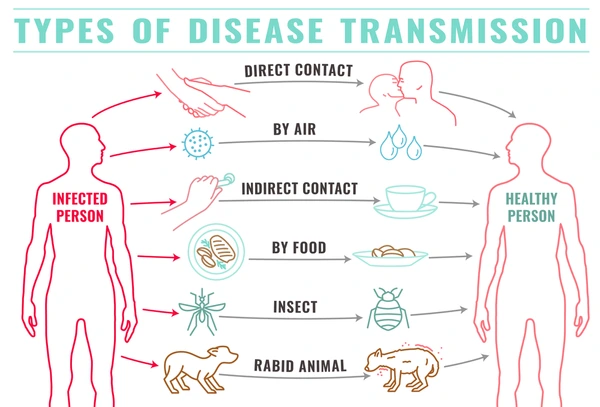
Modes of transmission
i. Communicable disease is the transmission of an illness either through the air, water, or consumption, from person to person, in addition to vector-borne illnesses (i.e., typhoid, dengue, flu, chickenpox, and COVID-19).
ii. Non-communicable diseases (NCDs) do not spread between people; they are usually caused by lifestyle, genetics, or environment (e.g., cancer, diabetes, or asthma).
Important!
-
Around 60% of human diseases are caused by pathogens like bacteria, viruses, fungi, and parasites.
-
According to the WHO, non-communicable diseases (NCDs) like diabetes and heart disease cause 74% of deaths worldwide each year.
-
Environmental factors like air pollution kill an estimated 7 million people annually due to illnesses like asthma, lung cancer, and stroke.