

Treatment of diseases:
Alexander Fleming was working on a disease-causing bacteria culture in \(1928\). When he returned to his laboratory after a vacation, he found spores of green mould, otherwise known as the fungus Penicillium notatum, contaminated the petri dishes of bacteria. He noticed that the presence of mould inhibited bacterial development. Also, many of these bacteria were destroyed by this fungus. He published his work and named the mould juice that kills many bacteria in his laboratory Penicillin, a well-known antibiotic.

Read the content given below to know more about me.
Microorganisms are the source of antibiotics and vaccines.
Antibiotics:
The word "Antibiotic" is derived from the Greek words "anti", which means "against," and "bios", which means "life" (a bacterium is a life form).
Answer:
Antibiotics are medications used to kill or inhibit the growth of disease-causing microorganisms.
There are microorganism-derived products that are taken as pills, capsules, or injections. Primarily, bacteria are used in manufacturing antibiotics. Nowadays, many fungi and algae are also being used.
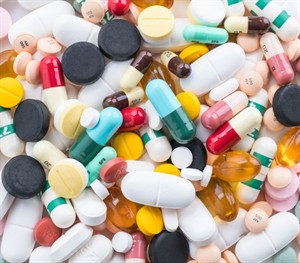
Antibiotic tablets
Example:
Penicillin, streptomycin, erythromycin and tetracycline are the most common antibiotics made from fungi and bacteria.
Antibiotics are manufactured by growing specific microorganisms and are used to treat a wide range of illnesses. They are also incorporated into livestock and poultry feed to prevent microbial infections. They are also used to fight a variety of plant diseases. On the other hand, antibiotics are ineffective against the common cold and flu, caused by viruses. When the disease-causative microbes are viruses and fungi, then antiviral and antifungal drugs are used.
-
Antivirals: Target viruses, although they are often more challenging to treat (e.g., drugs for HIV and influenza).
-
Antifungals: Used to treat fungal infections like ringworm.
Measures to use the antibiotics:
- It is essential to note that antibiotics can only be used under the supervision of a trained physician.
- It is necessary to complete the entire course prescribed by the doctor.
- If you take antibiotics when you don't need them or in the wrong doses, the medication can become less effective.
- Antibiotics taken unnecessarily can also destroy the body's beneficial bacteria.
Antibiotics respective to their organisms:
|
Class
|
Type
|
Antibiotic
|
| Bacteria | Streptomyces griseus | Streptomycin |
| Bacteria | Streptomyces erythreus | Erythromycin |
| Bacteria | Bacillus subtilis | Bacitracin |
| Fungi | Penicillium notatum | Penicillin |
| Fungi | Cephalosporium acremonium | Cephalosporin |
They have saved millions of lives since their discovery.
Activity:
How do you believe bacterial pathogens have gained antibiotic resistance? What steps may be taken to reduce antibiotic resistance?
We must take antibiotics responsibly only when recommended by a physician, in the appropriate dosage, and for the proper amount of time to address the issue of antibiotic resistance. By avoiding overuse, antibiotics remain effective for future generations and help stop the emergence of resistant microorganisms.
Antibiotic resistance:
Antibiotic resistance occurs when bacteria change and become able to survive even after being exposed to antibiotics that are used to kill them.
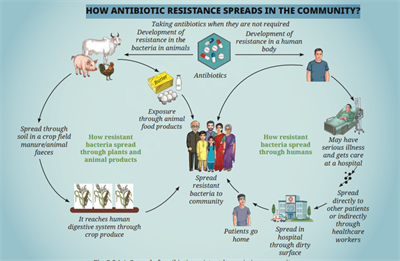
Spread of antibiotic-resistant bacteria in the community
How does it happen?
- Overuse: Taking antibiotics even when not necessary (such as for colds and flu, which are viral infections).
- Misuse: Not completing the full course of antibiotics the weak bacteria to die, but the stronger ones survive.
- Livestock use: In many places, antibiotics are administered to animals to promote faster growth and weight gain. It can create resistant bacteria that spread through food.
- Global spread: Resistant bacteria can travel from one person to another and across countries.
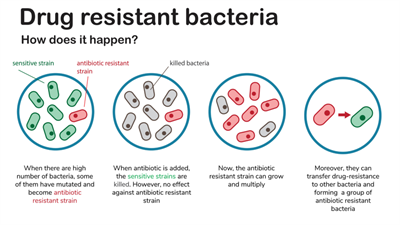
Drug resistant bacteria
Consequences:
- Infections last longer and become harder to treat.
- Once curable diseases (like \(TB\)) may become life-threatening.
- Hospitals face "superbugs" like MRSA (Methicillin-resistant Staphylococcus aureus).
Prevention and responsible use:
i. Take antibiotics only with a doctor’s prescription.
ii. Always complete the full prescribed course.
iii. Never share or reuse leftover antibiotics.
iv. Wash hands and maintain hygiene to prevent infections in the first place.
i. Take antibiotics only with a doctor’s prescription.
ii. Always complete the full prescribed course.
iii. Never share or reuse leftover antibiotics.
iv. Wash hands and maintain hygiene to prevent infections in the first place.
India has long sought to strike a balance between modern and traditional approaches. Alongside allopathic medicines (such as antibiotics), traditional systems of medicine play a crucial role.
Traditional Medicine: Knowledge, skills, and practices based on centuries of experience using natural herbs, diet, exercise, and lifestyle to prevent and treat diseases.
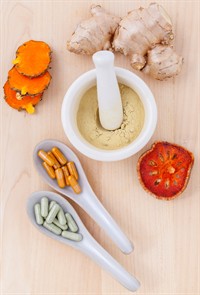
Traditional medicines
Ayurveda:
- The ancient Indian system focuses on the balance of body, mind, and spirit.
- Uses herbs like Ashwagandha (for strength), Tulsi (immunity), and Neem (skin health).
- Promotes preventive health care through diet and routine.
Lifestyle medicine:

Exercising regularly improves your health.
- Eating a balanced diet, avoiding junk food, exercising regularly, and getting proper sleep can help prevent both communicable and non-communicable diseases.
- Reduces the need for antibiotics and strong medicines.
Modern medicine and traditional practices can complement each other to improve health outcomes. For instance, the Rotavirus vaccine, a product of modern medicine, protects children from severe diarrhoea, which is a major cause of illness and hospitalisation in young kids. Vaccination helps the body build immunity specifically against the virus.
At the same time, Ayurveda recommends natural herbs and dietary practices that support digestion and hydration. Herbs like ginger, cumin, and fennel can ease stomach discomfort, while oral rehydration solutions or herbal drinks aid in avoiding dehydration. Children can recover more rapidly and retain greater health by combining traditional food habits with contemporary vaccinations. It illustrates how combining contemporary medicine with conventional methods frequently produces better and more thorough outcomes.
Ministry of Ayush
Important!
- Alexander Fleming discovered the first antibiotic, Penicillin, in \(1929\). It was produced from the fungus called Penicillium.
- WHO warns that by \(2050\), drug-resistant infections could kill more people than cancer if no action is taken.
- The Government of India has a dedicated ministry called AYUSH (Ayurveda, Yoga, Unani, Siddha, and Homoeopathy) to promote traditional medicine and encourage research on its integration with modern healthcare. AYUSH also runs programs to educate people on using these conventional methods safely, in conjunction with contemporary medical practices.