

Activity: Imagine a grassland ecosystem with organisms such as grass, frogs, hares, foxes, grasshoppers, snakes, and eagles. Now, think about “Who eats whom?” and draw arrows showing these feeding relationships, just like a food chain, to understand how energy flows in nature.
In a forest, the deer eats grass, and the tiger, in turn, eats the deer. In an ecosystem, there is a chain-like relationship among the organisms that inhabit it.
The sequence of living creatures that represent who eats whom in an ecosystem is called a food chain.
The food chain describes how an organism derives energy and nutrients by eating other organisms. It shows the relationship between producers and consumers (e.g., deer, goats, cows, and tigers).
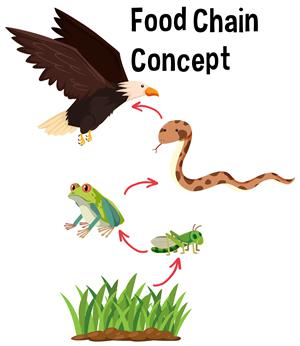
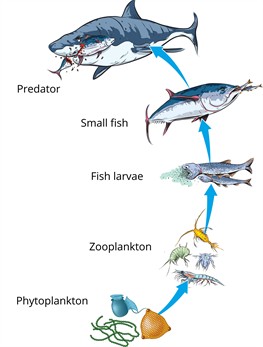
Food chain in the terrestrial ecosystem (Forest) and in the aquatic ecosystem
Flow of energy:
The food chain starts with energy from the sun. The sun is the ultimate source of energy that powers and triggers photosynthesis in producers.
Important!
Energy from the sun is stored in plant's parts.
When the grasshopper eats grass, the grasshopper obtains energy from the grass. The energy thus flows from grass to grasshopper. The frog obtains energy by consuming a grasshopper. The energy is then transferred to a snake when the snake consumes the frog, and so on.
Thus, primary energy production in the living world occurs through plants (via photosynthesis).
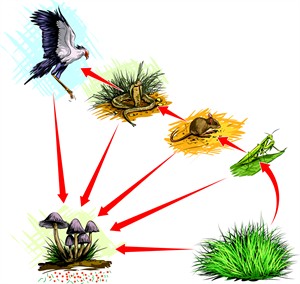
The flow of energy
The microorganisms reduce the excreta and dead bodies of animals into simple organic material and put them into the soil in the form of humus.
Humus is a nutrient-rich material that helps plants grow. Thus energy travels from primary producers to the highest-level predators, then back to soil.
Activity: During this activity, you will investigate a crop field ecosystem containing millets, mice, and an eagle by counting individual organisms and recording those numbers on a table. After all organisms are counted and recorded on the chart, students will start with the highest number of organisms in 1 group (millets) at the bottom of the pyramid, and the organism with the lowest number counted (eagle) at the top of the pyramid. This pyramid illustrates the decline in energy and population of organisms in the ecosystem.
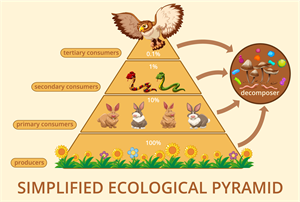
The energy pyramid
Trophic levels:
Each step of the food chain forms a trophic level. In an ecosystem, a trophic level comprises a group of organisms that occupy the same level in a food chain.
Energy is passed from producers to consumers.
- First trophic level: The producers are plants, which are autotrophs (they produce their own food).
-
Second trophic level: Animals that eat plants are called the primary consumers.
-
Third trophic level: Animals which eat primary consumers are called secondary consumers.
-
Fourth trophic level: Animals that consume secondary consumers (predators) are called tertiary consumers.
-
There are larger predators which eat tertiary consumers. They are called the quaternary consumers.
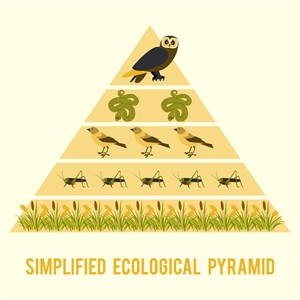
Ecological pyramid
Charles Elton proposed the concept of ecological pyramids in \(1927\). They are also known as "Eltonian pyramids".
Ecological pyramids are a graphical representation of environmental parameters such as the biomass, energy or the number of individuals in various trophic levels of a food chain, with the producer at the bottom and the top carnivore at the tip.
Limitations of the ecological pyramid:
1. Ecological pyramids assume that the food chain is a simple one. Simple food chains do not occur in nature; instead, food webs are present.
2. A single species can be present and can operate in two or more trophic levels. Ecological pyramids do not accommodate such cases.
3. Ecological pyramids do not have a place for decomposers, even though they play a vital role in the ecosystem.
The living organisms use \(90\%\) of the energy obtained from food for life processes.
Only about \(10\%\) of the energy goes to the next trophic level or to the organism when it gets eaten.
Loss of energy at each level can be shown as an energy pyramid.
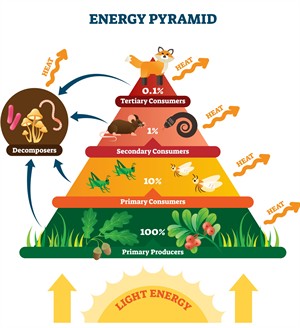
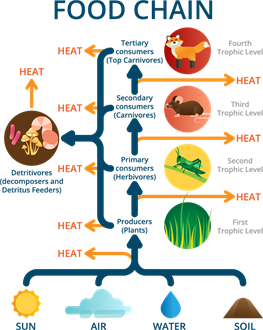
Energy Pyramid and the transfer of energy
In the food chain, there is a top-level predator with no natural predators. In an aquatic ecosystem, there is no natural predator for an alligator. While in a forest, there are no natural predators for tigers or foxes.
Importance of the food chain:
1. Helps to understand the feeding relationship and interaction between organisms in an ecosystem.
2. Energy flow and nutrient calculation in an ecosystem can be estimated.
3. The movement of toxic substances and the impact of pollution can be studied.
Activity: In this activity, students observe a food web showing various organisms, such as grass, a grasshopper, a frog, a bird, a snake, an owl, and a fox. They are asked to add more arrows to show additional feeding relationships among these organisms. By doing so, they understand how each organism is connected to many others in an ecosystem, forming a complex food web rather than a simple food chain.
Food web:
Consumers in an ecosystem have multiple food sources and do not rely on a single species. If we put all the food chains in an ecosystem together, we end up with an interconnected network, called a food web.
A food web is useful for showing the many feeding relationships between other species within an ecosystem.
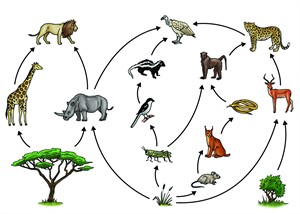
Food web
Characteristics of the food web:
1. A food web is more realistic than a food chain.
2. A food web consists of various food chains interlinked at different trophic levels.
3. A food web is not straight, and the food chain components do not run parallel.
4. A food web provides several alternate foods to the consumers. Also, feedback checks in a food web keep the populations of various species constant.
5. A food web is essential for the stability of an ecosystem.
Reference:
https://www.flickr.com/photos/121935927@N06/13578885414