

How does one change lead to another?
In an ecosystem, one small change in the living or non-living components can trigger a chain reaction that affects many other organisms and processes. This is known as a cascading effect.
When a single factor (such as pollution or the loss of a species) changes, it disrupts the balance of interactions between organisms and their environment, leading to further consequences.
Some examples of this cause-and-effect chain in the ecosystem are
1. Pond ecosystem:
Pollution kills aquatic plants, reducing oxygen in the water. Fish die due to an oxygen shortage, disturbing the food chain. Insects multiply and spread to farms, forcing the use of pesticides that harm the environment.
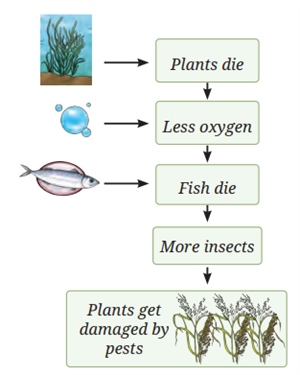
Cause and effect in a pond ecosystem
2. Forest ecosystem:
Deforestation destroys trees, leading to soil erosion and loss of rainfall. Animals lose shelter and food, causing an imbalance in predator-prey relationships. Reduced biodiversity weakens the entire ecosystem.
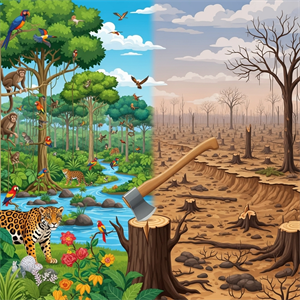
Cause and effect in a forest ecosystem
This shows that a single change in nature can create a ripple effect, disrupting the entire ecosystem.
Every element in nature is interlinked. When humans pollute, overuse, or modify ecosystems, they unintentionally harm other species and themselves.
Environmental issues are problems that harm the natural world, such as pollution, deforestation, and climate change.
Maintaining ecological balance means allowing nature to regulate itself without excessive interference.
Activity: Frog leg exportation in the \(1980s\)
The exportation of frog legs from India during the \(1980s\) mainly came from the Indian Bullfrog (Hoplobatrachus tigerinus), which not only contributed to the decline of frog populations but also led to outbreaks of pest species, as frogs are naturally arboreal insectivores.
Due to increased pest populations in the area, farmers used pesticides, contaminating natural ecosystems and posing a public health risk. The government responded with a ban on the export, showing how removing one species disrupts the balance of nature.

Hoplobatrachus tigerinus
What are the benefits of an ecosystem?
An ecosystem provides both ecological and human benefits by supporting life processes, maintaining balance, and offering resources for survival and well-being.
Types of ecosystem benefits:
-
Ecological benefits: Ecosystems provide clean air and water, regulate climate, support biodiversity, recycle nutrients, and control natural processes such as floods and soil formation.
-
Economic benefits: They provide resources such as food, timber, medicines, and fibres; support farming, fishing, and tourism; and maintain fertile soil and water for agriculture.
-
Cultural & aesthetic benefits: Ecosystems offer natural beauty, recreation, peace, and strengthen cultural and spiritual connections with nature.
-
Regulating benefits: They control pests, prevent soil erosion, maintain groundwater levels, and reduce flood and storm damage.
-
Supporting benefits: Ecosystems support essential processes such as pollination and seed dispersal, helping maintain stable life systems.
The Sundarbans ecosystem:
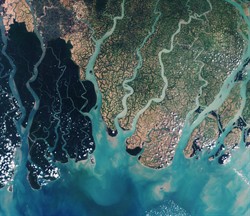
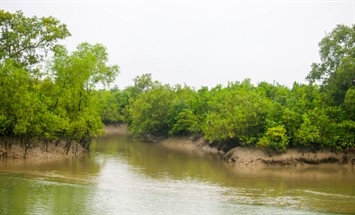
The Sundarban Delta
-
The Sundarbans form the world’s largest mangrove forest, located at the delta of the Ganga and Brahmaputra rivers (India–Bangladesh).
-
It was declared a UNESCO (United Nations Educational, Scientific and Cultural Organisation) World Heritage Site \(1987\).
Importance:
- Acts as a natural barrier against cyclones and floods.
-
Absorbs carbon dioxide and releases oxygen.
-
Home to many endangered species (e.g., Royal Bengal Tiger, estuarine crocodile).
Threats:
- Deforestation for farming and fuelwood.
-
Illegal hunting and overuse of resources.
-
Pollution from industries and untreated sewage.
Human actions can destroy even the most protective natural ecosystems. Conservation is essential.
Protected areas :
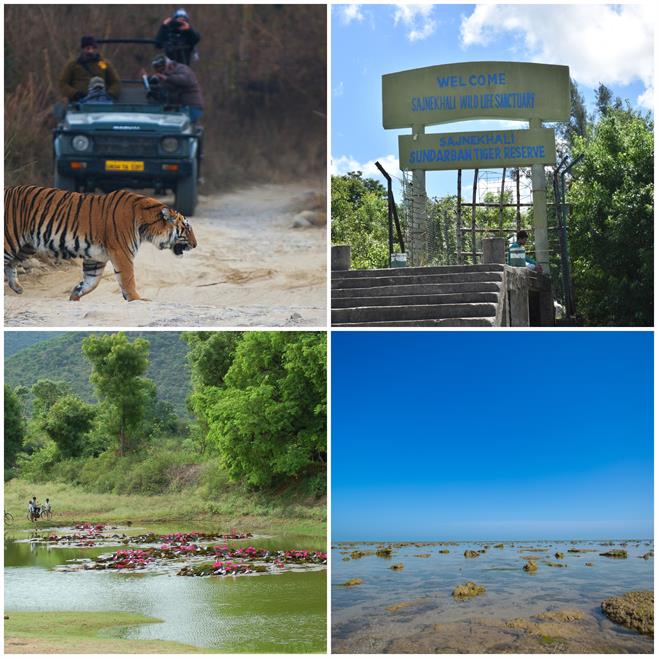
Images of Jim Corbett National Park, Sajnekhali Wildlife Sanctuary, Nilgiri Biosphere Reserve and Gulf of Kutch Marine Park (clockwise).
To conserve wildlife and ecosystems, India has:
-
National parks: Protect wildlife and habitat. Examples are Jim Corbett (Uttarakhand), Manas (Assam), Kaziranga (Assam), Keibul Lamjao (Manipur) and Gir (Gujarat).
-
Wildlife sanctuaries: Conserve biodiversity and culture. Examples are Eaglenest (Arunachal Pradesh), Chilika Lake (Odisha) and Sajnekhali.
-
Biosphere reserves: Shelter for endangered species. Examples are Nilgiri Biosphere.
-
Marine parks: Conserve marine life. Examples are Pirotan Island (Gujarat) and the Gulf of Kutch.
These areas help conserve biodiversity and serve as natural laboratories for ecological balance.
How do healthy ecosystems serve our farms?
Healthy ecosystems support sustainable agriculture by maintaining soil fertility, controlling pests naturally, and promoting biodiversity.
Agricultural practice that meets and satisfies the current human needs, without compromising the future generations (both environment and natural resources), is termed sustainable agriculture.
Farming and the Green Revolution:
Between \(1950\)–\(1965\), India faced severe food shortages. The Green Revolution introduced machines, synthetic fertilisers, and pesticides, which rapidly increased crop yields. Eventually, these practices became impractical because of the following reasons:
-
Excessive use of synthetic fertilisers and pesticides.
-
Depletion of groundwater due to over-irrigation.
-
Deterioration of soils and beneficial organisms.
Activity: Spend a day on a farm and ask the farmers about their use of pesticides, fertilisers and recycled materials. Following the meeting with the farmers, we would like to report on their concerns. .
Problems in modern farming:
-
Soil fertility diminishes because of the loss of humus and microbes.
- Synthetic fertilisers and pesticides allow crops to be grown faster, but they damage soil health in the long term.
- Natural predators decline, increasing pest populations.
-
Earthworms and decomposers die due to heavy ploughing and the use of chemicals.
-
Pests develop resistance to pesticides.
-
Monoculture reduces biodiversity and pollinators.
Important!
Monoculture is the agricultural practice of growing only one type of crop on the same land over and over again.
Sustainable farming practices:
To maintain balance and productivity, farmers should:
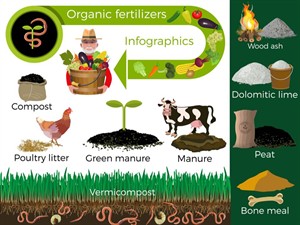
Organic fertilisers
-
Use organic manure and compost instead of chemicals.
-
Practice crop rotation and mixed cropping.
-
Encourage natural predators and reduce pesticide use.
-
Use bio-fertilisers and biopesticides.
-
Preserve local crop varieties and biodiversity.
Important!
Vrikshayurveda is an ancient Indian text that teaches eco-friendly farming by nourishing the soil with organic manures such as Kunapa Jala, emphasising that healthy soil supports healthy plants and a balanced ecosystem.