

Your home gives you food, water, air, shelter and everything you need. But if you were a fish, would you survive at home? No! You’d need water and gills.
Every organism has its own perfect home called a habitat.
Observe the pictures given below and choose which picture corresponds to the habitat.
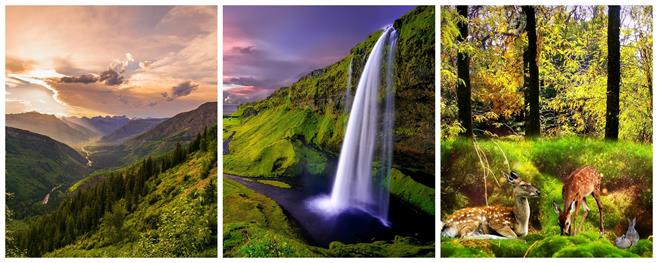
A Mountain with lush greenery , lots of trees and a river flowing amidst mountains and animals in the forest
All three pictures are part of the habitat, but the environment encompasses much more.
A habitat is the natural home or environment of an organism where it lives, grows, reproduces, and interacts with other organisms and with its surroundings.
Activity 1: You can try this activity in your free time. Explore nearby areas in groups to observe different habitats. Carefully note the living organisms and non-living things you find in each habitat and record all your observations.
| Habitat type | Examples of organisms | Special features |
|---|---|---|
| Forest | Tiger, deer, trees, and insects | Thick vegetation, moderate rainfall |
| Desert | Camel, cactus, and lizard | Hot, dry, little water,and sandy soil |
| Mountains | Snow leopard, pine trees | Cold, less oxygen, snowfall |
| Oceans / Seas | Whales, fish, seaweed | Salty water, high pressure |
| Freshwater (ponds, lakes) | Frogs, lotus, algae | Fresh water, sunlight, oxygen dissolved |
| Grassland | Elephant, lion, grass | Open, moderate rainfall |
| Urban areas | Humans, rats, crows | Artificial environment |
| Tree bark or soil | Insects, fungi, worms | Small, shaded, moist micro-habitats |
Key features of a habitat:
- It provides all basic needs: food, water, air, and shelter.
- It offers favourable conditions such as proper temperature, light, and moisture.
- Different organisms live in different habitats depending on their adaptations.
- One habitat can support many different species living together.
- Habitats can be large (forest, ocean) or small (tree bark, puddle, rock surface).
All living (biotic) and non-living (abiotic) components continuously interact, and the link between them maintains the balance in the environment. Any change or deterioration in any of the elements of the environment likely impacts the entire environment and the species that live there.
The living and the non-living components in an environment together constitute an ecosystem.
Ecology (Greek term: Oikos - home, Logos - study) is the branch of biology which deals with the inter-relationship among organisms and interactions between organisms and their environment.
What is an ecosystem?
An ecosystem is a community where the biotic and abiotic components of the environment are linked through energy flow and the cycling of nutrients.
Let us look at an example of an ecosystem to gain a better understanding.
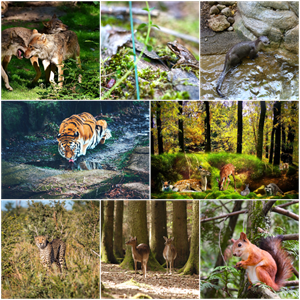
A forest ecosystem
A tree or a shrub grows in the forest using air, sunlight and water. The other biotic components or living components include the insects, birds, and frogs that feed on the leaves, flowers or fruits present on a tree or shrub.
The higher animals, such as snakes and birds, depend on the smaller birds, frogs, and insects for sustenance. To grow, reproduce, and perform other activities, the biotic components interact with each other and with the abiotic components. Thus, this example portrays an ecosystem of a forest. The different types of ecosystems are ponds, rivers, lakes and gardens.
In the following section, let us study the components of an ecosystem.
The ecosystem comprises biotic factors and abiotic factors.
The living things of the environment, which include the plants, animals, bacteria, fungi, etc., are called the biotic factors.
The non-living components such as air, water, sunlight, and minerals present in the soil are called the abiotic factors.
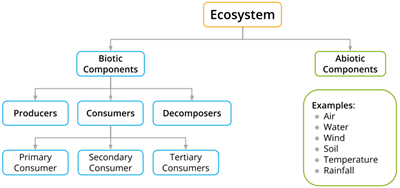
Biotic and abiotic factors of the ecosystem
We have seen in our earlier standards that biotic components can be classified as producers, consumers and decomposers based on their food dependency on one another.
Activity 2: Assume a forest ecosystem in your mind. Think of the different organisms that could live there, such as trees, deer, birds, foxes, or mushrooms. Using your knowledge or other sources, identify what each organism eats and classify them as herbivores (plant-eaters), carnivores (animal-eaters), or omnivores (both plant and animal eaters)and record your observations.
Classification of biotic consumers:-
1. Producers:
Producers are autotrophs who prepare their food from solar energy, water, and carbon dioxide (\(CO_2\)). Solar energy is the primary and ultimate source of energy for almost all ecosystems. The producers trap and convert the solar energy to chemical energy in the form of food. Producers are also called transducers as they can change light energy into chemical energy.
The food is produced through the process of photosynthesis in the presence of chlorophyll. The prepared food is in the form of organic compounds like sugar and starch. Producers also maintain the \(CO_2\) and \(O_2\) balance in nature.
Example:
Green plants, algae and bacteria like cyanobacteria.
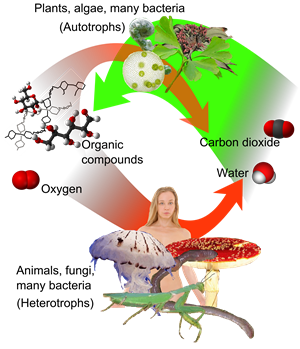
The types of organisms are based on their nutrition
2. Consumers:
Consumers depend on the producers directly or indirectly for their food and thus are called heterotrophs. The consumers can be further classified as primary, secondary and tertiary consumers.
i. The primary consumers are herbivores, which depend entirely on the producers directly for their food. Herbivores are also called first-order consumers.
Example:
Deers, elephants, cattle like cows, goats, sheep, and bulls.
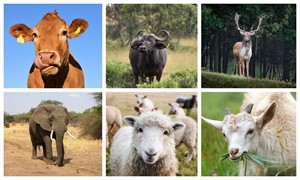
Herbivorous animals
ii. The secondary consumers depend on the primary consumers for their food and thus are indirectly dependent on the primary consumers.
Secondary consumers can be carnivores or omnivores. Carnivores depend only on animals, whereas omnivores depend on both plants and animals for their survival. Carnivores are also called second-order consumers.
Example:
Snakes, seals, squids, crabs, and eagles are examples of carnivores.
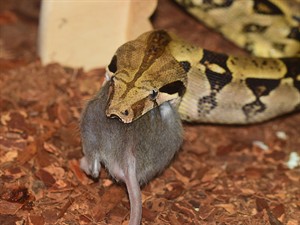
Snake
Humans, crows, monkeys, and bears are common examples of omnivores.
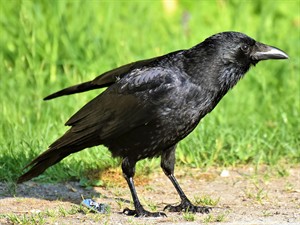
Crow
iii. The tertiary consumers depend on the primary and the secondary consumers.
Example:
Larger carnivores or secondary carnivores, such as lions, wolves, leopards, and tigers, are typical examples of tertiary consumers.
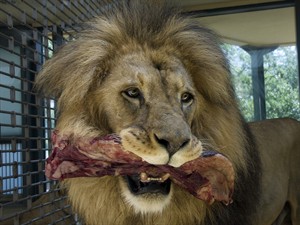
Lion
3. Decomposers:
The decomposers break down the dead remains and the waste products generated by organisms. They break down the complex organic substances into a simpler inorganic form, which goes to the soil, which plants can reuse. Decomposers are also called saprotrophs as they feed on dead and decaying matter and organic wastes.
They are also called reducers as they remove or degrade the dead remains of organisms.
Example:
Bacteria, fungi like mushrooms, and earthworms.
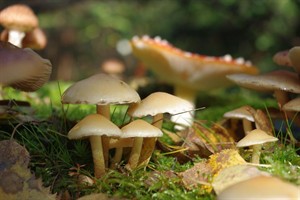
Mushroom
India hosts many migratory birds that travel thousands of miles to escape harsh climates and find food. These birds not only beautify habitats but also help maintain ecosystem balance by acting as pollinators, seed dispersers, and pest controllers. For example, Demoiselle Cranes visit Khichan village in Rajasthan during winter.
Abiotic components
| Abiotic Factor | Role / Importance |
|---|---|
| Sunlight | Provides energy for photosynthesis and warmth. |
| Water | Essential for all life processes; controls body temperature. |
| Air | Provides oxygen for respiration and CO₂ for photosynthesis. |
| Soil | Supplies minerals and provides anchorage for plants. |
| Temperature | Affects metabolic activity, growth, and distribution of organisms. |
| Minerals | Needed for nutrition and growth (e.g., calcium, nitrogen, phosphorus). |
Who All Live Together in Nature?
A population is a group of organisms of the same species living together in a particular habitat at a given time. Example: Many fish of the same kind in a pond form a population of that fish.
Activity 3: You can perform this activity in your free time. Divide into four to five groups, and each group can choose any two organisms, either plants or animals, to study. Mark a 1m × 1m area in your school garden, identify four organisms in that area, and count how many of each are present. Record your counts and then compile the data from all groups to get an overall understanding of the population of these organisms.
A community is formed when different populations live together in the same habitat.
All biotic components (plants, animals, microorganisms) together form a community. Organisms in a community interact and depend on each other for survival.
Flowers are made up of a stalk, green leafy parts that are the sepals, colourful petals, and the reproductive parts, the carpels/pistil (female) and stamens (male). Stamens release pollen, which is a very fine, yellow dust.
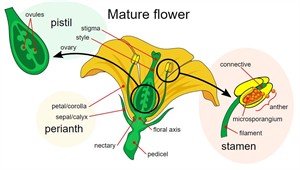
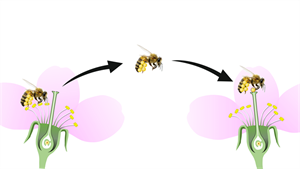
Flower structure and pollination by pollinators
Pollination is the transfer of pollen from the stamens to the carpels, sometimes within the same flower (self pollination) or from one flower to another (cross pollination). Pollination is essential to making fruit and seeds and can be accomplished by a range of agents called pollinators, including wind, water, insects, birds, and bats.
Reference:
http://dl.maxpixel.freegreatpicture.com/?f=frog-4444526_1280.jpg&type=Download&token=fbc82e291bdb2b353fe16a1cfc319d7d&pid=4444526
https://www.flickr.com/photos/o_0/29800306434
https://www.pxfuel.com/en/free-photo-jysoc/download
https://www.pxfuel.com/en/free-photo-xpqga/download
https://www.pxfuel.com/en/free-photo-xnmik/download
https://www.pxfuel.com/en/free-photo-xpzex/download
https://www.pxfuel.com/en/free-photo-xgnly/download