

What makes Earth suitable for life?
The following features make life sustainable and suitable for the planet.
1. Position of the Earth:
The habitable zone is the region around a star where temperatures allow liquid water to exist. It is also called the Goldilocks Zone because conditions are optimal for sustaining of life.
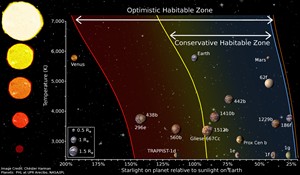
The habitable zone
- Here, temperatures allow water to exist in liquid form, which is essential for life.
- If Earth were closer to the Sun, the planet would become extremely hot, causing all the water on its surface to evaporate.
- If Earth were farther from the Sun, the planet would become too cold, causing the water on its surface to freeze.
Importance of liquid water:
All known life requires liquid water to survive, reproduce, and carry out chemical reactions. Although some microbes survive freezing conditions, long-term life needs water in liquid form.
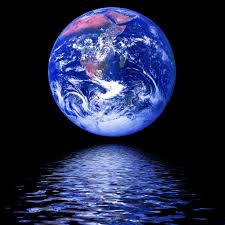
The Blue Planet
Important!
About \(70%\) of Earth is covered with water. From space, it appears blue due to its oceans, earning it the nickname the Blue Planet.
Supports millions of species in oceans, rivers, lakes, and underground water reserves.
Mars and its possible habitability:
Mars lies at the edge of the habitable zone. No life has been found yet, but scientists believe Mars once had liquid water. Mangalyaan (ISRO’s Mars Orbiter Mission) studied the Mars surface and atmosphere. Mars is generally called the 'Red planet' because it appears slightly reddish. This colour is due to the iron oxide present on its surface.
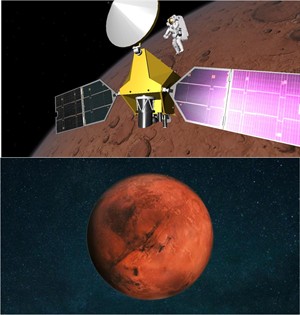
Mangalyaan satellite and Mars
2. Size of the Earth:
The size of Earth depends on the following factors:
Earth’s size and gravity:
- Earth has the right size, which gives it the right amount of gravity.
- This gravity is strong enough to hold the atmosphere close to the planet. It prevents essential gases from escaping into space.
- If Earth were smaller, gravity would be weaker, leading to a thinner atmosphere (like Mars).
- If Earth were larger, gravity would be too strong, making life struggle under under the intense force.
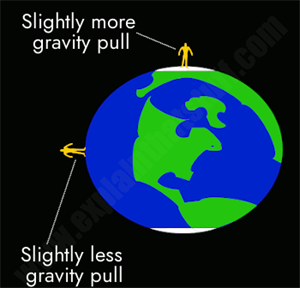
Earth's gravity
Atmosphere and Ozone layer:
The atmosphere is retained due to Earth’s ideal gravity. It contains: Oxygen, Carbon dioxide, and water vapour. Together, these gases make Earth suitable for sustaining life.
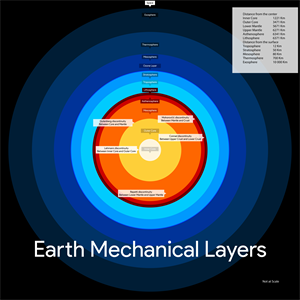
Earth's atmospheric layers
Important!
A layer of ozone gas \(O_3\) in the atmosphere that absorbs harmful UV rays from the Sun and protects living cells from damage, mutations, and diseases.
3. Magnetic field of the Earth:
Magnetic field: An invisible region around a magnet (or Earth) where magnetic forces are felt.
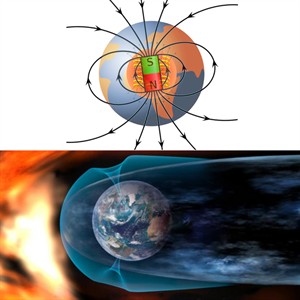
Earth acts as a giant magnet, shielding against cosmic rays.
-
Earth behaves like a giant magnet because molten iron and nickel move in its outer core.
-
This movement generates a magnetic field around the Earth called the geomagnetic field.
Earth’s magnetic field protects the planet from harmful space particles like:
- Solar wind (charged particles from the Sun),
- Cosmic rays (high-energy particles from outer space).
These particles can damage the atmosphere and harm living cells. The magnetic field acts as a protective shield, making life on Earth possible.
What allows life to be sustained on Earth?
Life thrives on Earth because living and non-living components interact in balance.
1. The non-living components:
i. Air (Atmosphere):
- The atmosphere is the blanket of gases surrounding the Earth, containing oxygen for respiration and carbon dioxide for photosynthesis.
- It regulates Earth’s temperature, preventing extreme heating during the day and cooling at night.
- It protects life by blocking harmful solar radiation and burning up small meteorites before they reach the surface.
ii. Sunlight:
-
Sunlight provides energy for life, enabling photosynthesis and heating Earth, driving weather.
-
Greenhouse gases trap some of this heat, creating the greenhouse effect that keeps Earth warm enough for life.
iii. Water (Hydrosphere):
-
Water covers about \(70%\) of Earth and is found in oceans, rivers, lakes, and glaciers.
-
It is essential for life, supporting processes like digestion, nutrient transport, and temperature regulation.
-
Water supports aquatic life and is replenished through the water cycle, providing a continuous supply of fresh water.
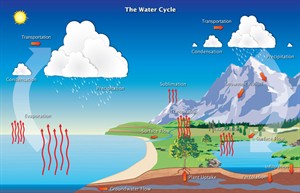
The water cycle
iv. Earth’s Crust: Soil, Rocks, and Minerals (Geosphere):
-
The geosphere consists of the solid part of Earth, rocks, minerals, and soil.
-
Soil contains important nutrients, such as nitrogen, phosphorus, and potassium that plants require.
-
Rocks and minerals provide valuable resources such as iron, copper, bauxite, coal, and petroleum, which are essential to industries and daily life.
Geodiversity
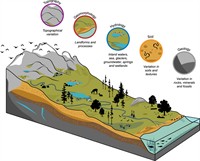
Geodiversity
Geodiversity refers to the different types of Landforms, Rock types, and Soil types that create different habitats (forests, deserts, grasslands, coastal, etc.) and support multiple ecosystems.
2. The living things (Biosphere):
Plants:
Animals:
Animals depend directly or indirectly on plants for food. They help with important processes such as pollination, seed dispersal, and maintaining the balance of food chains. Grazing, predation, and animal movement shape ecosystems and influence biodiversity.
Microorganisms:
Microorganisms such as bacteria and fungi break down dead plants and animals. They return essential nutrients to the soil, maintaining the nutrient cycle. Some microorganisms also help with nitrogen fixation, fermentation, and production of medicines.
The importance of balance:
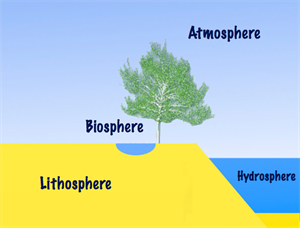
The interconnected system
Earth as an Interconnected System:
-
Earth's four "spheres" (atmosphere, hydrosphere, geosphere, and biosphere) form a system that functions as a single unit, with continual interactions among these spheres.
-
Air influences water (winds cause evaporation), water influences soil (rain forms fertile land), soil affects plant growth, and plants support animals.
-
Animals and microorganisms help maintain cycles like carbon, oxygen, and nitrogen.
Effects of disturbance:
If any one part of the system is disturbed, it affects everything else. For example:
-
Deforestation reduces rainfall and leads to soil erosion.
-
Loss of water bodies affects climate and plant growth.
-
Damage to soil reduces crop yield.
-
Disturbance in food chains affects the biodiversity.
Importance of balance:
-
Maintaining balance is essential to keep Earth habitable.
-
Sustainable practices such as afforestation, water conservation, and pollution reduction help protect this balance.
Important!
The atmosphere is the layer of gases surrounding the Earth, held in place by gravity.
The lithosphere is the solid outer layer of the Earth, consisting of the crust and the upper mantle.
The hydrosphere includes all the water on Earth, such as oceans, rivers, lakes, and groundwater.
The biosphere is the sphere of Earth where all living organisms, plants, animals, and microorganisms exist.
The geosphere refers to all the solid parts of Earth, including rocks, minerals, soil, and landforms.
Reference:
https://www.lyellcollection.org/doi/full/10.1144/SP530-2022-107