

Human beings are an essential part of the environment and are considered the most evolved species on Earth. The activities performed by humans can affect and harm the environment around us.
Our actions significantly impact the environment, which, in turn affects humans, as we are an integral part of the environment.
Delicate balance of life:
-
Life on Earth relies on interdependent natural systems where all living and non-living things work together.
-
Small changes in oxygen levels, temperature, or the ozone layer can endanger life.
Triple Planetary Crisis:
The Triple Planetary Crisis refers to the three major environmental challenges that threaten life on Earth: climate change, biodiversity loss, and pollution.
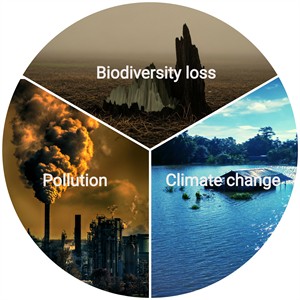
Triple Planetary Crisis
The modern world faces three major environmental crises:
- Climate change:
Climate change is defined as long-term changes in Earth’s temperature, rainfall, and weather patterns.
Causes:
- Burning of fossil fuels (coal, oil, gas), which releases greenhouse gases (\(CO_2\) and \(CH_4\)).
- Deforestation reduces the number of trees that absorb \(CO_2\).
Consequences:
- Melting of ice caps, which leads to rising sea levels, leads to flooding of coastal cities.
- Extreme weather events such as storms, heatwaves, droughts, and heavy rainfall are observed.
- Disruption of agriculture leading to reduced crop yields.
- One risk to biodiversity is the extinction of sensitive species.
In general, \(CO_2\) is absorbed by plants, trees, and plankton, which helps maintain the equilibrium of the carbon cycle. Nevertheless, this equilibrium has been upset by increasing \(CO_2\) emissions.
2. Biodiversity loss:
Reduction or extinction of plant, animal, and microbial species is known as biodiversity loss.
Importance: In addition to providing food, shelter, and other ecological services, every species helps maintain ecosystem stability.
Example:
- If grasses vanish, herbivores like deer and grasshoppers lose food.
- Predators like tigers and foxes also lose their prey, leading to a collapse in the food chain.
Biodiversity loss weakens ecosystems and reduces nature’s resilience to environmental changes.
3. Pollution:
Introduction of harmful substances into the environment, causing adverse effects, is known as pollution.
Types of pollution:
i. Air pollution:
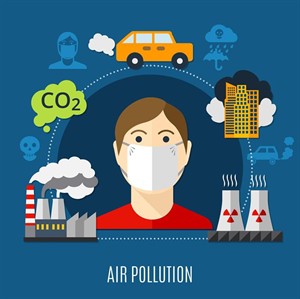
Air pollution
Sources: Factories, vehicles, and burning fuels.
Effects: smog, acid rain, respiratory problems, and crop damage.
ii. Water pollution:
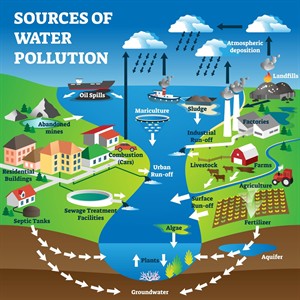
Sources of water pollution
Sources: Industrial waste, agricultural runoff, and plastics.
Effects: Harms aquatic life, makes water unsafe for humans, and spreads diseases.
ii. Soil pollution:
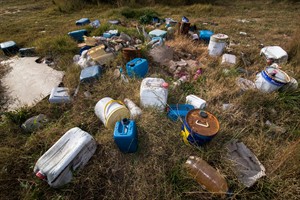
Soil Pollution
Sources: Excessive use of fertilisers and pesticides, and improper waste disposal.
Effects: Reduced soil fertility, lower crop yields, and toxic substances enter the food chain.
Human actions and their impact:
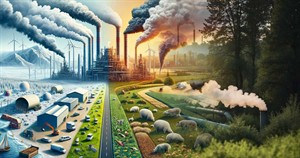
Activities of a human disturbing nature
-
Activities disturbing the balance:
- Deforestation, excessive fossil fuel consumption, industrialisation, and urbanisation are activities that upset the equilibrium.
- Pollution of the air, water, and soil results from improper garbage disposal.
2. Impact on life:
- The extinction of species, modifications of natural habitats, and the occurrence of extreme climate are among the consequences.
- Even small changes in temperature or oxygen levels can have serious repercussions.
Solutions and preventive measures:
1. Global measures:
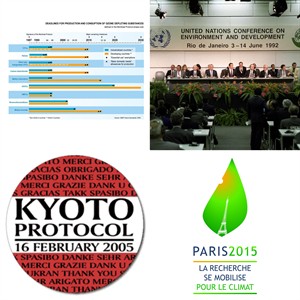
Montreal Protocol, Earth Summit, Paris Agreement and Kyoto Protocol (clockwise)
- An international agreement known as the Montreal Protocol \(1987\) aims to help restore the ozone layer by progressively eliminating CFCs and other substances that depleted it.
- The Earth Summit \(1992\) was a worldwide event in which nations and organisations met to discuss and closely cooperate on sustainable development, biodiversity preservation, and climate change.
- The Kyoto Protocol \(2005\) and the Paris Agreement \(2015\) are international accords in which nations pledged to cut greenhouse gas emissions; the Paris Agreement aims to keep global warming below \(1.5° Celsius\).
2. Local and individual actions:
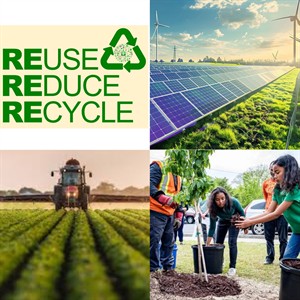
The 3 R's, renewable energy, community initiatives and sustainable farming (clockwise)
- Prefer solar, wind, and hydro which are renewable energy sources.
- Reducing, reusing, and recycling are still the best options for plastics, paper, and textiles.
- The most important features of eco-friendly farming are water saving and the application of organic manure.
- Using energy-efficient appliances and turning off unnecessary lights are recommended practices to lower electricity usage.
- Among the community projects are planting trees, clean-ups, and educational programs.
Earth’s atmosphere (air), hydrosphere (water), biosphere (living organisms), and lithosphere/geosphere (land and soil) are closely interconnected, so any damage to one sphere affects the others. For example, water pollution harms aquatic life and also impacts human health.
Sustainable living
Importance of sustainable practices:
-
Maintaining biodiversity: Diverse ecosystems are more robust, resilient, and harmonious.
-
Reducing pollution: Better soil, water, and air promote both ecological and human health.
-
Climate protection: Lowers the likelihood of droughts, floods, and extreme weather.
-
International cooperation: To safeguard Earth, national policies and international agreements are essential.
-
Individual responsibility: Small actions like saving water, planting trees, and spreading awareness have a cumulative impact.