

Have you ever wondered why, out of the billions of stars and planets in the universe, life chose only Earth as its home?

The Cosmos
Earth is not just any planet orbiting the Sun. It is filled with mountains, rivers, oceans, forests, soils, air, and living organisms of all kinds. Today, powerful satellites from ISRO (Indian Space Research Organisation) capture detailed images of Earth.
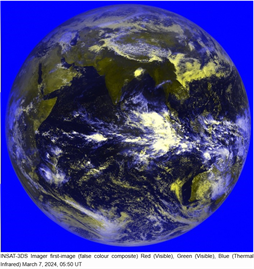
The false coloured image of Earth by ISRO
These images, often false-coloured, help scientists study oceans, forests, weather, and oil spills, and even detect climate change.
To understand why Earth is the only known home for life, we begin with a basic question.
Why is Earth a unique planet?
A unique planet is one with rare or special features not found together on any other known planet. Earth is unique because it supports life.
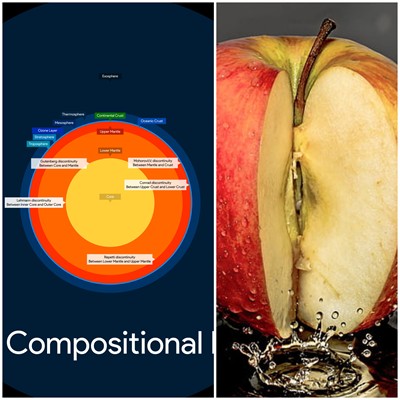
Layers of Earth compared to an apple
Although planets differ in size, temperature, and composition, only Earth has a delicate combination of factors: air, water, a moderate temperature, soil, and a protective atmosphere that allows life to thrive.
Earth's layers:
- Crust: The crust is the thin, outermost solid layer of the Earth where we live.
- Mantle: The mantle is a thick layer of semi-molten rock beneath the crust that slowly moves and drives plate movements.
- Outer core: The outer core is a layer of hot, liquid iron and nickel that creates Earth’s magnetic field.
- Inner core: The inner core is the deepest, solid sphere, mostly made of iron , under extremely high pressure.
Activity: Observing Earth’s features
To identify interesting features of Earth that support life. Students list features such as:

Earth habitability
-
Air does not escape into space.
-
Gravity holds us to the ground.
-
Water remains in liquid form.
-
The temperature is comfortable.
-
The atmosphere protects us.
This activity helps students appreciate everyday features we often take for granted.
What do the planets of our solar system look like?
We live in the solar system, which has the Sun at its center and eight planets orbiting it. These planets are of two types:
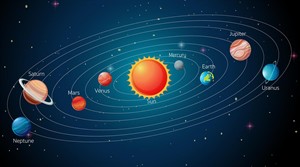
The solar system
1. Inner rocky planets:
The first four planets that are closer to the Sun are called inner planets. They are Mercury, Venus, Earth, and Mars. These planets are also called terrestrial or rocky planets, as they have solid, rocky surfaces and form the inner solar system.
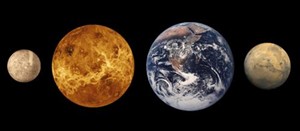
Inner planets: Mercury, Venus, Earth and Mars
Mercury – Extremely hot during the day, freezing at night, no atmosphere.
Venus – Thick, poisonous \(CO_2\) atmosphere, hottest planet, no water.
Earth – Life-supporting, moderate temperature, oxygen-rich air.
Mars – Cold, thin atmosphere, dry and dusty.
The surfaces and atmospheric compositions of inner planets form and exhibit similar patterns. Inner planets do not have any rings (tiny pieces of rock covered with ice) around them.
2. Outer gas/ice giants:
The next four planets that are farther away from the Sun are called outer planets. They are Jupiter, Saturn, Uranus, and Neptune. The four outer planets have a very dense atmospheres comprising hydrogen, helium, and other gases. These gaseous planets are called Gas giants or Jovian planets becasue they lack solid rocky surfaces.
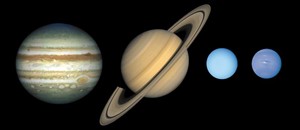
Outer planets: Jupiter, Saturn, Uranus and Neptune
Jupiter – Largest, mostly gas, no solid surface.
Saturn – Famous rings, very low density.
Uranus – Extremely cold, methane-rich atmosphere.
Neptune – Farthest, strong winds, icy.
The outer planets have a system of rings around them and a large number of satellites. The gas giants orbit around the Sun more slowly than the inner planets.
When we compare all these planets, one fact becomes clear: Only Earth has the perfect environment to support life.
Activity: Students can work in groups to research each planet’s temperature, size, and atmosphere using library books or trusted educational websites. After gathering the information, they should discuss and table it with accurate data.
Planets in our solar system:
| S. No | Planet | Average Temperature (°C) | Radius Compared to Earth | Has an Atmosphere? |
|---|---|---|---|---|
| 1. | Mercury | 167 | 0.38 | No (if yes very trace) |
| 2. | Venus | 464 | 0.95 | Yes |
| 3. | Earth | 15 | 1 | Yes |
| 4. | Mars | –62 | 0.53 | Yes (very thin) |
| 5. | Jupiter | –110 | 11.2 | Yes |
| 6. | Saturn | –140 | 9.45 | Yes |
| 7. | Uranus | –195 | 4 | Yes |
| 8. | Neptune | –200 | 3.9 | Yes |
Why is Venus the hottest planet, and what are its other unique features?
Venus is the nearest neighbour planet of Earth, which does not have any satellites of its own. Venus is said to be the 'Twin of the Earth' due to their similarities in size and surface composition with Earth. It appears yellowish in colour.
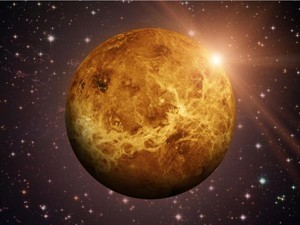
Venus
Rotation of the planet:
All the other planets rotate in the anti-clockwise direction from west to east. However, Uranus and Venus rotates in the clockwise direction, i.e., from east to west. This planet Venus completes its rotation in \(243 days\), and the period of revolution is
\( 225 days\).
Appearance in the sky:
Due to the planet's thick atmosphere, the light that reaches the clouds is reflected into the sky, making the planet appear brightest. This brightest planet appears in the eastern or western sky. Hence, it is also called a morning star or an evening star.
Hottest planet of the solar system:
Although Mercury is closest to the Sun, Venus is hotter because it has a thick carbon dioxide atmosphere. \(CO_2\) traps heat. This is called the greenhouse effect.
Greenhouse effect: A process in which gases like \(CO_2\) trap heat in a planet’s atmosphere, preventing heat from escaping.
Earth’s atmosphere also traps heat, but in the right amount, keeping our planet warm enough to support life.
How a plant Greenhouse works:
The Earth’s atmosphere and a plant greenhouse “trap heat,” but they work in different ways.
1. Atmospheric Greenhouse effect:
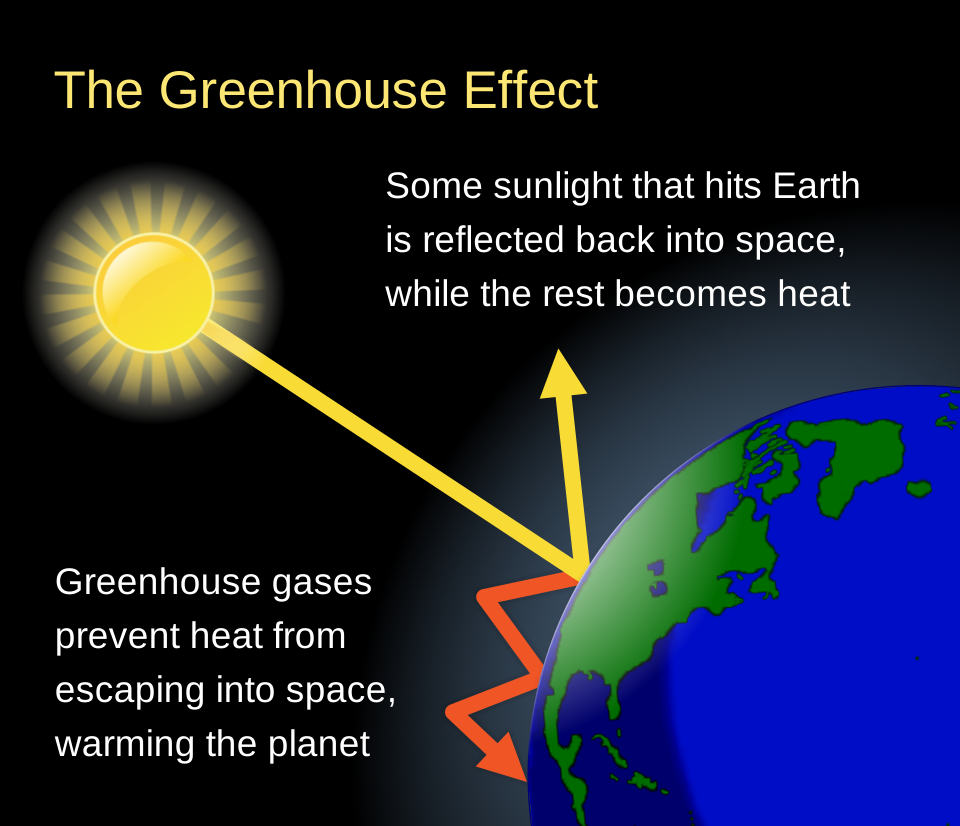
Greenhouse effect
- On Earth, gases like carbon dioxide, water vapour, and methane keep the planet warm.
- These gases absorb the heat that Earth gives off after sunlight hits it.
- Because the heat does not escape easily into space, Earth stays warm enough for life.
- So here, the trapping occurs due to gases.
2. Plant Greenhouse – Closed space traps warm air:

Plant Greenhouse
- A greenhouse is a closed structure made of glass or transparent plastic.
- Sunlight enters and warms the inside.
- Warm air gets trapped inside because it cannot escape, making the greenhouse hotter than the outside.
- Here, the trapping happens because the space is closed, not because of gases.