

Many living organisms around us are so small that the human eye cannot detect them without aid, yet they play an important role in nature and our daily lives.
What Are Microorganisms?
Microorganisms are very small living organisms that can be seen only with a microscope.
-
Also called microbes
-
Found everywhere: air, water, soil, food, and inside our bodies.
Microbes are
- Unicellular (e.g., bacteria such as Escherichia coli and protozoa like Entamoeba coli)
- Multicellular (Algae and Fungi)
- Acellular (not composed of cells-Virus)
Activity 1:
Collect pond or stagnant water in a container with an elder's help, then place a drop on a slide using a dropper. Cover it with a coverslip and observe the tiny organisms under a microscope or a Foldscope.
Classification of microorganisms:
Biologists group them into five classes.

Classification of microorganisms
Activity 2:
Collect moist soil in a beaker using a spoon, add water, stir well, and allow the soil suspension to settle. Take a drop from the top layer, place it on a slide, cover with a coverslip, and observe it under a microscope.
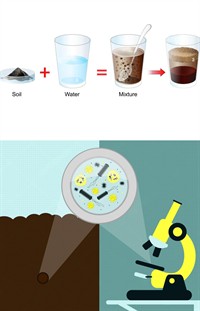
Observation of soil suspension under the microscope
The organisms(Single-celled) present in pond water
-
Amoeba: A protozoan with an irregular shape that moves and captures food using temporary finger-like projections called pseudopodia.
-
Paramecium: A slipper-shaped protozoan that swims through water using thousands of coordinated, hair-like structures called cilia.
-
Algae: Green organisms containing chlorophyll that allow them to prepare their own food through the process of photosynthesis.
-
Euglena: A green protist that moves using a whip-like flagellum and uniquely shows both plant-like (making food) and animal-like (eating food) features.
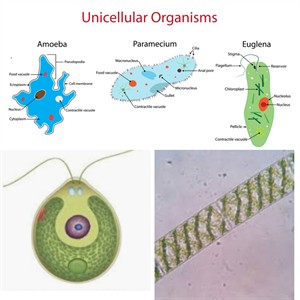
Amoeba, Paramecium, Euglena and Algae
The organisms present in soil.
-
Bread mould (Fungi): It consists of branched filaments without chlorophyll and reproduces using a sac-like structure (sporangium) that holds spores.
-
Mould (Fungi): This type features branched filaments without chlorophyll that form a brush-like structure (such as Penicillium) to release its spores.
-
Algae: These are often spherical organisms that contain chlorophyll, a green pigment that allows them to produce their own food through photosynthesis.
-
Bacteria: These single-celled organisms appear in spherical, comma, spiral, or rod shapes and move using a long flagellum and many smaller hair-like projections.
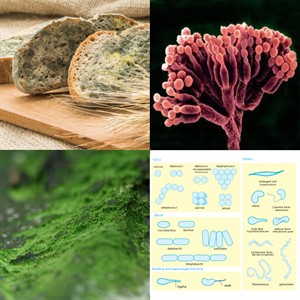
Bread mould, Penicillin, bacteria and algae (clockwise)
Important!
Viruses are microscopic, acellular organisms that multiply only inside living cells and can cause diseases in plants, animals, and bacteria.
Food items like oranges or apples rot due to powdery or cotton-like growth caused by microbes, which are present everywhere in the air, water, soil, and food, and can easily infect exposed food.
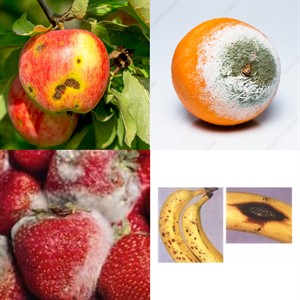
Fruit with microorganisms growing on it.
Useful Role of Microorganisms
1. Cleaning the Environment
Activity 3:
Prepare a soil container with fruit and vegetable peels, cover it with soil, and observe after 2–3 weeks to see how microorganisms cause decomposition.
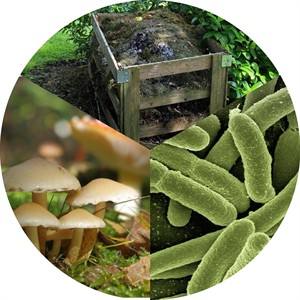
Manure and decomposers
- Microorganisms decompose plant waste and animal waste and turn it into compost, but they do not decompose inorganic materials such as polythene, plastic bags and plastic toys.
-
Convert waste into manure, which enriches soil fertility.
-
Help recycle nutrients in nature.
-
Algae produce oxygen during the photosynthesis process. Microalgae provide more than \(75\)% of the oxygen consumed by animals and humans worldwide.
-
Certain bacteria, like Bacillus, are capable of decomposing waste and sewage in the water. Hence, they aid in naturally cleaning water.
Important!
Some microorganisms decompose plant and animal waste in oxygen-free conditions and release biogas rich in methane, which is used as a fuel for cooking, heating, electricity generation, and vehicles.
Ancient Indian texts like the Vedas and Atharvaveda mention ‘Krimi’, referring to visible and invisible tiny organisms and describing both their beneficial and harmful effects.
2. Microorganisms and Food
Activity
Prepare dough with yeast in bowl A and without yeast in bowl B. Keep both warm for 4–5 hours, and observe the increase in volume due to yeast activity.
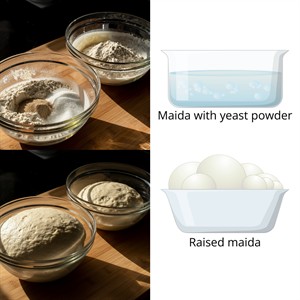
Action of yeast in dough (fermentation)
Making bread, idlis and dhoklas:
Yeast helps in making bread and cakes by releasing carbon dioxide
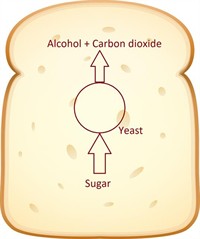
Action of yeast during bread formation
Curd:
Activity 4:
Add curd to warm milk (A) and cold milk (B), keep them in warm and cool places respectively, and observe how temperature affects curd formation.
Lactobacillus is a type of bacteria that aids in the production of curd. When a small amount of curd introduces bacteria into milk, Lactobacillus bacteria convert the lactose sugar in the milk to lactic acid. Increased acidity in milk causes casein, a protein, to coagulate or form lumps, resulting in curd formation.
\(\text{Milk}\) \(\xrightarrow{\small{\text{at 30°C to 40°C/(Lactobacillus acid bacteria)}}}\) \(\text{Curd}\).
Rhizobium bacteria live in the root nodules of leguminous plants and convert atmospheric nitrogen into a form usable by plants, enriching the soil and reducing the need for chemical fertilisers through a beneficial symbiotic relationship.
For farmers, this relationship is of great importance. If they grow grams, peas, moong, beans, and other legumes, nitrogenous fertiliser usage will reduce.
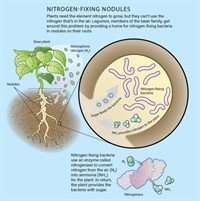
Process of nitrogen fixation
3. Microalgae – Tiny Helpers
- Microalgae produce oxygen through photosynthesis
- Used as food supplements (e.g., Spirulina, Chlorella, and Diatoms)
- Help clean water and produce biofuel.
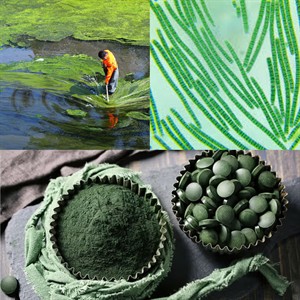
Growing and uses of microalgae as medicines
Spirulina - Super food
Spirulina culture
-
Spirulina can be easily grown in a glass tank with pond water, at a moderate temperature, and with regular stirring.
-
After 3–6 weeks, farmers harvest the Spirulina by filtering it through a fine cloth.
-
Spirulina farming supports food security and provides a sustainable livelihood opportunity.
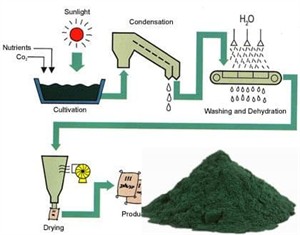
Spirulina culture