

Cell and Its interaction with environment:
The cell is the basic structural and functional unit of life.
Plasma Membrane (Cell Membrane):
- The outermost covering of the cell.
- Separates the cell from its environment.
- Regulates the movement of substances in and out of the cell through selective permeability.
Function:
- Allows the entry of essential substances such as nutrients and oxygen.
- Enables the removal of waste materials like carbon dioxide.
Transport across Cell Membrane:
(A) Diffusion:
The movement of substances from a region of higher concentration to a region of lower concentration.
Examples:
- Movement of CO₂ out of the cell.
- Movement of O₂ into the cell.
- Key Feature: Passive process (does not require energy).
(B) Osmosis:
The movement of water through a selectively permeable membrane from a region of higher water concentration to one of lower water concentration.
Difference between Diffusion and Osmosis:
| Feature | Diffusion | Osmosis |
| Definition | Movement of substances from higher to lower concentration | Movement of water from higher to lower water concentration |
| Substance | Any particles | Only water |
| Membrane | Not required |
Required (selectively permeable)
|
Osmosis in Cells:
Behaviour of Cells in Different Solutions
| Solution Type | Effect on Cell |
| Hypotonic |
Cell gains water and swells
|
| Hypertonic |
Cell loses water and shrinks
|
| Isotonic |
No net movement of water
|
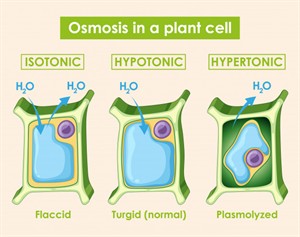
Osmosis
Plasmolysis:
- The shrinkage of cell contents due to the loss of water, mainly observed in plant cells.
Experimental Demonstration of Osmosis:
Potato Osmometer experiment:
Observation:
Water enters the potato cavity containing sugar solution, causing the liquid level to rise.
Water enters the potato cavity containing sugar solution, causing the liquid level to rise.
Conclusion:
Water moves through a selectively permeable membrane due to osmotic movement.
Water moves through a selectively permeable membrane due to osmotic movement.
Cell Division:
Cell division is the process by which new cells are formed from pre-existing cells.
Types of Cell Division:
(A) Mitosis:
- Occurs in body (somatic) cells.
- Produces two identical daughter cells.
- Maintains the same number of chromosomes.
- Essential for growth and repair.
.(B) Meiosis:
- Occurs during formation of reproductive cells.
- Produces four non-identical daughter cells.
- Chromosome number is reduced to half.
- Responsible for variation.
Mitosis vs Meiosis:
| Feature | Mitosis | Meiosis |
| Cells formed |
\(2\)
|
\(4\)
|
| Nature | Identical | Non-identical |
| Chromosomes | Same number | Half number |
| Role | Growth and repair |
Reproduction and variation
|
Role in Similarity and Variation:
- Mitosis ensures genetic stability by producing identical cells
- Meiosis introduces variation, which is important for survival and evolution
Uncontrolled Cell Division and Cancer:
- Cell division is usually a controlled process.
- However, when this control is lost, it can lead to continuous and rapid division, resulting in the formation of a mass of abnormal cells known as a tumor.