

Animal husbandry
Animal husbandry refers to the scientific management of livestock for food and useful products. Proper feeding, breeding, shelter, and disease control ensure healthy and productive animals.
Cattle farming:
Cattle are raised for milk production and draught labour such as ploughing, irrigation, and carting. Milk-producing females are called milch animals, while those used for labour are draught animals. In India, the main species are Bos indicus (cows) and Bos bubalis (buffaloes).
Cattle breeds:
-
Indigenous/local breeds: High disease resistance (e.g., Red Sindhi, Sahiwal).
-
Foreign/exotic breeds: Longer lactation period (e.g., Jersey, Brown Swiss).
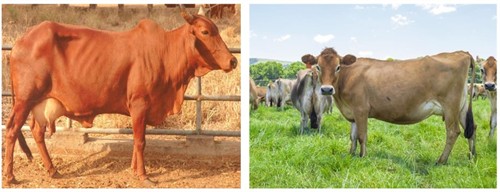
Red sindhi & jersey
Increasing milk production:
Milk yield can be improved by increasing the lactation period, crossbreeding local and foreign breeds, and maintaining hygienic shelters for healthy, disease-free cattle.
Poultry farming
Poultry farming involves rearing birds for eggs and meat. Layers are raised for egg production, while broilers are raised for meat. Proper feeding, ventilation, lighting, and disease prevention are essential for high productivity.
Crossbreeding indigenous (Aseel) and exotic (Leghorn) breeds improves production.
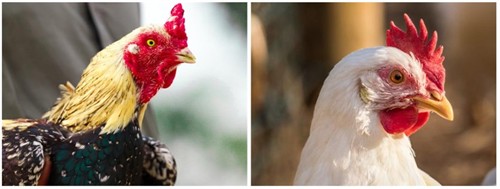
Aseel & leghorn
Broilers and egg layers:
Broilers are fed high-protein and vitamin-rich feed for fast growth and quality meat, proper care prevents mortality.
Egg layers are raised for commercial egg production. Require controlled diet, more space, proper lighting, and \(6–8\) hours of rest.
Fish farming (Pisciculture)
Fish is an important source of animal protein and can be obtained from natural resources or through artificial breeding in controlled environments.
Types of fish:
-
Finned true fish
-
Shellfish (prawns, molluscs)
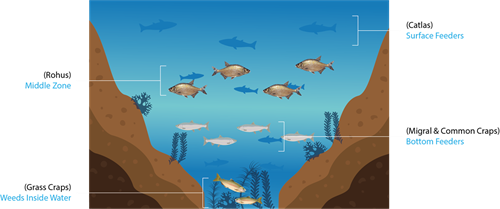
Composite fish culture
Bee-keeping (Apiculture)
Apiculture is the practice of rearing honeybees for honey and wax.
An apiary is a place where beehives are kept for large-scale honey production.
Common bee varieties:
- Apis cerana indica – Indian bee
- Apis dorsata – Rock bee
- Apis florae – Little bee
- Apis mellifera – Italian bee
Honey production depends on bee species, availability of flowering plants, and proper colony management.