

Need for food production
All living organisms require food for energy, growth, and repair. Food is obtained from plants and animals through agriculture and animal husbandry. With increasing population, scientific methods are required to increase food production sustainably.
Agricultural revolutions in India
To meet the growing population’s needs, India increased food production through revolutions:
-
Green Revolution – More food grains with modern farming.
-
White Revolution – Increased milk production.
-
Blue Revolution – More fish and marine products.
-
Yellow Revolution – Higher edible oil seed production.
Overuse of land, water, and soil during these revolutions harmed the environment, so sustainable farming is necessary.
Types of crops:
Crops are the plants that are grown by farmers in a larger area for food or other uses.
-
Cereals – Rice, wheat, maize, sorghum, barley, millets (provide carbohydrates)
-
Pulses – Gram, peas, black gram, green gram, pigeon pea, lentils (provide proteins)
-
Oilseeds – Groundnut, sesame, soybean, mustard, castor, linseed, sunflower (provide fats)
-
Fruits and vegetables – Provide vitamins, minerals, and small amounts of carbohydrates, proteins, and fats
-
Fodder crops – Oats, berseem, sudangrass (grown for livestock).
Crop seasons in India:
-
Kharif (June–October): Paddy, maize, pigeon pea, soyabean, groundnut, cotton, black gram, green gram.
-
Rabi (November–April): Wheat, peas, gram, mustard, linseed.
-
Zaid (March–June): Watermelon, muskmelon, cucumber.
Improvement in crop variety:
Selection based on disease resistance, fertilizer response, product quality, and yield. Crop improvement is done for better yield, quality, stress resistance, shorter maturity, wider adaptability, and desirable agronomic traits. Varieties should perform well under different climatic and soil conditions.
Methods:
- Hybridisation is crossbreeding plants (intervarietal, interspecific, intergeneric).
- Gene introduction is creating genetically modified crops.
Nutrients for plants:
Plants need \(16\) essential nutrients:
-
Macronutrients (Required in large amounts) – Nitrogen, phosphorus, potassium, calcium, magnesium, sulphur
-
Micronutrients (Required in small amounts) – Iron, manganese, boron, zinc, copper, molybdenum, chlorine
-
Sources of the given nutrients air (carbon, oxygen), water (hydrogen, oxygen), soil (rest of the nutrients)
Manures and fertilisers
Manure is an organic substance prepared from decomposed plant and animal waste that improves soil fertility and structure. Compost, vermicompost, and green manure are common types. Fertilisers are commercially produced chemicals supplying nitrogen, phosphorus, and potassium to increase crop yield quickly. However, excessive fertiliser use can harm soil health and cause water pollution.
Organic farming
Organic farming is an eco-friendly agricultural system that avoids chemical fertilisers and pesticides. It depends on organic manure, crop rotation, biofertilisers such as Rhizobium, and natural biopesticides like neem products.
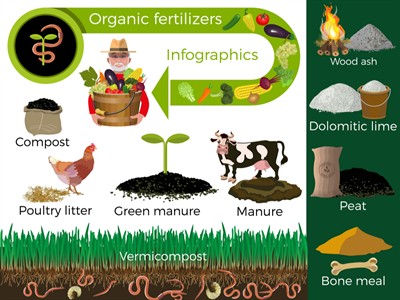
Organic farming
Irrigation
Irrigation is the controlled supply of water to crops when rainfall is insufficient. Water is supplied through wells, canals, tanks, and river lift systems. Techniques like rainwater harvesting and watershed management help conserve water and improve groundwater levels.
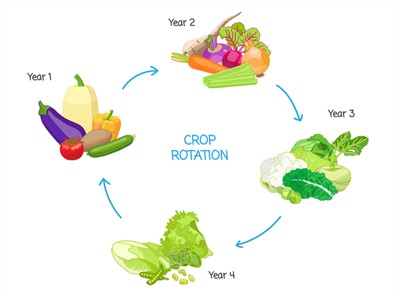
Crop protection
Crops must be protected from weeds, insects, and diseases that reduce yield. Weeds compete with crops for nutrients and are controlled by manual removal or weedicides. Insect pests damage plants by feeding on different parts and are controlled using resistant varieties and pesticides.
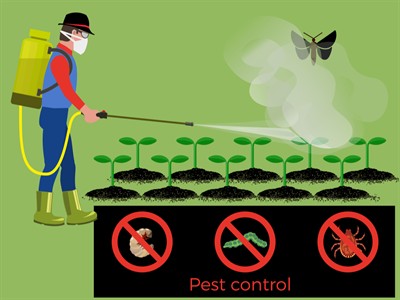
Crop protections