

Animal husbandry:
Animal husbandry is the scientific management of livestock, including feeding, breeding, care, utilisation, and disease control.
Need:
With the increase in population and living standards, the demand for milk, meat, eggs, and leather has risen. Systematic management of animals also ensures proper rearing and productivity.
Cattle farming:
Cattle are raised for milk production and draught labour such as ploughing, irrigation, and carting. Milk-producing females are called milch animals, while those used for labour are draught animals. In India, the main species are Bos indicus (cows) and Bos bubalis (buffaloes).
Cattle breeds:
-
Indigenous/local breeds: High disease resistance (e.g., Red Sindhi, Sahiwal).
-
Foreign/exotic breeds: Longer lactation period (e.g., Jersey, Brown Swiss).
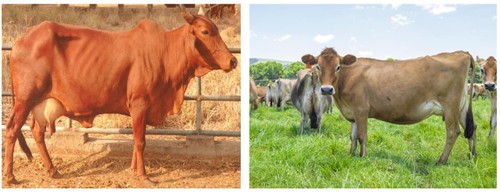
Red sindhi and Jersey
Increasing milk production:
Milk yield can be improved by increasing the lactation period, crossbreeding local and foreign breeds, and maintaining hygienic shelters for healthy, disease-free cattle.
Farm management in cattle:
Efficient farm management ensures humane farming, healthy cattle, and clean milk. Proper cleaning, regular brushing, well-ventilated sheds, and sloping floors are essential.
Food requirements:
Cattle need food for maintenance and milk production. Roughage (hay, grass, legumes) provides fiber, while concentrates (gram husk, oil cakes, cereals) supply proteins and nutrients. Balanced feed with micronutrients improves milk yield.
Cattle diseases:
Cattle are affected by external parasites (lice, mites, ticks, flies), internal parasites (worms, flukes), and infectious diseases (bacterial and viral). Vaccination helps prevent infections.
Poultry farming:
Poultry farming is the rearing of domestic fowl for eggs (layers) and meat (broilers).
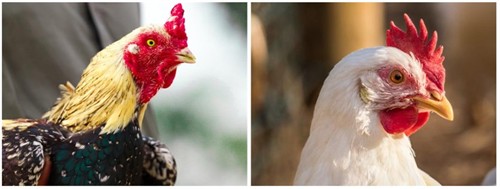
Aseel and Leghorn
Broilers and egg layers:
Broilers are fed high-protein and vitamin-rich feed for fast growth and quality meat, proper care prevents mortality.
Egg layers are raised for commercial egg production. Require controlled diet, more space, proper lighting, and \(6–8\) hours of rest.
Management and disease prevention:
Maintain clean, ventilated shelters, control temperature, and prevent diseases through nutrition, vaccination, and disinfecting.