

Microscopic studies reveal that every cell possesses three primary components in common: the plasma membrane, the nucleus and the cytoplasm.
A plant cell and an animal cell mainly consist of the following parts.
1. Plasma membrane
1. It helps to exchange material through the cytoplasmic matrix.
2. Cell wall
3. Cytoplasm
4. Nucleus
5. Cell organelles
Plasma membrane or Cell membrane:
Plasma membrane
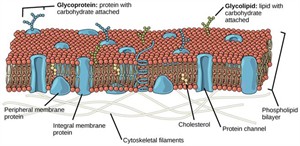
The plasma membrane is a thin, elastic lipid–protein bilayer that separates the cell from its environment, providing flexibility and selective permeability.
Functions of the plasma membrane:
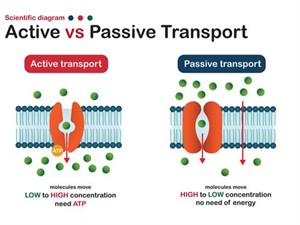
The plasma membrane is a flexible, selectively permeable barrier that maintains cell shape, protects against pathogens, and controls the movement of substances in and out of the cell through two main transport types;
Active transport involves the movement of ions or molecules from regions of lower concentration to those of higher concentration. As this process runs counter to natural processes, it occurs only at the expense of energy.
Here, energy is utilised in the form of \(ATP\) molecules (Adenosine triphosphate).
Passive transport involves the movement of ions or molecules without any expenditure of energy; i.e., it is a naturally driven process. This type of transportation occurs across the plasma membrane.
The passive transport is of two types.
1. Diffusion
2. Osmosis
Diffusion is a naturally driven process by which substances (solid, liquids & gases) move from a higher concentration to a lower concentration region.
In cells, diffusion occurs in solids, liquids and gases. Diffusion helps in gaseous exchange.
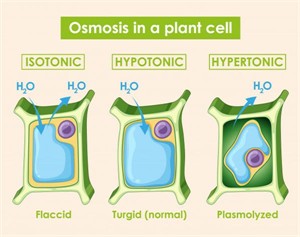
Water movement into and out of cells occurs through diffusion. This diffusion process in water is called osmosis.
Thus, osmosis is the movement of water from a region of higher water concentration to a region of lower concentration.
There are three types of osmotic solutions which can be transported across the plasma membrane.
1. Hypotonic solution
2. Hypertonic solution
3. Isotonic solution
2. Hypertonic solution
3. Isotonic solution
Hypotonic solution:
If the solution surrounding the cell has a higher water concentration compared to inside the cell (or the outside solution is very diluted), then the cell gains water by osmosis. As a result, the cell swells up (Endosmosis).
Hypertonic solution:
Suppose the solution surrounding the cell has a lower concentration of water than inside the cell (i.e. outside solution is very concentrated). In that case, the cell will lose water by osmosis. As a result, the cell shrank (Exosmosis).
Isotonic solution:
It is the solution that has the same osmotic concentration as inside the cell, and there is no movement of water molecules between the membrane. As a result, no overall change is observed, and the cell size remains the same.
Cell wall:
The cell wall is the outermost, rigid, non-living part of the cell, present outside to the plasma membrane of the cell.
The cell wall present in plant cells is made up of cellulose, fungi are made up of chitin, bacteria are made up of peptidoglycan, etc. and is absent in animal cells.
Functions of the cell wall:
1. It protects protoplasm from mechanical injury and pathogens.
2. The cell wall prevents cell damage from excessive endosmosis.
3. The cell gives a structural framework to the cell
4. The cell gives mechanical strength and rigidity to the cell.
5. Growth of the cell wall helps in cell expansion.
6. The cell prevents the cell from bursting out under osmotic pressure.
Nucleus:
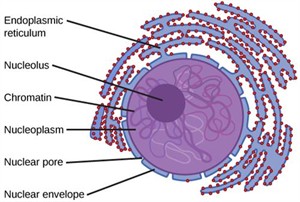
Robert Brown discovered the nucleus in \( 1831\) and is the controlling centre of all the activities. Hence, it is described as the brain of the cell. It is composed of a double-layered covering called the nuclear membrane. It has numerous pores called nuclear pores. They transfer the material from inside the nucleus to the cytoplasm.
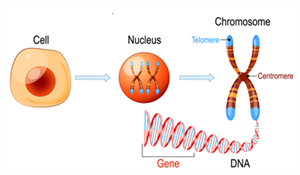
A picture showing the components of the nucleus
The nucleus contains Chromosomes. If they are visible as rod-shaped structures, cell division will occur. It encompasses a liquid ground substance called Nucleoplasm. It contains nucleolus and chromatin material.
A picture showing the location of the gene inside a cell
Functions of the Nucleus:
1. The nucleus is the chief controller of a cell. It contains chromosomes which carry genes. Genes are responsible for the transmission of hereditary characteristics from parents to offspring.
2. Nucleus with RNAs helps direct the synthesis of structural proteins and other chemical needed for cell growth and cell maintenance.
3. The nucleus controls all the metabolic activities of the cell.
4. It plays a key role in cellular reproduction, a process that involves cell division and produces genetically identical daughter cells by a process known as mitosis.
Cytoplasm:
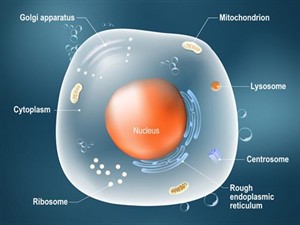
A picture depicting the presence of cytoplasm inside a cell and how the organelles are suspended in it
The enormous region of a cell that is enclosed by its cell membrane is called as the cytoplasm.
Cytoplasm has two major parts:
1. Cytosol (or) Ectoplasm: It is the fluid part of cytoplasm.
2. Cell organelles (or) Endoplasm: Many organelles are present inside the cytoplasm.
Based on the membrane covering, organelles are classified into three types: membrane-less organelles (ribosomes), single membrane-bound organelles (Endoplasmic Reticulum, Golgi apparatus, Lysosomes, Vacuoles) and double membrane-bound organelles (Mitochondria and plastids).
Functions of cytoplasm:
1. It helps to exchange material through the cytoplasmic matrix.
2. It is the site of synthesis of many molecules like carbohydrates, proteins and lipids.
3. It acts as the site for specific metabolic pathways such as glycolysis.
4. Most of the crucial cellular and enzymatic reactions, like cellular respiration.